
25 November 2026 | Sahyadri Tiger Reserve, Maharashtra
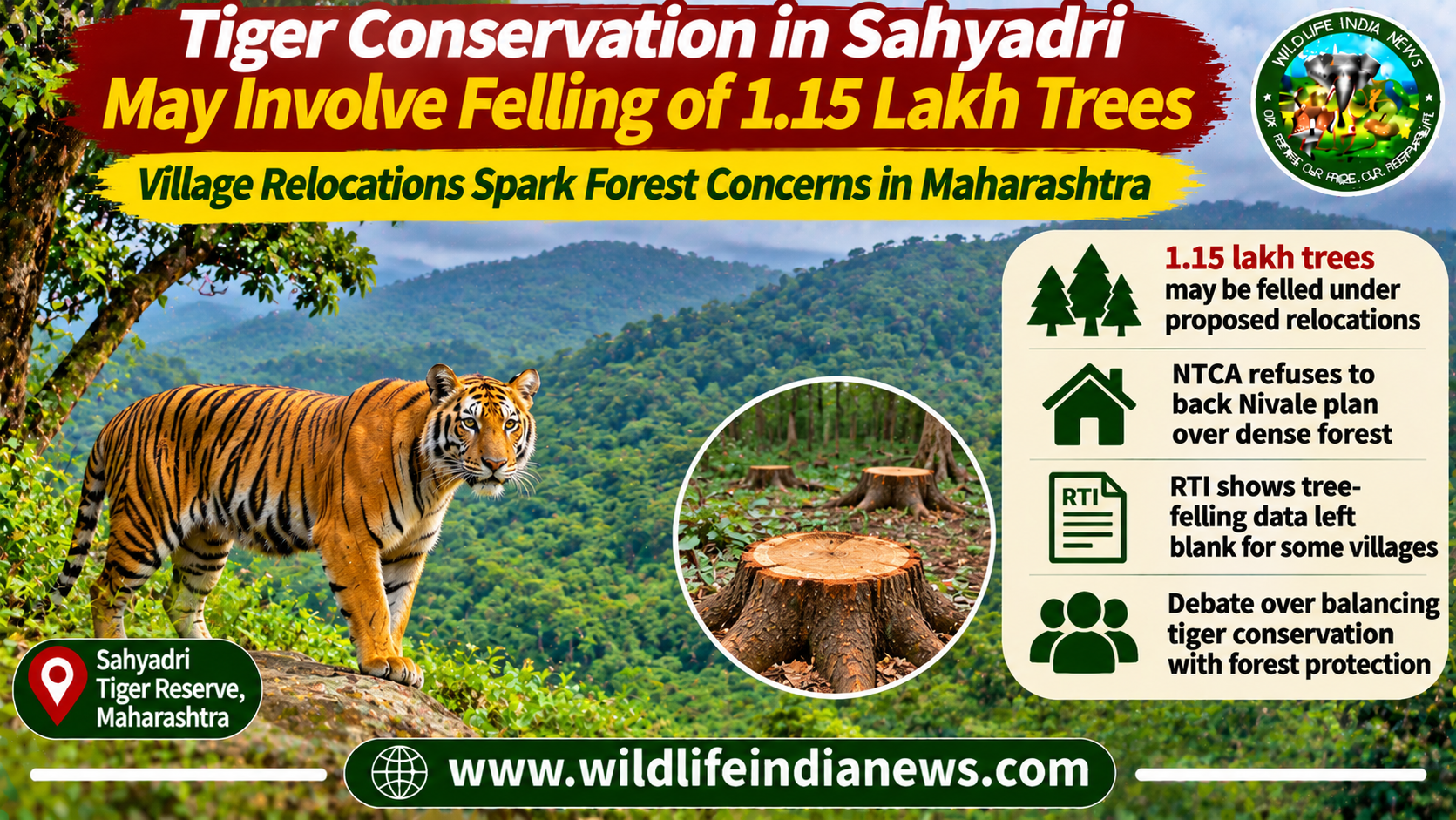
Maharashtra’s efforts to strengthen tiger conservation in the Sahyadri Tiger Reserve have come under scrutiny after official records revealed that proposed village relocation projects could involve the felling of nearly 1.15 lakh trees.
The National Tiger Conservation Authority (NTCA) has refused to recommend the proposed rehabilitation of Nivale village, citing the use of dense forest land for resettlement. Information obtained under the Right to Information (RTI) Act has also raised questions about the ecological impact of other relocation projects and the lack of publicly available data on actual tree felling.
NTCA Objects to Nivale Rehabilitation Plan
The Nivale village relocation proposal involves 63.091 hectares of forest land at Kagal in Kolhapur district, where 34,705 trees have been listed for felling.
In its communication dated February 16, 2026, the NTCA said the proposed rehabilitation site included dense forest patches and did not conform to the principle of prioritising degraded or unrecoverable forest land for resettlement.
The authority also pointed out that Nivale had already been relocated once and called for a comprehensive assessment of the cumulative ecological impact of related proposals.
It therefore declined to recommend the proposal.
More Than 1.15 Lakh Trees Involved in Relocation Proposals
The RTI response obtained by Jeetendra Ghadge of the Young Whistleblowers Foundation highlighted the scale of the proposed tree loss across the Sahyadri landscape.
Key village-wise figures include:
- Male: 227.9 hectares of forest land, with 38,738 trees listed for felling.
- Vele: 112.25 hectares, involving 2,918 trees.
- Nivale: 63.091 hectares, involving 34,705 trees.
- Kolane: A 76.17-hectare relocation proposal questioned by the Union environment ministry.
The actual number of trees felled in the Male and Vele projects was left blank in the forest department’s RTI response. Therefore, the figure of nearly 1.15 lakh represents the cumulative proposed impact, not the confirmed number of trees already cut.
Government Cites Conservation Benefits
The Maharashtra government has argued that relocating villages from critical tiger habitat would reduce human disturbance and return substantial areas of land to the forest.
A central inspection report on Male village found that 20,071 of the 38,738 trees listed for felling were Gliricidia, an invasive species originally planted to green barren land. Around 87% of the listed trees were below 60 cm in girth.
The report also stated that relocation would return 519.49 hectares to the forest and noted that 140 families were seeking rehabilitation.
The state has said that 55 villages have already been relocated from tiger reserves and protected areas across Maharashtra.
Conservation Versus Forest Destruction
The controversy highlights a difficult question: can forest land be cleared to rehabilitate communities from protected areas in the name of wildlife conservation?
Environmental concerns extend beyond the number of trees involved. Mature natural forests support biodiversity, wildlife movement, soil stability and water systems, functions that compensatory plantations cannot immediately replace.
Conservation experts and activists have called for transparent, proposal-wise ecological assessments, exploration of less damaging rehabilitation sites and clear disclosure of actual tree-felling figures.
The challenge for Maharashtra is to secure tiger habitats without undermining the very forest ecosystems that conservation efforts seek to protect.
Source: The Times of India, 24 November 2026; Ministry of Environment, Forest and Climate Change communications dated 16 February 2026
Last Updated: 25 November 2026
Leave a Reply