8 November 2026 | Lokhandewadi, Beed district, Maharashtra
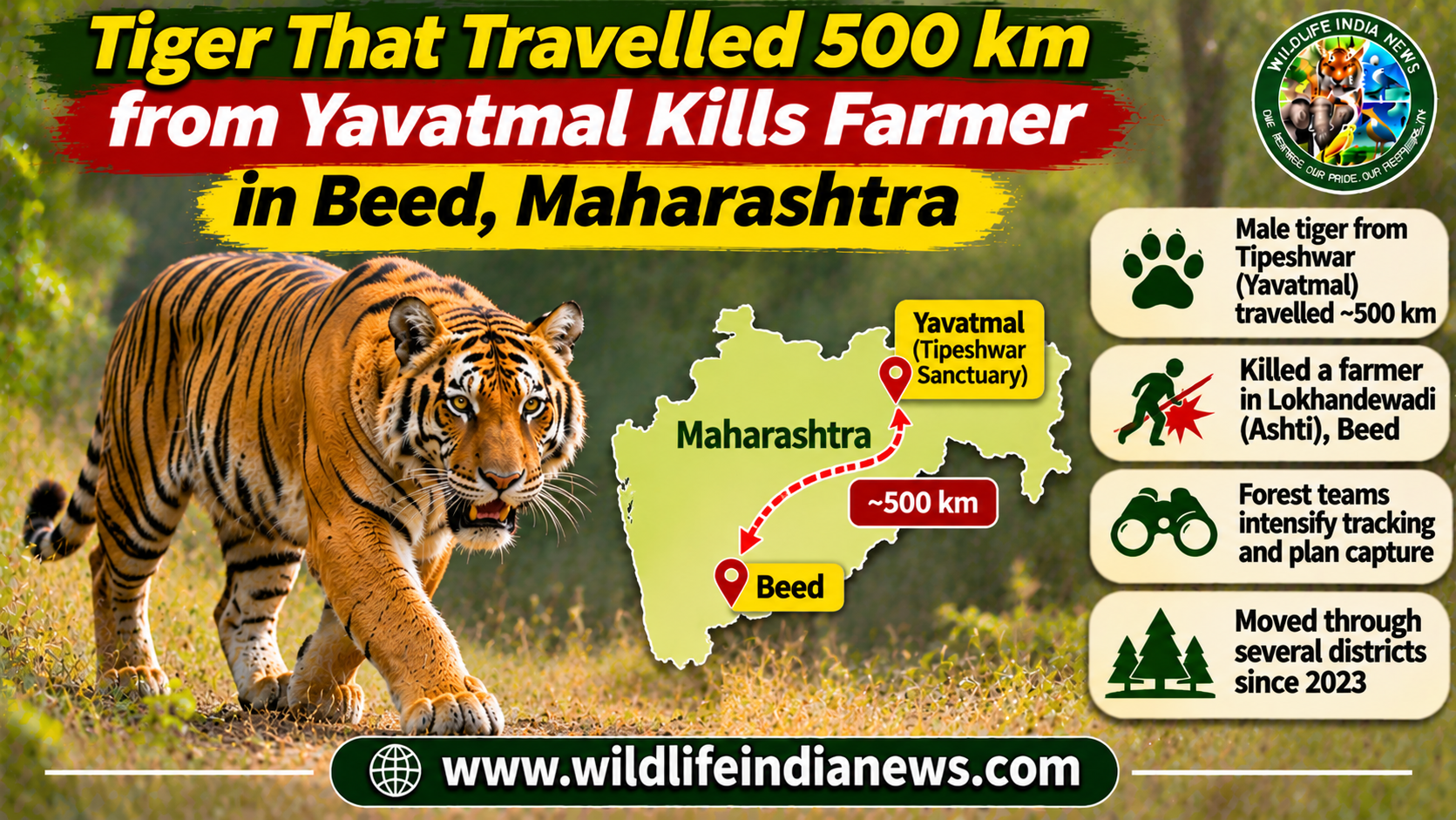
A male tiger that travelled nearly 500 km from Tipeshwar Wildlife Sanctuary in Maharashtra’s Yavatmal district has killed a farmer in Beed district, triggering heightened surveillance and precautionary measures by the Forest Department.
The fatal attack occurred on Saturday morning, November 7, near Lokhandewadi village in Ashti taluka. The tiger, known as Ramling in Hindustan Times reports and Avenger in other media accounts, attacked a farmer who had entered a nearby forested hill to collect fodder for his cattle.
The incident marks the animal’s first reported fatal attack on a human since it began its extraordinary journey across several districts of Maharashtra.
Farmer Dragged 400–500 Metres into Vegetation
The victim, Devidas Manik Takle, also identified as Pintu Takale in some reports, was collecting grass and fodder near Sonipathar hillock in the Lokhandewadi–Deolali area.
According to forest officials, the tiger attacked him from behind and dragged him approximately 400–500 metres into dense vegetation.
When the farmer’s son went to look for him, he noticed bloodstains and drag marks. He alerted other villagers, who approached the area carrying sticks and axes. The tiger reportedly abandoned the body and fled into the forest as the villagers approached.
The farmer was found dead at the spot.
Forest officials confirmed the tiger attack on the basis of the injuries, post-mortem findings and inspection of the site.
A Tiger with an Extraordinary Journey
The animal’s movements have attracted considerable attention among wildlife officials and conservationists.
The male tiger originated from Tipeshwar Wildlife Sanctuary in Yavatmal district. It left its natal habitat in 2023 and subsequently travelled through several districts, including Nanded, Latur, Dharashiv, Solapur, Ahilyanagar and Beed.
Its journey covered nearly 500 km, making it one of the most closely monitored dispersing tigers in Maharashtra.
The tiger was first recorded in the Dharashiv region in December 2024. Its pugmarks were subsequently detected in Beed in October 2025, and camera-trap images confirmed its presence in the Brahmgaon forest range of Ashti in August 2026.
Forest officials said it has been moving across forest patches in five districts, periodically changing its location and returning to areas it had previously visited.
Recent Livestock Attacks
Before the fatal incident, the tiger had reportedly killed two cattle and a horse in Beed district after returning to the area around October 17.
Officials said the animal generally moved between forest patches in Beed and neighbouring districts, sometimes remaining in a particular forest division for two to three months before moving elsewhere.
The tiger’s movements have made monitoring difficult, particularly because it uses a large landscape that includes agricultural fields, scrubland, hillocks and forest patches.
Forest Department Intensifies Surveillance
Following the farmer’s death, the Forest Department stepped up efforts to track the tiger and prevent further human-wildlife conflict.
Four camera traps and CCTV systems have been installed at strategic locations, while patrolling has been intensified in Ashti and adjoining forest areas.
Officials are also seeking permission to capture the tiger. Its movements are being monitored to determine the safest course of action.
The Forest Department has urged residents to avoid entering isolated hillocks, dense vegetation and forest areas alone. Farmers have also been advised to exercise caution while collecting fodder or grazing cattle near forest boundaries.
Reports indicate that compensation of ₹10 lakh is to be provided to the victim’s family.
Drought and Fodder Shortages Increase Human Exposure
Forest officials have pointed to drought-like conditions and fodder shortages as factors increasing the risk of human-wildlife encounters in the region.
With limited fodder available near settlements, farmers frequently venture into forested hillocks and scrubland to collect grass for livestock.
Such activities can bring people into close proximity with large carnivores, particularly when visibility is poor and vegetation is dense.
The tragedy highlights the need for practical measures to reduce exposure, including local warnings, safer fodder collection practices, rapid communication of tiger movements and coordinated monitoring by forest personnel.
The Challenges of Tiger Dispersal Beyond Protected Areas
The journey of this tiger is an example of the remarkable distances that young male tigers can cover while searching for new territories.
Dispersal is essential for maintaining genetic exchange between tiger populations and allowing animals to colonise suitable habitats. However, when tigers move through fragmented landscapes containing villages, farms and livestock, the risk of conflict increases.
The Beed incident also demonstrates the challenges of managing a wide-ranging tiger outside a conventional protected area. Forest departments must balance the safety of local communities with the need to avoid unnecessary harm to the animal.
The immediate priority is to prevent further casualties through effective tracking, public warnings and an appropriate response by wildlife authorities.
The tiger’s extraordinary journey from Yavatmal to the Marathwada region has become a conservation story with a tragic human cost. Ensuring that future dispersal movements do not result in similar tragedies will require better habitat connectivity, local preparedness and sustained coordination among forest divisions.
Source: Hindustan Times (8 November 2026); The Times of India (7 November 2026); PTI/The Week (7 November 2026); The Indian Express.
Last Updated: 8 November 2026
Leave a Reply