8 November 2026 | Devpura Beat, Haridwar, Uttarakhand
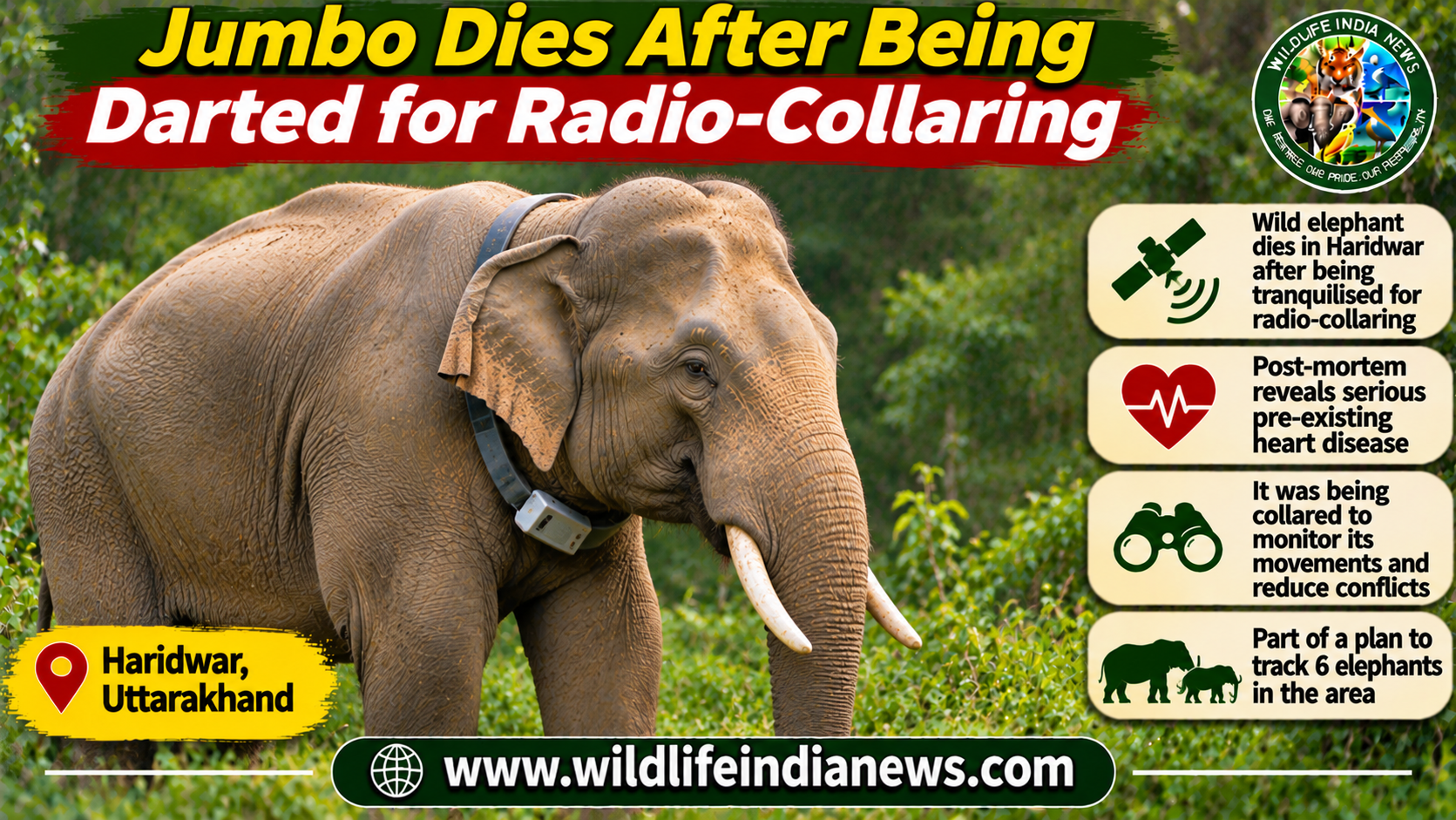
An approximately 55-year-old wild elephant died after being tranquilised during an operation to fit it with a radio collar in Haridwar, Uttarakhand. The animal’s condition deteriorated following the procedure on November 6, and it could not be revived despite emergency medical intervention by a team of wildlife experts and veterinarians.
The incident has raised concerns about the challenges involved in monitoring elderly wild elephants, particularly those frequently moving through human settlements and agricultural areas.
Elephant’s Condition Deteriorated After Darting
The operation was conducted in Devpura Beat of the Haridwar Forest Division by a joint team comprising senior scientists from the Wildlife Institute of India (WII), experts from WWF, wildlife veterinarians and Forest Department personnel.
The elephant was tranquilised under expert supervision as the first animal selected for radio-collaring in the area.
Following the procedure, it was kept under continuous observation. However, its condition suddenly deteriorated.
The veterinary team immediately initiated emergency treatment, including oxygen support, cardiopulmonary resuscitation (CPR), reversal medication and intravenous fluids.
Despite sustained efforts, the elephant could not be revived and was declared dead.
Post-Mortem Reveals Serious Heart Disease
An independent team of veterinary specialists conducted the post-mortem examination and estimated the elephant’s age at approximately 55 years.
The examination revealed severe cardiac abnormalities, including myocardial fibrosis and cardiomyopathy.
Myocardial fibrosis involves the formation of scar tissue in the heart muscle, while cardiomyopathy refers to a disease affecting the heart muscle and its ability to function effectively.
Veterinary experts attributed the death to these pre-existing cardiac conditions. The findings indicated that the animal’s weakened heart was unable to withstand the physical stress associated with the procedure.
The Forest Department said that the team had made every possible effort to save the elephant.
Why Was the Elephant Selected for Radio-Collaring?
The elephant had reportedly been moving repeatedly through residential areas and agricultural fields around Haridwar. Its movements towards the city had raised concerns about possible human-elephant encounters.
Forest authorities had identified 18 elephants in the area for monitoring, of which six were selected for radio-collaring.
The aim was to obtain more accurate information about their movements and help forest personnel respond more effectively to potential conflict situations.
The initiative was also considered important in view of the expected increase in visitors during the 2027 Kumbh Mela in Haridwar.
The elephant that died was the first animal selected for the planned radio-collaring operation.
Radio-Collars and Human-Elephant Conflict Management
Radio-collaring is an important wildlife research and management technique. A collar equipped with a tracking device enables researchers and forest officials to monitor an animal’s movements over large areas.
For elephants that regularly enter agricultural fields or settlements, tracking information can help authorities:
- Identify frequently used movement routes.
- Provide early warnings to vulnerable villages.
- Monitor seasonal movement patterns.
- Understand habitat use and feeding behaviour.
- Plan timely interventions to reduce human-elephant conflict.
However, capturing and immobilising large wild animals involves risks, particularly when the animal is old or has an undiagnosed medical condition.
The Need for Careful Assessment Before Immobilisation
The death in Haridwar highlights the importance of veterinary assessment and risk management before undertaking chemical immobilisation of large wild mammals.
Age-related health conditions may remain undetected in free-ranging animals because they cannot undergo routine medical examinations.
Although the operation was conducted by an experienced team, the incident demonstrates that even carefully supervised procedures can carry serious risks.
Wildlife authorities may need to consider additional health assessments, individual risk evaluation and alternative monitoring methods wherever feasible, especially for elderly animals.
Balancing Human Safety and Elephant Welfare
The elephant had been selected for radio-collaring because its movements near populated areas raised concerns about human-elephant conflict.
The objective of the operation was therefore to improve monitoring and reduce the possibility of dangerous encounters between people and elephants.
Its death is an unfortunate setback for the monitoring initiative. It also serves as a reminder that wildlife management decisions must balance public safety with the welfare and health of individual animals.
As the Forest Department continues its efforts to monitor elephants around Haridwar, the findings from this incident could help inform the planning of future radio-collaring operations.
Source: The Times of India (7 November 2026); Amar Ujala (7 November 2026); Live Hindustan (7 November 2026).
Last Updated: 8 November 2026
Leave a Reply