7 November 2026 | New Delhi
What if forests could be protected, wildlife could thrive, and people could continue living and earning their livelihoods within the same landscape?
This is precisely the idea behind Biosphere Reserves – conservation areas that seek to strike a balance between protecting nature and promoting sustainable human development.
India, with its extraordinary ecological diversity, has established 18 Biosphere Reserves representing some of its most important terrestrial, coastal, marine and mountain ecosystems.
But do you know what exactly a Biosphere Reserve is? How does it differ from a National Park or a Wildlife Sanctuary? And why are these landscapes so important for the future of conservation?
Let’s explore.
What Are Biosphere Reserves?
A Biosphere Reserve is a large terrestrial, coastal or marine area designated for conserving biodiversity, promoting sustainable development and supporting scientific research.
The concept is part of UNESCO’s Man and the Biosphere (MAB) Programme, launched in 1971. The programme seeks to establish a harmonious relationship between people and their natural environment.
Unlike conventional protected areas that primarily focus on safeguarding wildlife and habitats, Biosphere Reserves follow a broader conservation approach. They recognise that human communities are an integral part of many ecosystems and that conservation can succeed when local people participate in protecting their natural surroundings.
These reserves serve as living laboratories where scientists, conservationists, government agencies and local communities work together to develop sustainable ways of managing natural resources.
The Three Zones of a Biosphere Reserve
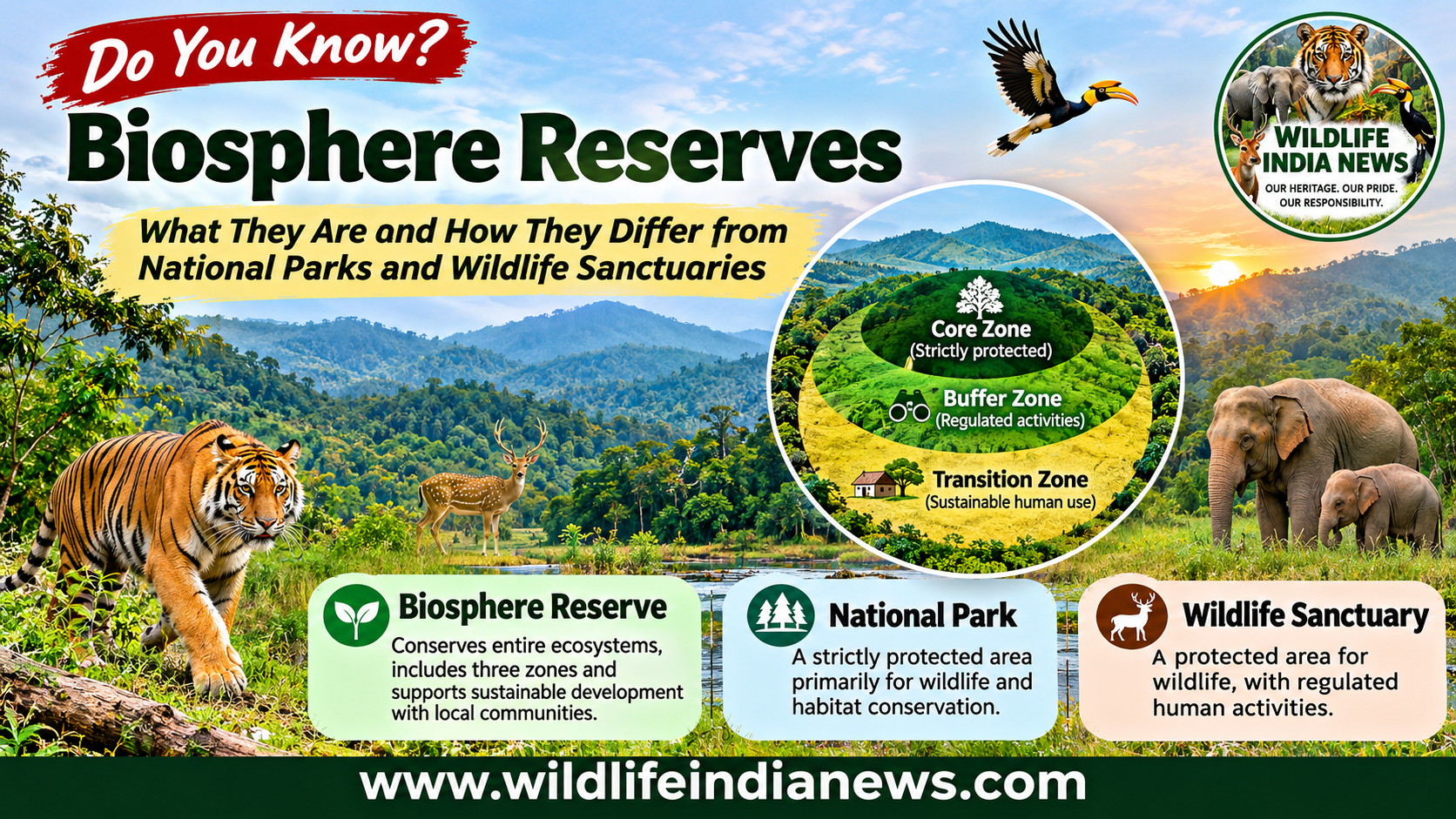
One of the most distinctive features of a Biosphere Reserve is its division into three interconnected zones. Each zone has a different level of protection and permits different types of human activities.

1. Core Zone – The Heart of Conservation
The core zone is the most strictly protected part of a Biosphere Reserve. It contains ecologically important habitats that require long-term protection.
- Protects natural ecosystems, habitats and wildlife species.
- Conserves genetic diversity.
- Allows limited scientific research and ecological monitoring compatible with conservation.
- Minimises human interference and activities that could damage the ecosystem.
National Parks or Wildlife Sanctuaries may form part of the core area.
2. Buffer Zone – Protection with Controlled Activities
The buffer zone surrounds or adjoins the core area and acts as a protective belt.
Activities compatible with conservation objectives are encouraged, including:
- Scientific research and ecological monitoring.
- Environmental education and training.
- Regulated ecotourism and nature interpretation.
- Sustainable use of natural resources.
- Habitat restoration and conservation-related activities.
3. Transition Zone – Where People and Nature Coexist
The transition zone is generally the outermost area of a Biosphere Reserve. It is where local communities live, work and participate in sustainable development.
Activities may include:
- Agriculture and horticulture.
- Sustainable forestry and traditional livelihoods.
- Responsible tourism.
- Environment-friendly enterprises.
- Community-based conservation initiatives.
The transition zone demonstrates that human development and nature conservation can progress together.
What Are the Three Main Functions of Biosphere Reserves?
Biosphere Reserves are not merely protected landscapes. Under UNESCO’s Man and the Biosphere Programme, they are expected to perform three complementary and equally important functions.

1. Conservation Function

The primary conservation function is to protect biodiversity, ecosystems and cultural diversity.
It includes:
- Conservation of natural habitats and threatened species.
- Protection of genetic diversity.
- Maintenance of ecological processes and ecosystem services.
- Preservation of traditional knowledge and cultural heritage.
2. Sustainable Development Function

Biosphere Reserves promote economic development that is environmentally sustainable and socially and culturally appropriate.
This function seeks to improve the quality of life of local communities without destroying the natural resources on which they depend.
Examples include:
- Sustainable agriculture and organic farming.
- Community-based ecotourism.
- Sustainable harvesting of forest produce.
- Traditional crafts and environmentally responsible enterprises.
- Livelihood opportunities that encourage local participation in conservation.
3. Logistic Support Function

The logistic support function provides the scientific and educational foundation for conservation and sustainable development.
It includes:
- Scientific research and ecological monitoring.
- Environmental education and awareness.
- Training and capacity-building.
- Exchange of scientific information and traditional knowledge.
- Demonstration projects and dissemination of sustainable practices.
Together, these three functions make Biosphere Reserves important centres for conservation, research, education and sustainable development.
How Are Biosphere Reserves Different from National Parks and Wildlife Sanctuaries?
Although all three designations contribute to wildlife and biodiversity conservation, their objectives, geographical coverage and management approaches are different.
The most important distinction is that National Parks and Wildlife Sanctuaries primarily focus on protecting wildlife and their habitats, whereas Biosphere Reserves aim to conserve entire ecosystems while also promoting sustainable development and human well-being. Feature Biosphere Reserve National Park Wildlife Sanctuary Primary objective Conservation and sustainable development Wildlife and habitat protection Wildlife and habitat protection Geographical coverage Generally large landscapes Legally notified protected area Legally notified protected area Human settlements May exist in transition zones Generally not permitted within the park May exist subject to applicable legal provisions Human activities Vary according to zones Highly restricted Regulated Zonation Core, buffer and transition No equivalent three-zone framework No equivalent three-zone framework Research and education Major objectives Permitted subject to regulations Permitted subject to regulations Sustainable livelihoods Important objective Not a primary objective Not a primary objective Governing framework National designation and UNESCO MAB framework for international recognition Wildlife (Protection) Act, 1972 Wildlife (Protection) Act, 1972
An important distinction: A Biosphere Reserve is not simply another category of protected area under the Wildlife (Protection) Act, 1972. It is a broader conservation and sustainable-development framework. National Parks and Wildlife Sanctuaries can form part of its core or buffer areas.
How Many Biosphere Reserves Does India Have?

India has 18 nationally notified Biosphere Reserves, of which 13 are included in UNESCO’s World Network of Biosphere Reserves (WNBR).
These reserves represent a remarkable range of ecosystems, from the tropical rainforests of the Western Ghats to the mangroves of the Sundarbans and the cold deserts of the Himalayas.
Some Prominent Biosphere Reserves of India
1. Nilgiri Biosphere Reserve – Tamil Nadu, Kerala and Karnataka

India’s first Biosphere Reserve, established in 1986, the Nilgiri landscape is renowned for its tropical forests, montane grasslands and exceptional biodiversity. It is home to elephants, tigers, Nilgiri tahr and the endangered lion-tailed macaque.
2. Sundarbans Biosphere Reserve – West Bengal

Famous for its extensive mangrove forests and intricate network of tidal waterways, the Sundarbans is an important habitat of the Royal Bengal Tiger. Its unique tidal ecosystem supports a wide variety of terrestrial and aquatic species.
3. Nanda Devi Biosphere Reserve – Uttarakhand

Located in the western Himalayas, this reserve encompasses spectacular mountain landscapes, alpine meadows and rich Himalayan biodiversity. It is known for its remarkable natural beauty and rare high-altitude wildlife.
4. Gulf of Mannar Biosphere Reserve – Tamil Nadu

One of India’s most important marine conservation areas, it is known for coral reefs, seagrass beds, mangroves and endangered marine species, including dugongs. Its marine ecosystem supports an extraordinary variety of life.
5. Pachmarhi Biosphere Reserve – Madhya Pradesh

Situated in the Satpura range, this reserve features dense forests, hills, valleys and waterfalls. It supports diverse wildlife, including leopards, Indian giant squirrels and gaur.
6. Cold Desert Biosphere Reserve – Himachal Pradesh

This high-altitude cold desert ecosystem is characterised by rugged mountains, sparse vegetation and extreme climatic conditions. It provides habitat for the elusive snow leopard, Himalayan ibex and blue sheep.
The Cold Desert Biosphere Reserve was included in UNESCO’s World Network in September 2025.
Do You Know? Some Interesting Facts About Biosphere Reserves
1. India’s first Biosphere Reserve was established in 1986.
The Nilgiri Biosphere Reserve was the first to be established in India. It spans three states – Tamil Nadu, Kerala and Karnataka.
2. Not every Biosphere Reserve is recognised by UNESCO.
India has 18 nationally notified Biosphere Reserves, but only 13 are part of UNESCO’s World Network of Biosphere Reserves. National designation and UNESCO recognition are two different things.
3. People can live inside a Biosphere Reserve.
Unlike the popular perception that all protected areas must be free of human settlements, Biosphere Reserves accommodate communities in their transition zones, where sustainable economic activities are encouraged.
4. Biosphere Reserves are not exclusively terrestrial.
They can include forests, mountains, wetlands, coastal ecosystems, islands and marine environments.
5. Biosphere Reserves are living laboratories.
Apart from conserving wildlife, they support research, environmental education, climate monitoring and the development of sustainable livelihood models.
6. Biosphere Reserves form a global conservation network.
UNESCO’s World Network of Biosphere Reserves brings together designated landscapes across countries to promote biodiversity conservation, research and sustainable development.
Why Are Biosphere Reserves Important for India?
India’s ecological wealth faces increasing pressures from habitat destruction, climate change, infrastructure development, unsustainable resource extraction and human-wildlife conflict.
Biosphere Reserves offer an integrated approach to addressing these challenges.
Their importance extends beyond protecting endangered animals and plants. They also help:
- Maintain ecological connectivity and protect large landscapes.
- Conserve genetic diversity and threatened species.
- Protect watersheds, forests, wetlands and coastal ecosystems.
- Preserve traditional knowledge and cultural heritage.
- Promote sustainable livelihoods for forest-dependent communities.
- Support scientific research and environmental education.
- Strengthen climate resilience and ecosystem restoration.
By involving local communities in conservation, Biosphere Reserves demonstrate that protecting nature and improving human well-being need not be conflicting objectives.
The Way Forward
Biosphere Reserves represent an important evolution in the philosophy of nature conservation. They move beyond the idea of protecting isolated patches of forests and wildlife habitats and embrace a landscape-level approach that considers people, biodiversity and ecological processes together.
National Parks and Wildlife Sanctuaries remain indispensable for providing legal protection to wildlife and their habitats. Biosphere Reserves complement these efforts by creating a wider framework in which conservation, research and sustainable development can work together.
Ultimately, the success of a Biosphere Reserve depends not only on the wildlife it protects but also on how effectively it enables people and nature to coexist.
Because conservation is not merely about keeping humans away from nature; it is also about learning how to live responsibly with it.
Leave a Reply