6 November 2026 | Jaisalmer, Rajasthan
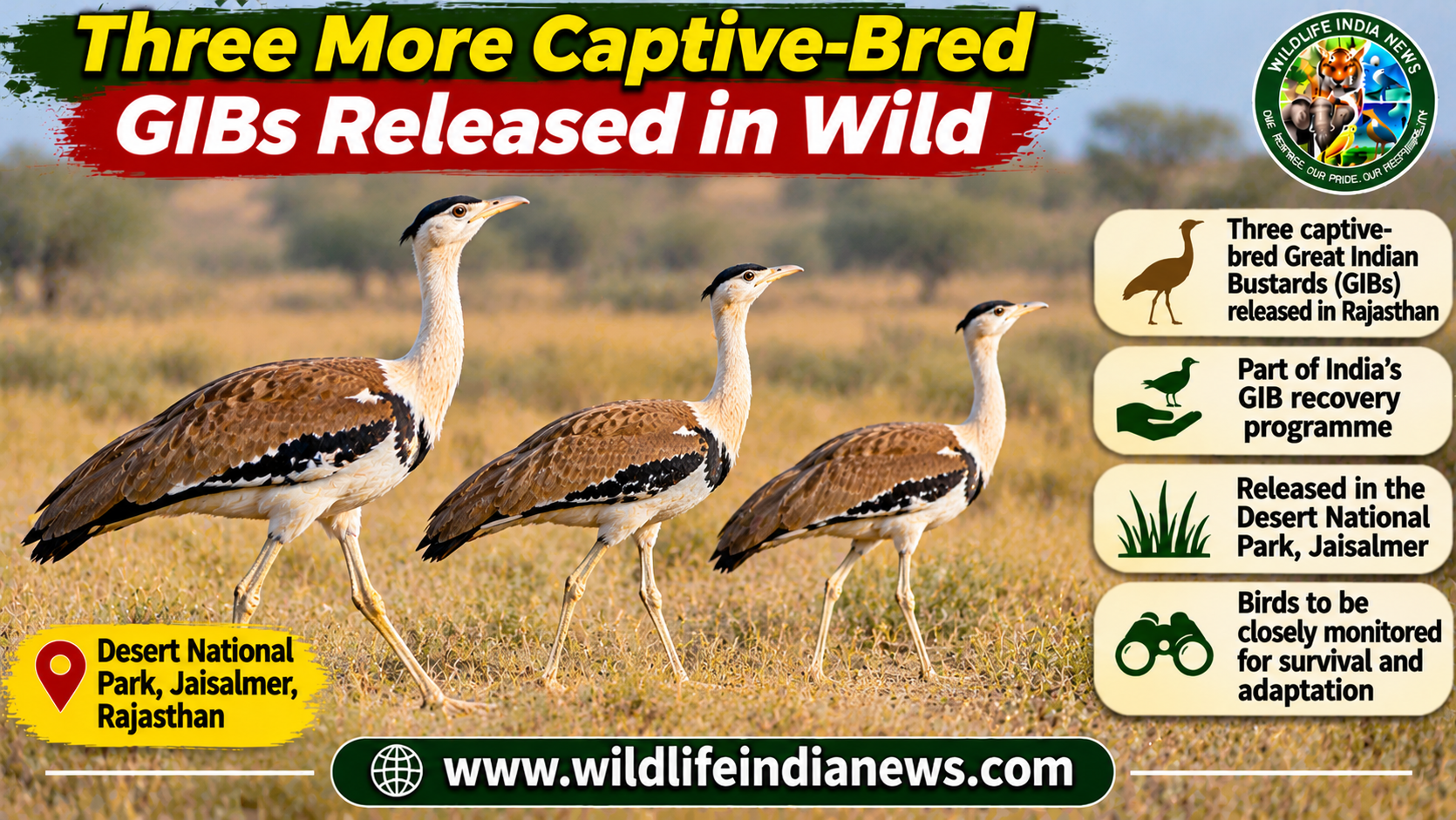
India’s efforts to bring the critically endangered Great Indian Bustard (GIB) back from the brink of extinction have received another boost with the release of three more captive-bred birds into the wild in Rajasthan.
The latest release is part of the ambitious recovery programme being implemented in the Desert National Park landscape of Jaisalmer. It marks another step in the transition from captive breeding to the more challenging phase of reintroducing the species into its natural habitat.
The development follows the first releases of captive-bred Great Indian Bustards in October, a landmark achievement after nearly a decade of conservation breeding efforts.
A New Phase in Project Great Indian Bustard
The latest release follows the launch of the rewilding programme on October 4, when Union Environment Minister Bhupender Yadav released two captive-bred male Great Indian Bustards at Sam in the Desert National Park.
Two additional birds were released subsequently, taking the initial number released to four.
The release of three more birds represents a further expansion of the pilot initiative. The programme aims to gradually establish a viable wild population using birds raised at specialised conservation breeding facilities in Rajasthan.
The releases are being undertaken through a collaborative programme involving the Ministry of Environment, Forest and Climate Change, Rajasthan Forest Department and Wildlife Institute of India (WII), with technical support from international conservation partners.
Nearly a Decade of Captive-Breeding Efforts
The conservation-breeding programme began in 2016, when the Wildlife Institute of India and Rajasthan Forest Department established specialised facilities at Sam and Ramdevra in Jaisalmer.
The programme initially focused on collecting eggs from the wild, artificial incubation, chick rearing and developing a viable captive population.
The breeding centres have made considerable progress. According to the Environment Ministry’s October 2026 figures, the facilities housed 97 birds, including 57 captive-bred individuals and 40 originating from wild-laid eggs.
The programme recorded 24 live chicks in 2025 and another 29 in 2026.
These achievements have made it possible to begin releasing captive-bred birds into the wild, although scientists emphasise that breeding success alone cannot guarantee the recovery of a species.
Rewilding: The Real Test Begins
Raising Great Indian Bustards in captivity is only the first stage of the recovery effort. The more difficult challenge is ensuring that the birds can survive independently in the wild.
Before release, selected birds undergo specialised preparation to develop the physical abilities and behaviours required for survival outside captivity.
At the rewilding facilities, they are exposed to natural sunlight, temperature variations and airflow. They are also encouraged to forage for natural food and adapt to conditions resembling their future habitat.
After release, satellite tracking and field monitoring help scientists study their movements, habitat use, feeding behaviour and survival.
The information collected will help conservation teams improve release protocols and determine which approaches are most effective.
Early Setbacks Highlight the Challenges
The initial releases have also demonstrated the risks associated with reintroducing captive-raised birds into a natural ecosystem.
One of the first four released Great Indian Bustards was found dead in October, reportedly following predation by a desert fox. The incident prompted scrutiny of the rewilding programme and highlighted the vulnerability of young birds during their transition to life in the wild.
Conservation scientists have emphasised that predation is a natural ecological process and that eliminating native predators is not an appropriate solution.
The challenge is to improve the preparedness of released birds, identify suitable release locations and monitor their adaptation without compromising the ecological balance of the landscape.
Protecting the Thar Grasslands Is Equally Important
The Great Indian Bustard is closely associated with India’s dry grassland ecosystems. Its survival depends on extensive open habitats that provide feeding, nesting and breeding opportunities.
Habitat degradation, conversion of grasslands, disturbance and collisions with overhead power lines have contributed significantly to the species’ decline.
The Rajasthan Forest Department has been undertaking habitat restoration measures in the Desert National Park, including the development of approximately 200 sq km of fenced grassland enclosures.
Long-term telemetry studies by WII have identified these enclosures as important breeding habitats.
The conservation programme also requires sustained efforts to reduce infrastructure-related mortality, protect nesting grounds and work with local communities.
A Critical Step Towards Recovery
The release of three additional captive-bred Great Indian Bustards is encouraging news for one of India’s most threatened birds.
However, the ultimate measure of success will not be the number of birds released but how many survive, adapt, establish territories and eventually reproduce in the wild.
India has made significant progress in captive breeding, but rebuilding a self-sustaining wild population will require years of careful monitoring, habitat protection and scientific management.
For the Great Indian Bustard, the journey from captive breeding centres to the open grasslands of Rajasthan has begun. Ensuring that these birds can thrive in the wild is now the most important task.
Source: The Times of India (6 November 2026); Press Information Bureau, Ministry of Environment, Forest and Climate Change; The Indian Express; Mongabay India.
Last Updated: 6 November 2026
Leave a Reply