5 November 2026 | Poolangudiyiruppu, Tenkasi district, Tamil Nadu
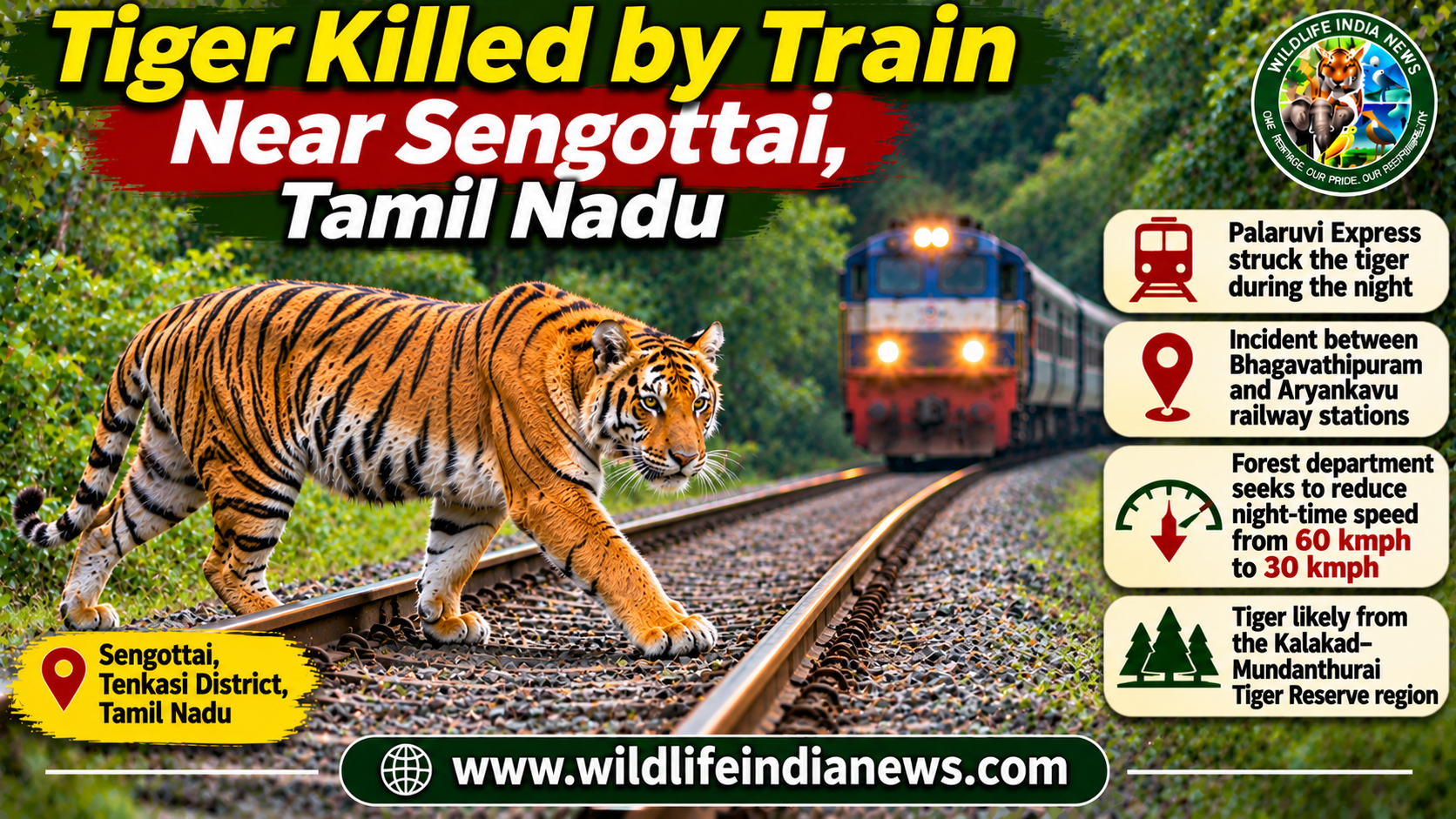
A male tiger was killed after being struck by the Palakkad–Thoothukudi Palaruvi Express near Sengottai in Tamil Nadu’s Tenkasi district during the early hours of Wednesday, November 4. The impact dragged the animal approximately 50 metres along the railway tracks, according to preliminary post-mortem findings.
The incident occurred around 2.30 am between Bhagavathipuram and Aryankavu railway stations, near the Tamil Nadu–Kerala border. The tiger was reportedly attempting to cross the railway line after emerging from a mango grove adjoining farmland and a residential area.
The death has renewed concerns about the risks posed by railway traffic in wildlife habitats and the need for effective measures to prevent collisions involving large mammals.
Tiger Suffered Fatal Head Injuries
According to forest officials, the Palaruvi Express struck the tiger from the side as it attempted to cross the tracks.
Preliminary post-mortem findings indicated severe injuries to the animal’s skull, resulting in fatal brain damage. The rest of its body reportedly sustained only minor scratches, with no other major fractures detected.
The findings suggest that the tiger was not struck head-on but was hit from the side and dragged along the tracks.
Railway personnel alerted the Forest Department following the collision. Tenkasi District Forest Officer Rajmohan and other forest and railway officials inspected the site.
After the post-mortem examination, the carcass was cremated in a forest area in accordance with the prescribed procedures.
Tiger’s Identity and Origin Remain Unknown
Forest officials suspect that the tiger may have originated from the buffer zone of Kalakad–Mundanthurai Tiger Reserve (KMTR), located in the Western Ghats.
However, its identity and movements have not yet been established. Officials examined available camera-trap records but found no confirmed record of the animal in the footage reviewed so far.
The collision site is approximately one kilometre outside the forest boundary. Officials noted that wildlife movement beyond protected forest areas, particularly during the night, can be difficult to predict.
The post-mortem also indicated that the tiger had consumed prey before the accident. Why it moved towards the mango grove and whether it was attempting to return to the forest remain unclear.
Forest Department Seeks Lower Night-Time Train Speed
Following the incident, Tenkasi District Forest Officer Rajmohan reportedly wrote to the Railways seeking a reduction in the night-time speed limit on the affected stretch.
The proposed reduction is from 60 kmph to 30 kmph, giving train operators more time to respond if wildlife is spotted on or near the tracks.
Forest personnel have also been instructed to conduct regular night patrols along the stretch. Investigators are examining the circumstances of the collision, while additional camera installations are planned to monitor wildlife movement near the accident site.
The Forest Department has registered a forest offence case and initiated an investigation.
Railway Lines Can Disrupt Tiger Movement
The incident has highlighted the conservation challenges in the Sengottai–Aryankavu landscape, where railway infrastructure intersects forest habitats and wildlife movement routes.
A Wildlife Institute of India assessment in 2025 identified road and rail traffic near Aryankavu as potential barriers to tiger movement.
Railway lines can affect wildlife in two ways: they create a direct risk of collisions, and they can also disrupt the movement of animals between habitat patches. Tigers and other large mammals may be forced to cross tracks while moving between feeding areas, territories and forest corridors.
The same railway route has witnessed other wildlife-related incidents. In June 2026, the Palaruvi Express was reportedly stopped after an elephant herd entered the tracks on another section of the route.
Need for Wildlife-Sensitive Railway Management
The death of the tiger underscores the importance of integrating wildlife protection into railway operations in ecologically sensitive landscapes.
Measures that could reduce the risk include:
- Lower train speeds during identified wildlife movement periods.
- Thermal cameras and other early-warning systems at vulnerable stretches.
- Regular monitoring of animal movement through camera traps.
- Coordination between railway personnel and forest officials.
- Identification and improvement of safe wildlife crossing points.
The use of thermal detection technology, combined with timely communication between railway control rooms and forest teams, could help identify animals approaching railway tracks.
The loss of a tiger is particularly serious because every adult animal contributes to the long-term survival and genetic health of its population.
As investigations continue, the incident should serve as a reminder that conservation does not end at the boundaries of protected areas. Safe movement between forests is equally essential, and transport infrastructure must be managed with the needs of wildlife in mind.
Source: The Times of India (4 November 2026); The New Indian Express (5 November 2026); DT Next (4 November 2026).
Last Updated: 5 November 2026
Leave a Reply