3 November 2026 | Manas National Park, Assam
In 2004, as floodwaters from the Brahmaputra swept through Assam, a tiny one-horned rhinoceros calf was found stranded and separated from her mother. Barely four months old, she was rescued during a joint wildlife operation and given a second chance at life.
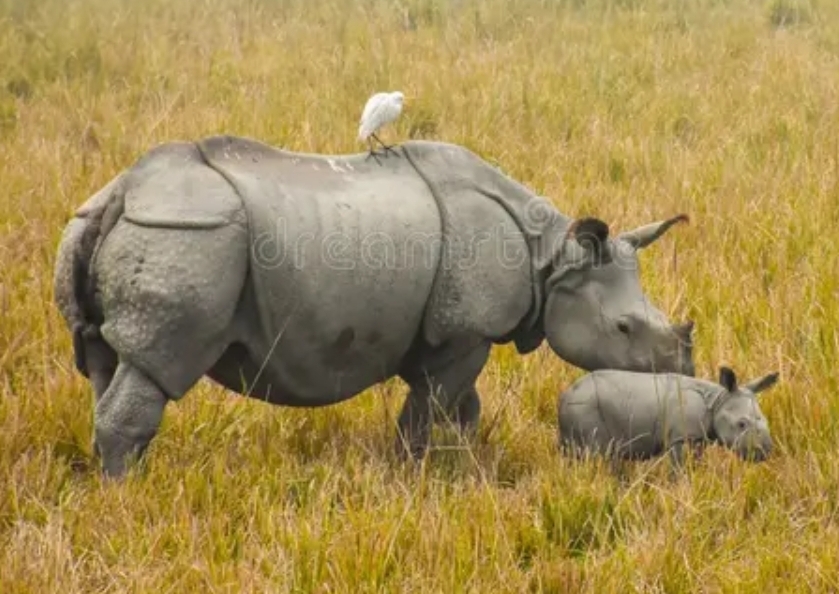
More than two decades later, that calf, named Ganga, has become one of India’s most inspiring wildlife conservation success stories. Now 22 years old, she has another reason to make headlines: her daughter, Ganga-A, has given birth to a healthy calf at Manas National Park.
The birth represents three generations of a rhino family thriving in the wild, demonstrating what sustained rescue, rehabilitation and reintroduction efforts can achieve.
It is also a reminder that successful conservation is not measured merely by the number of animals rescued or released, but by whether they can eventually survive, reproduce and contribute to a self-sustaining wild population.
A Tiny Calf Rescued from the Brahmaputra Floods

Ganga’s journey began during the devastating monsoon floods of 2004. Rising waters had left several wild animals vulnerable, and a young rhino calf was found separated from her mother.
A rescue team involving the Wildlife Trust of India (WTI) and the International Fund for Animal Welfare (IFAW) rescued the stranded calf. Attempts to reunite her with her mother were unsuccessful, leaving the team with no option but to provide long-term care.
She was taken to the Centre for Wildlife Rehabilitation and Conservation (CWRC), near Kaziranga, where she received specialised veterinary attention and round-the-clock care.
At such a young age, the calf required much more than medical treatment. She needed the care, nutrition and behavioural development normally provided by her mother.
The rescue team named her Ganga.
Preparing an Orphaned Rhino for Life in the Wild
Rehabilitating a young rhino for eventual release is a demanding process.
Ganga was hand-reared for nearly three years, with the rehabilitation team attempting to prepare her for life without becoming excessively accustomed to human beings.
The CWRC follows a rehabilitation approach designed to minimise unnecessary human contact. Keepers and veterinarians provide essential care, while enrichment activities help young animals develop natural behaviours.
For rhino calves, these activities can include swimming, exploring water bodies, locating food and interacting with other young animals. Such experiences help develop the physical and behavioural skills needed for survival after release.
The objective is not simply to raise a healthy animal, but to prepare it to function independently in its natural habitat.
Why Ganga Was Moved to Manas
In 2008, Ganga was moved to Manas National Park along with two other female rhinos, Mainao and Jamuna.
The relocation was part of a larger effort to restore the greater one-horned rhinoceros population in Manas, where the species had suffered severe losses during the period of civil unrest in the 1990s.
Manas offered an important opportunity for rehabilitation and reintroduction. Its extensive grasslands, wetlands and riverine habitats provide suitable conditions for rhinos.
There was also a conservation advantage in establishing a stronger population outside Kaziranga, where rhinos already occupied a relatively crowded landscape.
The animals were initially kept in a specially designed enclosure, known as a boma, to acclimatise to their new surroundings. They were gradually introduced to the wider habitat and released into the wild in 2010.
Ganga’s transition from a hand-reared orphan to a free-ranging wild rhino was a major achievement.
A Pioneer in Rhino Reintroduction
Ganga’s contribution to conservation did not end with her release.
In 2013, she became the first rehabilitated and released rhino in India to give birth in the wild, according to IFAW-WTI. She subsequently gave birth to more calves.
By 2023, IFAW-WTI had described her as the matriarch of Manas, reporting that she had produced four calves and already had a grand-calf.
The latest birth to her daughter Ganga-A, announced by Assam Chief Minister Himanta Biswa Sarma on October 31, 2026, adds another chapter to this remarkable lineage.
The newborn calf was reported to be healthy and under the care of forest personnel. It was born approximately 10–15 days before the announcement and was spotted in the Bansbari range of Manas National Park.
Ganga’s journey therefore illustrates how an animal rescued during a natural disaster can eventually contribute to the recovery of a threatened population.
Manas: From Population Collapse to Recovery
Ganga’s success is closely linked to the larger conservation story of Manas National Park.
A UNESCO World Heritage Site and an important component of the wider Manas conservation landscape, the park supports a remarkable variety of wildlife.
Its grasslands, riverine forests and wetlands provide habitat for the greater one-horned rhinoceros, Asian elephant, tiger, wild water buffalo and several other threatened species.
The rhino population in Manas suffered a severe decline during the 1990s, when political unrest and inadequate protection allowed poaching and other pressures to take a heavy toll.
The restoration programme subsequently brought together wildlife authorities, conservation organisations and local communities.
The IFAW-WTI rehabilitation and reintroduction programme became an important part of this recovery. Animals rescued from floods in Assam were raised at CWRC and, when ready, transferred to Manas.
According to IFAW-WTI, 21 rhinos rehabilitated at the centre had been successfully acclimatised and released into Manas by 2023. The organisation also reported that approximately half of the park’s wild-born calves at that time came from rhinos that had once been residents of the rehabilitation centre.
These figures underline the contribution of rehabilitation programmes to rebuilding a population that had once faced the risk of local extinction.
Why Rescue Alone Is Not Enough
Ganga’s story offers an important lesson for wildlife conservation.
During floods, young rhinos and other animals can become separated from their mothers, stranded on islands or swept away from their natural habitats. Rescue operations are essential, but they are only the first stage of a much longer process.
An orphaned animal may survive in captivity but still lack the skills required to live independently. Rehabilitation must therefore focus on natural behaviour, physical development and gradual acclimatisation.
The availability of a suitable release site is equally important. Releasing animals into habitats that lack adequate food, space or protection would undermine the entire effort.
Ganga’s success demonstrates the importance of connecting all these stages: rescue, veterinary care, behavioural rehabilitation, relocation, acclimatisation, release and long-term monitoring.
It also shows why conservation programmes need sustained institutional support. The journey from a rescued calf to a breeding adult can take years, and the benefits may become visible only after a generation or more.
The Next Challenge: Protecting a Growing Rhino Family
The birth of another calf is encouraging, but it also increases the importance of protecting the habitat in which Ganga’s family lives.
Manas faces the continuing challenges common to many wildlife landscapes, including habitat disturbance, human pressure, poaching risks and the need to maintain ecological connectivity.
The park’s location along the international boundary with Bhutan makes transboundary conservation especially important. Its wider ecosystem connects with Royal Manas National Park in Bhutan, allowing wildlife to use habitats extending beyond national boundaries.
Long-term protection will require effective anti-poaching measures, monitoring of rhino movements, preservation of grasslands and wetlands, and cooperation with communities living around the protected area.
Flood management and wildlife rescue preparedness will also remain essential in Assam, where seasonal inundation is a recurring ecological feature.
Ganga’s Legacy Is Bigger Than Her Family
Ganga’s story is more than an emotional account of an orphaned animal growing up to become a mother and grandmother.
It is evidence that well-planned wildlife rehabilitation can contribute directly to the recovery of threatened species in their natural habitats.
The latest birth is particularly meaningful because it demonstrates the lasting impact of a rescue operation conducted during the 2004 Brahmaputra floods.
Ganga was given a chance to survive. She was then prepared for life in the wild, successfully released and eventually became a breeding member of Manas’s rhino population.
Her daughter has now produced another calf, extending the family lineage.
For conservationists, this is the ultimate measure of success: not simply rescuing an animal from danger, but giving it the opportunity to live freely and contribute to the future of its species.
Source: Moneycontrol; The Times of India; NDTV; International Fund for Animal Welfare (IFAW) and Wildlife Trust of India (WTI).
Last Updated: 3 November 2026
Leave a Reply