31 October 2026 | India
India’s Asian elephants face a growing challenge. While protected areas provide food, water and shelter, elephants often need to travel beyond reserve boundaries to reach seasonal feeding grounds, breeding areas and other habitats. Increasing infrastructure development, agricultural expansion and habitat fragmentation are making these journeys increasingly dangerous.
This is where Project Elephant, launched in 1992, assumes particular importance. The programme seeks to protect elephants, their habitats and migration routes while addressing human–elephant conflict.
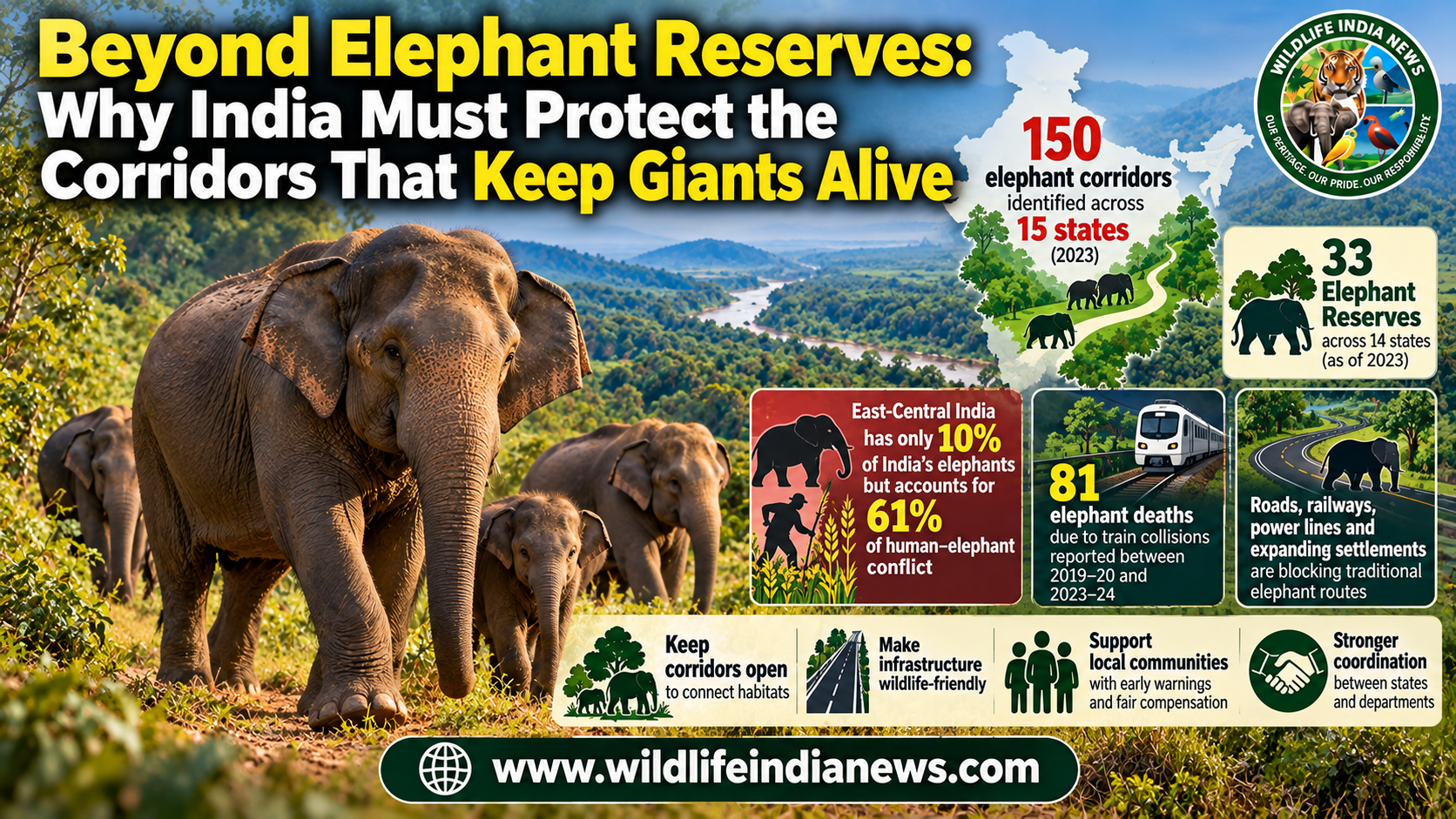
According to the Ministry of Environment, Forest and Climate Change, India had identified 150 elephant corridors across 15 states by 2023. The challenge now is to ensure these corridors remain functional as development pressures increase.
Why Elephant Corridors Are Essential
Elephant corridors connect forest patches and allow herds to move between feeding grounds, water sources and breeding habitats. These connections are essential for maintaining healthy populations and preventing isolated groups from becoming increasingly vulnerable.
When roads, railway lines, settlements and agricultural expansion obstruct traditional routes, elephants may be forced through villages and farmland. Such encounters can result in crop losses, human casualties and the deaths of elephants.
Corridors are therefore not merely strips of forest. They are essential ecological connections that must be protected through coordinated landscape planning.
Because elephant movements frequently cross state boundaries, conservation measures confined to individual reserves cannot adequately address the problem.
Where Is Human–Elephant Conflict Most Severe?
The intensity of human–elephant conflict varies considerably across India. Parts of eastern and central India, particularly Odisha, Jharkhand and Chhattisgarh, face serious challenges because elephants move through fragmented forests interspersed with agricultural land, villages, mines and infrastructure.
The Indian Masterminds report highlights a striking imbalance: the East-Central landscape reportedly supports around 10% of India’s elephant population but accounts for nearly 61% of reported human–elephant conflict.
In southern India, elephants move between adjoining forest complexes and agricultural settlements. In the Northeast, traditional elephant routes intersect with villages, tea-growing areas and other human activities.
These regional differences underline the need for locally tailored solutions rather than a uniform national approach.
Infrastructure: A Growing Threat to Elephant Survival
Roads, railway lines and electrical installations can turn traditional elephant routes into dangerous obstacles.
Government figures indicate that 81 elephant deaths caused by train collisions were reported between 2019–20 and 2023–24.
To reduce such incidents, authorities have introduced or promoted measures including railway speed restrictions, underpasses, ramps, fencing and elephant-detection systems.
However, infrastructure mitigation must be based on actual elephant movements. Poorly designed barriers or crossings may simply redirect animals towards other dangerous locations.
The solution is to incorporate wildlife requirements into infrastructure planning before projects are constructed, while improving safety measures along existing transport routes.
Human–Elephant Conflict: Communities Cannot Be Left Behind
For people living near elephant habitats, conservation can mean damaged crops, destroyed homes, injuries and loss of life. Elephants entering agricultural fields can cause substantial damage, while attempts to drive them away may expose both people and animals to danger.
Effective conservation must therefore address the needs of affected communities.
Important measures include:
- Early-warning systems to alert villages when elephants approach.
- Timely compensation for crop losses, injuries and fatalities.
- Rapid-response teams trained to manage dangerous encounters.
- Community participation in designing local conflict-prevention measures.
- Scientific monitoring to identify recurring hotspots and seasonal movement patterns.
Technology can improve early detection, but alerts are useful only when they reach residents promptly and trained teams can respond effectively.
What Project Elephant Must Prioritise Next
India’s identification of 150 elephant corridors is an important achievement, but mapping alone cannot guarantee their survival.
The next phase of conservation should focus on four priorities.
First, secure vulnerable corridors. Development projects should avoid obstructing critical elephant routes, while degraded connections should be restored wherever feasible.
Second, make infrastructure wildlife-sensitive. Roads, railways and power installations in elephant habitats require appropriate safety measures based on scientific assessments.
Third, strengthen community protection. Compensation, early warnings and village-level preparedness must become integral parts of conservation planning.
Fourth, improve cooperation between states and departments. Forest agencies, railways, electricity utilities, district administrations and local communities must coordinate their efforts because elephants move across administrative boundaries.
Success should be measured not simply by the number of reserves and corridors identified, but by reductions in elephant deaths, human casualties and crop losses, alongside improvements in habitat connectivity.
Can Development and Elephant Conservation Coexist?
India does not need to choose between economic development and wildlife conservation. It needs better planning that recognises the ecological importance of connected landscapes.
Infrastructure projects that ignore elephant movements can fragment habitats and create long-term costs through wildlife deaths and recurring conflict. Wildlife-sensitive planning can identify risks early and incorporate appropriate mitigation measures before construction begins.
No single intervention can eliminate every encounter. However, habitat protection, safer infrastructure, scientific monitoring and community participation can substantially improve the prospects for coexistence.
The Road Ahead: Keeping Corridors Open and Communities Safe
Project Elephant has helped shift India’s conservation approach beyond individual animals and protected areas towards entire landscapes. The identification of 150 elephant corridors provides a valuable foundation for this transition.
The priority now is to protect these connections, reduce dangerous encounters and ensure that communities living alongside elephants receive adequate support.
The true measure of elephant conservation will be a landscape where elephants can move safely between habitats and people can pursue their livelihoods without living in constant fear of the next encounter.
Protecting elephant corridors is therefore not merely about saving wildlife. It is about securing the future of India’s forests while making coexistence safer and more sustainable for everyone.
Sources: Ministry of Environment, Forest and Climate Change; Wildlife Institute of India; Press Information Bureau; Indian Masterminds.
Last Updated: 31 October 2026
Leave a Reply