Descriptions habitats and regional significance
Wildlife India News | Last updated 28 October 2026
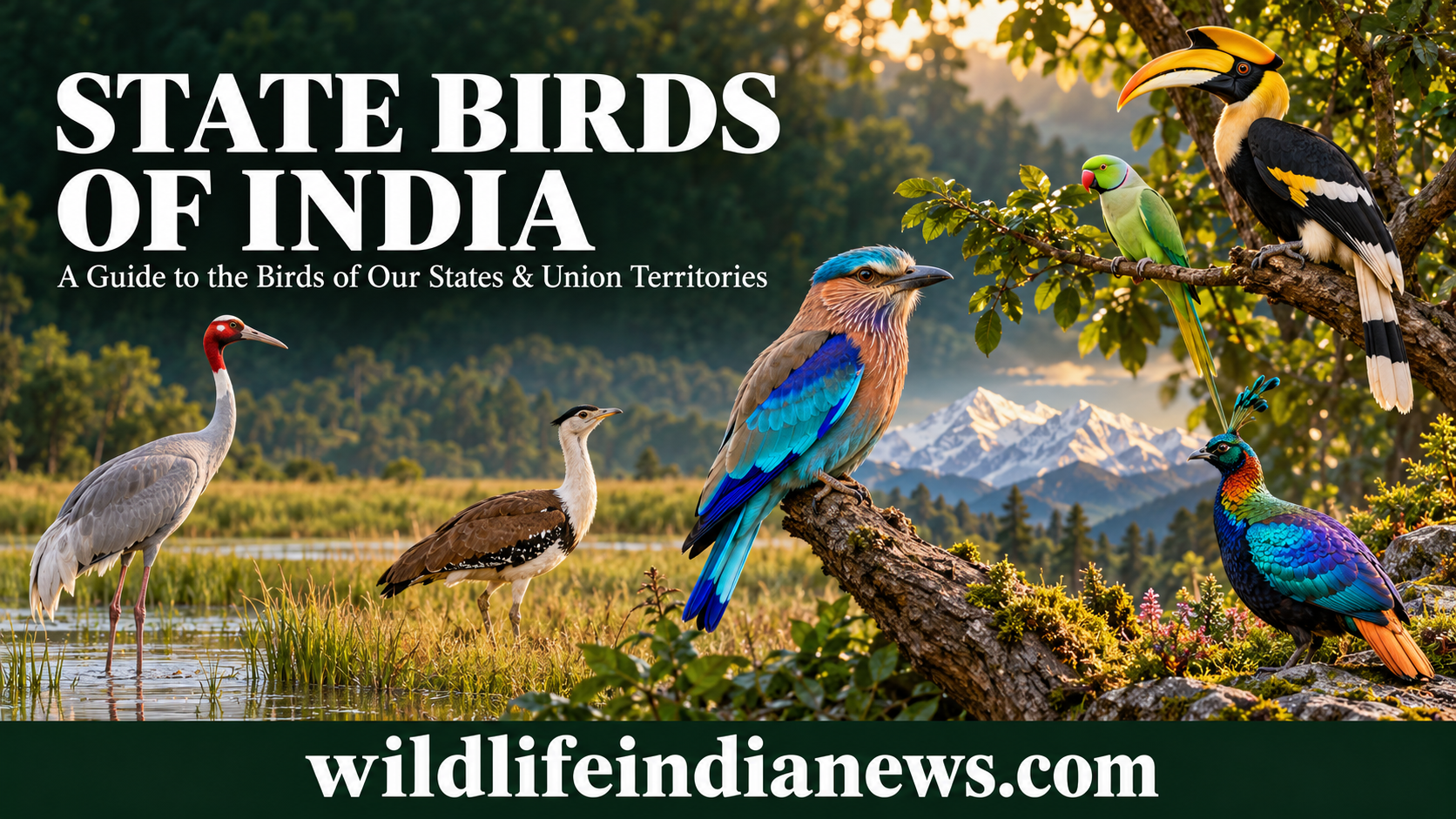
India’s bird emblems range from sparrows living beside people to hornbills in old forests and cranes breeding on the Himalayan plateau. This report covers all 28 states and 8 union territories, describing each designated bird, the habitat it needs and its ecological or cultural connection with the region.
A state bird does not need to be unique to its state. Several emblems are shared: the great hornbill represents Arunachal Pradesh and Kerala, while the Indian roller represents Karnataka, Odisha and Telangana. Recognition can also reflect cultural history rather than present-day abundance, as Punjab’s goshawk demonstrates.
How to read the profiles
The section headed Regional significance explains why the bird is a meaningful emblem. Where an original selection reason is documented, the profile attributes it to the relevant source. Otherwise, the explanation is an ecological or cultural interpretation, not a claim about the government’s original decision. Habitat descriptions identify suitable environments and illustrative landscapes, not guaranteed sighting locations.
Names and designations
Current usage is paired with familiar or older names where helpful. Important distinctions include Andhra Pradesh’s rose-ringed parakeet, Bihar’s house sparrow, Goa’s flame-throated bulbul, Jammu and Kashmir’s kalij pheasant and Lakshadweep’s sooty tern. Dadra and Nagar Haveli and Daman and Diu is included with its designation unconfirmed.
Conservation begins with habitat
Bird emblems have practical value when recognition leads to protection: old trees for hornbills, wet grasslands for cranes, safe nesting places for sparrows and undisturbed island colonies for seabirds. Protecting these habitats supports many species beyond the emblem itself.
Indian states
1 Andhra Pradesh

Rose-ringed parakeet | Psittacula krameri
A bright green, long-tailed parakeet with a red bill. Adult males develop a dark and rose-coloured neck ring. It feeds on seeds, fruits, buds and cultivated grain. Habitat: Open woodland, orchards, farmland, village groves and urban parks across the state.
Regional significance: Known as Rama Chiluka, it connects the state’s familiar birdlife with Telugu cultural imagery. Its beauty and everyday visibility make it an accessible emblem of biodiversity.
Conservation: Retain mature nesting trees and prevent illegal capture for the cage-bird trade.
Sources [1]
2 Arunachal Pradesh

Great Hornbill | Buceros bicornis
A very large black-and-white bird with a massive yellow bill and casque. Its fruit-rich diet makes it an important disperser of forest seeds. Habitat: Mature tropical and subtropical forests with large fruiting trees and cavities for nesting, including the eastern Himalayan foothills.
Regional significance: The hornbill is closely associated with Arunachal’s forest landscapes and the traditions of several Indigenous communities. Its regional symbolism combines cultural identity with the survival of old forests.
Conservation: Protect large nesting trees and reduce hunting through community participation.
Sources [2]
3 Assam

White-winged duck | Asarcornis scutulata
Also called the white-winged wood duck or Deo Hanh, this large, dark duck has a pale, speckled head and contrasting white wing patches. Habitat: Quiet forest pools, swampy woodland and streams within evergreen or semi-evergreen forest; it depends on secure wetland cover.
Regional significance: Assam’s 2003 notification identifies it as the state bird. Its strong association with forest wetlands makes it a distinctive emblem of habitats that receive less attention than the state’s open floodplains.
Conservation: Protect forest wetlands, nesting cavities and surrounding woodland from drainage, disturbance and fragmentation.
Sources [3], [4]
4 Bihar

House sparrow | Passer domesticus
A small, social brown-and-grey bird. Males have a black bib and contrasting head markings; females are plainer. Adults eat seeds and grain, while insects are important to chicks. Habitat: Villages, towns, farms and buildings with suitable nesting crevices and nearby food.
Regional significance: Bihar adopted the sparrow in 2013. Contemporary cabinet reporting explicitly linked the decision to protection and conservation, drawing attention to a bird familiar in everyday life.
Conservation: Preserve nesting spaces and insect-rich vegetation; local declines should not be confused with global extinction.
Sources [5], [6]
5 Chhattisgarh

Common hill myna or Bastar hill myna | Gracula religiosa
A glossy black bird with white wing patches, a bright bill and fleshy yellow-orange wattles. It is known for varied calls and vocal mimicry. Habitat: Forests with large trees and fruiting canopies, especially the Bastar landscape and Kanger Valley.
Regional significance: The local Bastar association gives the bird a strong connection with Chhattisgarh’s forest heritage. The designation highlights a forest-dependent species that is also vulnerable to trapping.
Conservation: Protect nesting trees and prevent illegal capture. Some official material uses the subspecies name G. r. peninsularis; the species-level name is used here.
Sources [7]
6 Goa

Flame-throated bulbul | Rubigula gularis
A small bulbul with olive-yellow plumage, a black head and a striking orange-red throat. It feeds on fruit and small invertebrates. Habitat: Forests and wooded edges of the Western Ghats, including Goa’s evergreen and moist deciduous landscapes.
Regional significance: This Western Ghats endemic represents Goa’s forested interior. Government pages also call it the ruby-throated yellow bulbul; modern avifaunal sources distinguish it as the flame-throated bulbul.
Conservation: Retain connected woodland. Older government web labels contain inconsistent scientific names, so Rubigula gularis follows the state’s avifaunal report and specialist assessment.
Regional significance: A locally common bird, tourism mascot or aviary display does not by itself establish an official territorial emblem. A notification or explicit administration statement is needed.
Sources [8], [9], [10]
7 Gujarat

Greater flamingo | Phoenicopterus roseus
Regional significance: The government climate action plan identifies the sooty tern as the territory bird. It represents Lakshadweep’s seabird colonies and oceanic ecology. Some secondary lists confuse it with the brown noddy.
A tall, pale pink waterbird with long legs, a bent filtering bill and black flight feathers. Flocks feed on small aquatic organisms in shallow water. Habitat: Coastal mudflats, saline wetlands, lagoons and salt pans, including the Kutch and Gulf of Khambhat landscapes.
Regional significance: It represents Gujarat’s internationally important coastal and saline wetland wildlife. The state’s extensive feeding and breeding landscapes explain its ecological relevance as an emblem.
Conservation: Maintain wetland water regimes and reduce disturbance, pollution and collision risks around feeding and breeding areas.
Sources [11]
8 Haryana

Black francolin | Francolinus francolinus
Known as kala teetar or black partridge, the male has a dark body, white cheek patches and a chestnut neck band. Females are mottled brown. Habitat: Tall grasses, scrub and crop margins, often near water or wetlands, with cover that allows ground movement.
Regional significance: Its close association with cultivated plains and grassy margins makes it an emblem of Haryana’s rural landscapes. The official black partridge notification dates to 1972.
Conservation: Retain uncultivated cover and field margins, and prevent hunting and trapping.
Sources [12]
9 Himachal Pradesh

Western tragopan | Tragopan melanocephalus
A shy Himalayan pheasant called Jujurana. Males have dark, white-spotted plumage and vivid facial colours; females are camouflaged brown. Habitat: Steep temperate forests with dense undergrowth, including parts of the Beas, Satluj and Ravi catchments.
Regional significance: Celebrated locally as the king among birds, it represents Himachal’s distinctive mountain forests. Its restricted Himalayan range gives the state an important role in its conservation.
Conservation: Protect forest understorey and reduce disturbance and hunting in breeding habitat.
Sources [13]
10 Jharkhand

Asian koel | Eudynamys scolopaceus
A long-tailed cuckoo famous for its ringing call. Males are glossy black; females are brown with pale spots and bars. It lays eggs in the nests of host birds. Habitat: Tree groves, forest edges, orchards, gardens and settlements with fruiting trees.
Regional significance: Its familiar song and association with wooded village landscapes connect it with Jharkhand’s natural and cultural life. The bird also demonstrates that emblems can celebrate familiar wildlife.
Conservation: Retain diverse fruiting trees and nesting habitat for the wider bird community.
Sources [14]
11 Karnataka

Indian roller | Coracias benghalensis
A stocky bird whose brownish body contrasts with brilliant blue wings and tail, especially in flight. It watches for prey from exposed perches. Habitat: Open countryside, grassland, scrub, farmland and scattered trees; nesting usually requires a cavity.
Regional significance: It represents Karnataka’s open and agricultural landscapes rather than only its dense forests. Its conspicuous aerial displays and insect-feeding habits make it a familiar rural bird.
Conservation: Protect open habitats, old trees and prey availability; specialist monitoring has reported declines that merit attention.
Sources [15], [16]
12 Kerala

Great hornbill | Buceros bicornis
A large forest bird with a prominent casque and yellow-and-black bill. Fruit, especially figs, is important in its diet, alongside some animal food. Habitat: Mature evergreen and semi-evergreen forests of the Western Ghats with large nesting trees.
Regional significance: Known as Vezhambal, it is deeply associated with Kerala’s forest identity and cultural imagination. Its seed-dispersal role links the emblem directly to forest regeneration.
Conservation: Retain old trees, fruit resources and connected forest, and prevent hunting.
Sources [17], [18]
13 Madhya Pradesh

Indian paradise flycatcher | Terpsiphone paradisi
A graceful insect-eating bird with a glossy dark head. Adult males can have spectacular elongated tail streamers and white or rufous plumage; females are shorter-tailed and rufous. Habitat: Woodland, shaded groves, forest edges and well-vegetated areas, often near water.
Regional significance: Locally called Doodhraj, it represents the beauty of the state’s wooded landscapes and the importance of smaller forest birds alongside large mammals.
Conservation: Maintain leafy woodland, nesting cover and insect availability; reduce pesticide pressure.
Sources [19]
14 Maharashtra

Yellow-footed green pigeon | Treron phoenicopterus
An olive-green and grey pigeon with yellow feet and a subtle shoulder patch. Known as Hariyal or Haroli, it feeds mainly on fruit and often gathers in flocks. Habitat: Deciduous woodland, groves, gardens and fruiting trees around villages and towns.
Regional significance: The bird links Maharashtra’s forests with its inhabited landscapes. Its dependence on fruiting trees makes it a useful symbol for retaining native trees beyond protected areas.
Conservation: Protect mature figs and other food trees, and prevent hunting.
Sources [20], [21]
15 Manipur

Mrs Hume’s pheasant or Nongin | Syrmaticus humiae
A ground-foraging hill pheasant. Males have chestnut plumage, a dark glossy neck and a long barred tail; females are more subdued brown. Habitat: Wooded hill slopes, open forest, scrub and grassy clearings with cover.
Regional significance: Nongin is a recognised part of Manipur’s identity. Its local name and hill-forest association connect the state emblem with the wildlife of the northeastern uplands.
Conservation: Reduce hunting, protect suitable hill habitat and involve local communities in monitoring.
Sources [22], [24]
16 Meghalaya

Common hill myna | Gracula religiosa
A glossy black, fruit-eating bird with bright wattles and white wing patches. Its varied, carrying calls are a characteristic part of forest soundscapes. Habitat: Evergreen and semi-evergreen forests, wooded hills and forest edges with fruiting trees.
Regional significance: The hill myna represents Meghalaya’s forest canopies and rich birdlife. Its ecological value includes moving seeds between feeding and roosting sites.
Conservation: Protect mature nesting trees and woodland, and prevent trapping for the pet trade.
Sources [23], [7]
17 Mizoram

Mrs Hume’s pheasant or Vavu | Syrmaticus humiae
A long-tailed pheasant, also called Hume’s bar-tailed pheasant. Males have chestnut and dark metallic plumage; the barred tail is particularly distinctive. Habitat: Hill woodland, forest edges and slopes with scrub, grass or other protective ground cover.
Regional significance: Known locally as Vavu, it represents Mizoram’s hill wildlife and shares its emblem status with Manipur. It is a suitable focus for community protection of forest landscapes.
Conservation: Prevent hunting and conserve connected habitat. Nesting birds are vulnerable to repeated disturbance.
Sources [24]
18 Nagaland

Blyth’s tragopan | Tragopan blythii
A stocky forest pheasant. Males have bright facial colours and white-spotted plumage; females are brown and harder to see against the forest floor. Habitat: Cool montane forests with dense undergrowth, including parts of the Japfu, Dzukou and Satoi landscapes.
Regional significance: Its strong connection with Nagaland’s mountain forests makes it a distinctive regional emblem. Community conservation gives the symbol practical relevance beyond ceremonial recognition.
Conservation: Reduce hunting and protect breeding habitat and dense forest cover.
Sources [25]
19 Odisha

Indian roller | Coracias benghalensis
A conspicuous blue-winged bird often seen on exposed branches or wires. It feeds on insects and other small prey caught on or near the ground. Habitat: Open woodland, farmland, scrub and grassland with perches and nesting cavities.
Regional significance: Often called Neelkanth, it connects Odisha’s familiar countryside birdlife with wider cultural traditions. Its ecological relevance lies in open habitats and agricultural landscapes.
Conservation: Keep old cavity-bearing trees and uncultivated patches; avoid capture and reduce harmful pesticide use.
Sources [26], [16]
20 Punjab

Northern goshawk or Eurasian goshawk | Astur gentilis
A powerful woodland hawk with broad wings, a long tail and a prominent pale eyebrow. Adults have finely barred underparts; young birds are browner and streaked. Habitat: Primarily wooded landscapes and forest edges across its wider range; it should not be described as a common bird of present-day Punjab.
Regional significance: The Baaj is associated with Guru Gobind Singh and Sikh heritage. This cultural connection, rather than local abundance, is central to its symbolism. Punjab corrected its notification to northern goshawk in 2015.
Conservation: Protect raptors from capture and persecution. Older official records use Accipiter gentilis, now a synonym.
Sources [5], [27], [28]
21 Rajasthan

Great Indian bustard | Ardeotis nigriceps
A large, long-legged ground bird with a pale neck, brown body and dark crown. It walks through open country feeding on varied plant and animal food. Habitat: Dry grassland, open scrub and desert plains, especially the Desert National Park landscape.
Regional significance: Known as Godawan, it represents Rajasthan’s grassland heritage. The state is central to the survival of this critically endangered species, giving the emblem an urgent conservation purpose.
Conservation: Safeguard breeding grasslands and address power-line collision risks, disturbance and habitat conversion.
Sources [29]
22 Sikkim

Blood pheasant | Ithaginis cruentus
A compact pheasant whose males show red streaks over grey-green plumage and red legs. Females are mainly brown; the name refers to feather colour. Habitat: High Himalayan forests, rhododendron scrub and subalpine vegetation; seasonal movement helps it respond to snow.
Regional significance: It represents Sikkim’s high mountain birdlife and forest–alpine transitions. It should not be confused with the more colourful Himalayan monal or satyr tragopan.
Conservation: Protect high-elevation vegetation and reduce hunting and disturbance.
Sources [30]
23 Tamil Nadu

Asian emerald dove | Chalcophaps indica
A small pigeon with shimmering green wings, a pinkish-brown body and a reddish bill. It often walks on the forest floor seeking fallen seeds and fruit. Habitat: Shaded forest, dense groves and wooded foothills, including the Western Ghats and other suitable forest patches.
Regional significance: Known as Maragatha Pura, it symbolises the state’s quieter woodland wildlife. Its presence connects forest-floor habitat with the trees that supply food and cover.
Conservation: Retain shaded woodland, understory and native food trees; reduce fragmentation and disturbance.
Sources [31], [32]
24 Telangana

Indian roller or Palapitta | Coracias benghalensis
A stocky, blue-winged bird that becomes especially colourful in flight. It hunts from perches and performs rolling aerial displays. Habitat: Open woodland, grassland, scrub and cultivated landscapes with scattered trees.
Regional significance: The official state explanation links Palapitta with Dasara and an auspicious association with Lord Rama’s victory. The government expressly describes the bird as a symbol of the state’s path to victory.
Conservation: Protect habitat and observe the bird in the wild; cultural recognition should not encourage capture or handling.
Sources [33]
25 Tripura

Green imperial pigeon | Ducula aenea
A large pigeon with a pale grey head and underparts, contrasting with glossy metallic green upperparts. Fruit forms a major part of its diet. Habitat: Evergreen and semi-evergreen forest, wooded edges and groves with fruiting canopy trees.
Regional significance: It represents Tripura’s lowland and hill-forest birdlife. As a canopy fruit-eater, it links the state’s bird emblem with the regeneration and continuity of woodland.
Conservation: Conserve fruiting trees and forest connections, and prevent hunting and trapping.
Sources [34]
26 Uttar Pradesh

Sarus crane | Antigone antigone
A very tall, long-legged crane with grey plumage and a red head and upper neck. Pairs are known for coordinated calls and courtship displays. Habitat: Shallow wetlands, marshes, flooded fields and agricultural mosaics where nesting and feeding conditions persist.
Regional significance: Uttar Pradesh is an important Indian stronghold. The sarus represents a landscape where working farms and wetlands can support wildlife together, with local stewardship essential to its survival.
Conservation: Protect seasonal wetlands and nests, and reduce disturbance, pesticide exposure and hazardous infrastructure.
Sources [35]
27 Uttarakhand

Himalayan monal | Lophophorus impejanus
A Himalayan pheasant with a spectacular iridescent male, a metallic crest and a copper-coloured tail. Females are mottled brown with a pale throat. Habitat: Temperate and subalpine forest, rhododendron scrub and adjoining high-elevation meadows.
Regional significance: Its association with the Himalayan landscape makes it an emblem of Uttarakhand’s mountain biodiversity. WII records its presence across several of the state’s major protected areas.
Conservation: Protect feeding and breeding habitat, and prevent hunting and disturbance in high mountain landscapes.
Sources [36]
28 West Bengal

White-throated kingfisher | Halcyon smyrnensis
A robust kingfisher with blue wings and back, a chestnut head and a conspicuous white throat and breast. Its bill is large and red. Habitat: Wetland edges, farmland, gardens and open wooded areas; it also hunts well away from water.
Regional significance: It represents a familiar part of Bengal’s countryside and wetland mosaics. The bird’s use of many habitats makes it a reminder that wildlife conservation extends beyond forest reserves.
Conservation: Retain banks for nesting, feeding habitats and clean waterways; avoid excessive pesticide use.
Sources [37]
Indian union territories
1 Andaman and Nicobar Islands

Andaman wood pigeon | Columba palumboides
A forest pigeon with a pale head, patterned neck, dark slate-grey upperparts and iridescent sheen. It is distinct from common city pigeons. Habitat: Dense broadleaved evergreen forests of the Andaman and Nicobar island groups.
Regional significance: As an endemic island bird, it has an especially direct geographical connection with the territory. Its designation highlights the irreplaceable wildlife found in the islands’ forests.
Conservation: Protect island forests and reduce fragmentation, hunting and disturbance.
Sources [38]
2 Chandigarh

Indian grey hornbill | Ocyceros birostris
A grey hornbill with a curved bill, a small casque and a long tail. It eats fruit and some animal prey and uses tree cavities for nesting. Habitat: Wooded urban areas, gardens, groves and open woodland with mature trees.
Regional significance: It represents Chandigarh’s tree-dependent wildlife and shows the conservation value of mature urban greenery. Large trees can support native birds within a planned city.
Conservation: Preserve cavity-bearing trees, native fruit resources and connected green spaces.
Sources [39]
3 Dadra and Nagar Haveli and Daman and Diu
Official designation unconfirmed | Not applicable
4 Delhi

House sparrow | Passer domesticus
A small, sociable seed-eating bird closely associated with people. Insects are particularly important when adults feed their young. Habitat: Buildings with nesting cavities, neighbourhood greenery, markets, farms and other urban or semi-urban spaces.
Regional significance: Delhi’s Wildlife Wing records a gazette notification dated 5 October 2012. The sparrow has become a prominent focus for reconnecting residents with familiar urban biodiversity and concern over disappearing nesting opportunities.
Conservation: Retain nesting spaces, insect-rich planting and food resources; suitable nest boxes can complement habitat improvement.
Sources [40], [5]
5 Jammu and Kashmir

Kalij pheasant | Lophura leucomelanos
A ground-foraging pheasant with a crest and red facial skin. Males show dark glossy plumage with pale markings; females are mottled brown. Habitat: Wooded Himalayan foothills and mountain slopes with dense cover, including parts of both Jammu and Kashmir.
Regional significance: The territory adopted it on 20 October 2021. Officials explained that it occurs in both regions, while the former state’s black-necked crane emblem belongs primarily to the now-separate Ladakh landscape.
Conservation: Protect forest undergrowth and reduce hunting and disturbance.
Sources [41], [42]
6 Ladakh

Black-necked crane | Grus nigricollis
A tall, pale-grey crane with a black head and neck, dark tail area and a red crown patch. Breeding pairs use high-altitude wetlands. Habitat: Marshes, wet meadows and lake margins of the Changthang plateau, including the Hanle and Tso Kar landscapes.
Regional significance: Notified on 31 August 2021, it has ecological and cultural importance and is regarded as a symbol of peace. Ladakh holds India’s breeding population, creating a particular responsibility for its nesting habitat.
Conservation: Protect wetland water regimes and nesting sites from disturbance, free-ranging dogs and damaging development.
Sources [43], [44]
7 Lakshadweep

Sooty tern | Onychoprion fuscatus
A dark-backed, white-bellied seabird with a contrasting forehead, pointed wings and a forked tail. It spends much of its life over tropical seas. Habitat: Open ocean and island breeding colonies, particularly the Pitti bird-sanctuary landscape.
Conservation: Protect nesting colonies from disturbance, introduced predators and marine pollution. Older sources use Sterna fuscata.
Sources [45], [31]
8 Puducherry

Asian koel | Eudynamys scolopaceus
A long-tailed cuckoo known for its musical calls. Males are glossy black and females are spotted brown; fruit is important in the diet. Habitat: Tree-filled settlements, gardens, groves, orchards and wooded edges.
Regional significance: An official newsletter dates the announcement to 16 April 2007 and connects the koel with Indian poetry and Subramania Bharathi’s writing about a koel grove in Puducherry. This gives the bird a clear literary and local association.
Conservation: Retain fruiting trees and diverse urban greenery, together with habitat for the host birds that raise koel chicks.
Sources [46]
Sources and further reading
Linked references support designations and the principal regional details. Older government material sometimes retains superseded names or threat categories; those older legal schedules, population figures and categories are not presented as current data here. Original notification reasons are distinguished from interpretation in the introduction and profiles.
[1] Andhra Pradesh Forest Department — State bird
[2] Arunachal Pradesh Forest Department — State profile
[3] Assam Forest Department — State symbol notification in official compendium
[4] Assam State Biodiversity Board — White winged wood duck
[5] Central Zoo Authority — House sparrow and northern goshawk profiles
[6] The Times of India — Bihar cabinet adoption and conservation purpose, 17 April 2013
[7] All India Forest Sports Meet official portal — Bastar hill myna
[8] Goa Forest Department — State symbols
[9] Goa Forest Department — Avifaunal diversity and flame throated bulbul
[10] State of India’s Birds — Flame throated bulbul in Goa
[11] Central Zoo Authority — Sayajibaug Zoo annual report identifying Gujarat’s bird
[12] Haryana Environment Department — Black francolin state emblem
[13] Himachal Tourism — Western tragopan and Himalayan habitat
[14] East Singhbhum District Administration — Asian koel profile
[15] State of India’s Birds — Karnataka summary identifying Indian roller
[16] State of India’s Birds — Indian roller in Karnataka
[17] Kerala Forest Department — State symbols
[18] Kerala Forest Department — Great hornbill ecology
[19] Madhya Pradesh State Biodiversity Board — State bird
[20] National Academy of Direct Taxes — Yellow footed green pigeon and Maharashtra designation
[21] Directorate of Forest Education — Yellow footed green pigeon description
[22] Manipur Forest Department — Nongin state bird
[23] Meghalaya Government — State bird identification
[24] Central Zoo Authority — Hume’s bar tailed pheasant and Mizoram designation
[25] Nagaland State Biodiversity Board — Blyth’s tragopan and regional habitats
[26] Odisha Wildlife Organisation — State icons
[27] The Indian Express — Punjab’s goshawk designation and cultural connection, September 2026
[28] Integrated Taxonomic Information System — Astur gentilis and former name
[29] Rajasthan Forest Department — Project Great Indian Bustard
[30] Sikkim Forest Department — Blood pheasant state symbol
[31] Government hosted state and territory fact sheets — Tamil Nadu and Lakshadweep
[32] State of India’s Birds — Asian emerald dove in Tamil Nadu
[33] Telangana Government — State symbols and Palapitta selection explanation
[34] Tripura Science Technology and Environment Department — State symbols
[35] Central Zoo Authority — Kanpur Zoo master plan and sarus conservation
[36] Wildlife Institute of India — State report on Himalayan monal in Uttarakhand
[37] West Bengal Biodiversity Board — White throated kingfisher state bird
[38] Andaman and Nicobar Administration — Wood pigeon identification and habitat
[39] Chandigarh Environment Department ENVIS — Indian grey hornbill designation
[40] Delhi Wildlife Wing — House sparrow and 2012 notification
[41] Jammu and Kashmir Government — Kalij pheasant notification, 20 October 2021
[42] Brighter Kashmir — Officials explain the kalij designation, 22 October 2021
[43] Ladakh Administration — Animal and bird notification, 31 August 2021
[44] Ladakh Administration — Black necked crane ecology and cultural significance
[45] Ministry of Environment — Lakshadweep climate action plan identifying sooty tern
[46] Puducherry Pollution Control Committee — Asian koel designation and poetry connection
Leave a Reply