Feature published: October 20, 2026 | 3:31 pm IST
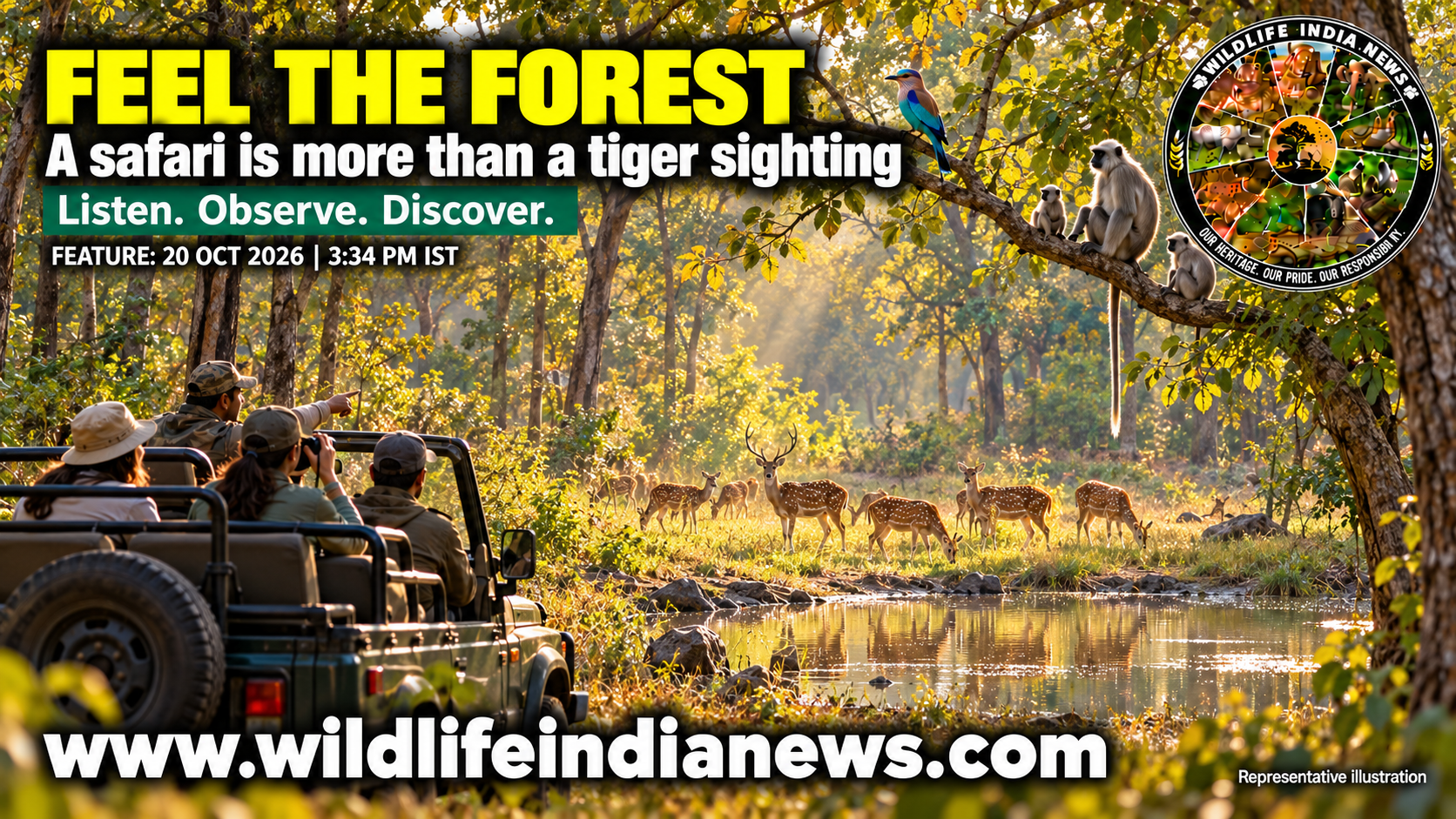
The safari vehicle returns to the gate. Someone asks the familiar question: “Did you see a tiger?” If the answer is no, disappointment often follows—even when the morning offered mist rising above a meadow, deer gathering at a waterhole, a woodpecker working its way up a tree and sunlight filtering through an ancient canopy.
This narrow measure of success overlooks much of what makes a forest worth visiting. A tiger sighting can be unforgettable. But a safari offers something larger: the opportunity to enter a living landscape, observe its relationships and experience a world that continues on its own terms.
To feel the forest is to notice what is happening around us, including the life that never becomes the centre of a photograph.
The Problem With Treating a Safari as a Tiger Hunt
For many visitors, the tiger becomes an unofficial promise attached to the booking. Travel advertisements, dramatic wildlife videos and photographs of close encounters can make sightings appear routine. An animal walking down an open track seems almost inevitable.
Yet visitors see only a limited part of a reserve during a limited period. A tiger may be resting behind vegetation, moving away from tourist routes or simply remaining unseen. Its absence from view tells us little about whether it is present nearby.
When every minute becomes a search for stripes, other encounters are hurried past. Deer become background scenery. Birds receive barely a glance. A beautiful stretch of forest becomes merely the distance between two possible tiger locations.
The disappointment is understandable, especially after an expensive journey. But expecting certainty from a wild animal places the experience on the wrong foundation. A safari booking provides regulated access to wildlife habitat; it cannot guarantee how wildlife will behave.
Begin With the Landscape, Before Looking for an Animal

Look at the forest itself. Where does dense woodland give way to grass? Which slopes are rocky? Where does water collect? How does the vegetation change beside a stream?
These are not decorative details. They help explain where animals find food, shelter and water—and why different species use different parts of a landscape.
A meadow and a shaded forest floor offer different viewing experiences. A waterbody may bring together birds, insects and mammals, while a patch of dense undergrowth may conceal more activity than it reveals.
Ask the guide about the dominant trees, seasonal changes and the history of the habitat. Understanding the setting gives every subsequent sighting more meaning.
Listen: Much of the Forest Is Heard Before It Is Seen
A safari becomes richer when conversation gives way to listening. Bird calls, rustling leaves, insects and the movement of animals create a soundscape that changes as the vehicle passes through different habitats.
An experienced guide may interpret an alarm call or a sudden change in an animal’s posture. These clues can suggest that something has attracted attention. They should be treated as possibilities, however, rather than a promise that a tiger is about to appear.
Listening also rewards visitors independently of predators. Locating a bird by its call, then finding it among branches, can become a satisfying encounter in its own right.
Silence is therefore part of the experience, rather than simply a rule imposed on tourists.
Watch Familiar Animals for Longer

A herd of deer can seem ordinary when seen repeatedly. Stay with it for a moment and individual behaviour begins to emerge: an animal pausing between mouthfuls, ears turning towards a sound, a youngster remaining close to an adult.
Langurs may be feeding, resting or interacting. A bird may be carrying nesting material or searching beneath bark. Even a familiar species becomes interesting when the question changes from “What is it?” to “What is it doing?”
Identification gives an encounter a name. Observation gives it a story.
This approach is especially valuable for children. Instead of asking them to wait for one spectacular animal, invite them to notice movement, shapes, sounds and behaviour throughout the drive.
The Smaller World Deserves Attention Too

Butterflies beside a damp patch, a spider’s web between branches, fungi on fallen wood or a beetle crossing the track can reveal another scale of forest life.
Such observations need not become a competition to count species. Their value lies in recognising that a forest contains many overlapping worlds, most of which are easy to miss from a moving vehicle.
Binoculars can be as useful as a camera. A notebook can hold a brief description of something unfamiliar. Ask about it later rather than insisting on an immediate identification.
Visitors should observe these details from permitted places. Curiosity never justifies leaving a vehicle where that is prohibited, collecting objects or disturbing an animal for a closer view.
A Good Guide Helps Visitors Understand the Whole Forest

A guide’s contribution extends beyond finding a tiger. Good interpretation connects a sighting to habitat, season and behaviour. It can turn an apparently quiet stretch of road into an absorbing lesson in natural history.
Visitors can encourage this from the beginning. Tell the guide that birds, trees, tracks and smaller animals matter to the group too. Ask questions, listen carefully and allow time for an explanation.
Judging guides entirely by tiger sightings places responsibility on them for an outcome they cannot control. Appreciate their knowledge, safe conduct and ability to help you notice more.
When the Tiger Appears, Give It Space

Broadening the purpose of a safari does not diminish the excitement of seeing a tiger. It prepares us to appreciate the animal within its habitat.
If one appears, remain quiet and follow the guide’s directions. Allow it to choose its path. A photograph should never take priority over an animal’s ability to move freely.
The same principle applies to every species. Feeding, calling out, playing recorded sounds or attempting to provoke movement turns observation into interference. Respectful distance often produces a more meaningful experience because the animal can continue its activity.
Tourism Should Leave Benefits Beyond the Photograph
The National Tiger Conservation Authority’s tourism guidance emphasises low-impact visits, biodiversity awareness and benefits for local communities. These principles give safari tourism a purpose beyond individual sightings.
Visitors can contribute by using authorised services, respecting local knowledge and asking operators how their activities support conservation and nearby communities. Comfort and responsible conduct should be considered together when choosing an experience.
The forest should not bear the cost of our impatience. Nor should local people become invisible within a tourism economy built around the landscapes they live beside.
Return With a Different Measure of Success
At the end of a safari, ask more than whether a tiger appeared. What did you hear? Which animal held your attention? What did the guide help you understand? What changed in the forest as the morning warmed?
A tiger may remain hidden while the forest offers hours of discovery. There may also be quiet periods when very little is visible. Learning to accept those intervals is part of experiencing a place that has not been arranged for us.
Go with the hope of seeing a tiger—and enough curiosity to enjoy everything around it. The most rewarding safari leaves you with a deeper interest in the forest, whether or not stripes cross the road.
Editorial theme prompted by the linked Mathrubhumi feature. Responsible-tourism context: National Tiger Conservation Authority.
Leave a Reply