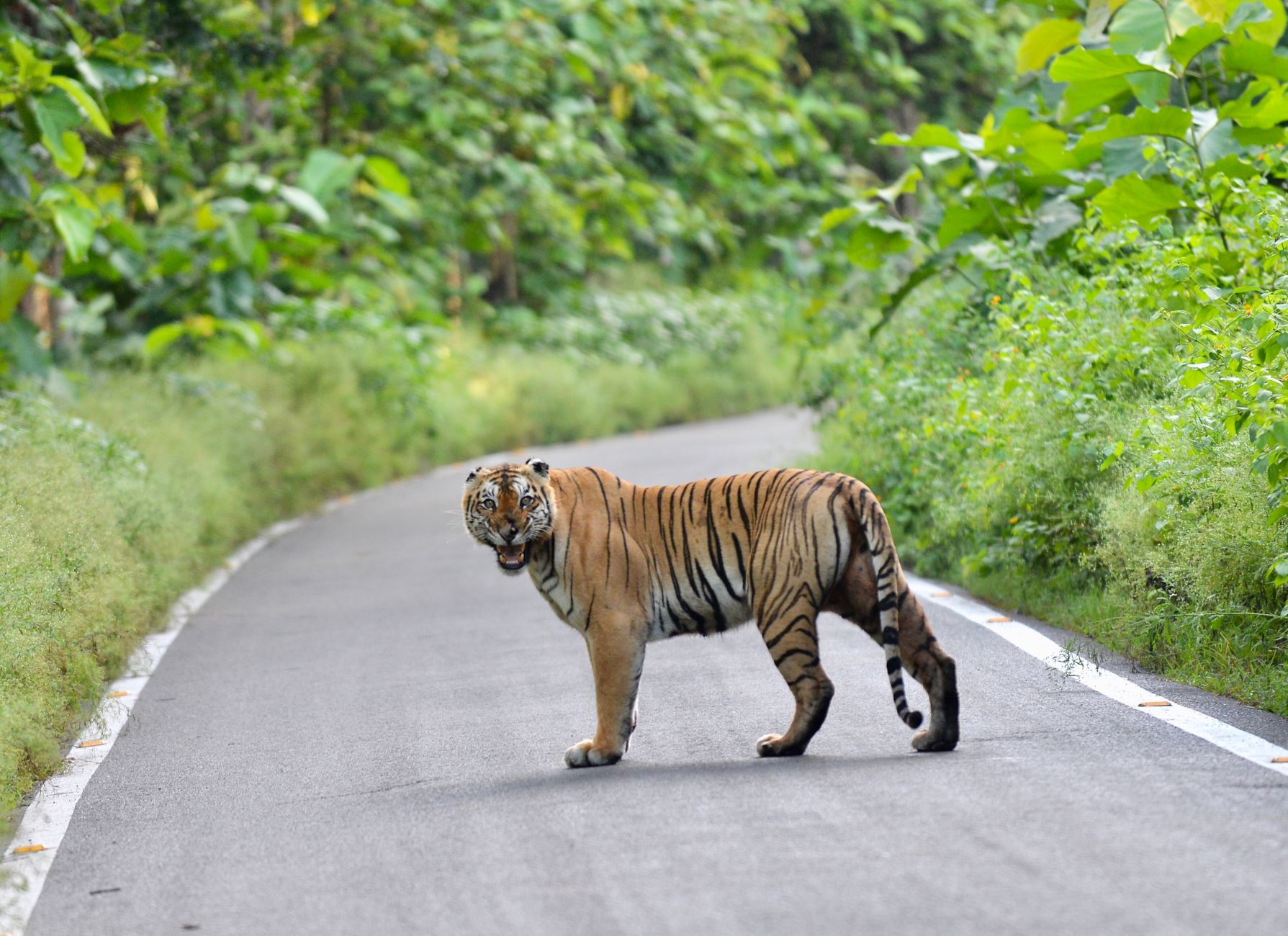
A young tiger leaving its birthplace does not recognise the boundary of a tiger reserve. It searches for space, prey and a mate, travelling through landscapes that may include forests, farmland, villages, roads and railway lines.
Whether that journey leads to a new territory or ends in a fatal encounter can depend on the condition of the habitat between protected areas.
Tiger reserves safeguard breeding populations. Forest corridors allow those populations to remain connected, helping animals disperse, find mates and contribute to the survival of tigers across a wider landscape. IFAW’s account of its work with the Wildlife Trust of India in Central India highlights why protecting these connections is essential to lasting recovery.
What Is a Tiger Corridor?

A tiger corridor is a landscape connection that allows animals to move between suitable habitats. It may consist of continuous forest, riverine vegetation or smaller woodland patches within a landscape also used by people.
A corridor need not resemble an uninterrupted green passage. Research in Central India’s Satpura–Maikal landscape describes both largely continuous forest links and “stepping-stone” connections through fragmented patches.
Scientists distinguish between structural connectivity, where habitats appear physically connected, and functional connectivity, where animals actually use those links for movement, dispersal and breeding. The distinction matters: a connection drawn on a map must also work for wildlife on the ground.
Why Even a Successful Tiger Reserve Needs Corridors
Tigers are territorial. As young animals mature, some leave their natal areas to seek breeding opportunities and establish territories elsewhere.
A reserve supporting successful reproduction must therefore be understood as part of a larger landscape. Without accessible habitat beyond its boundaries, dispersing animals may encounter increasingly restricted and dangerous routes.
The National Tiger Conservation Authority recognises the importance of connected forests and buffer areas for sub-adults, transient animals and other tigers outside established breeding territories. It also identifies connectivity as important for the genetic and demographic viability of many tiger populations.
Growing tiger numbers consequently strengthen the case for protecting dispersal routes. Recovery inside a reserve must be supported by conservation outside it.
Keeping Tiger Populations Genetically Healthy
Corridors provide opportunities for tigers from different populations to meet and breed. This movement of genetic material—known as gene flow—helps counter the effects of isolation.
When a small population becomes cut off, breeding opportunities narrow. Over generations, mating between relatives can increase, raising the risk that harmful inherited traits will affect population health.
A genomic study of Indian tigers found considerably greater evidence of recent inbreeding in the small, isolated northwestern population examined than in larger, connected populations. Population size and historical isolation also influenced the findings, but the research reinforces the importance of maintaining genetic connections.
A corridor’s full conservation value therefore extends beyond the passage of an individual animal. It includes the possibility that the dispersing tiger survives, establishes itself and reproduces.
Central India Offers Strong Scientific Evidence
A study published in Proceedings of the Royal Society B in 2013 analysed genetic information from 273 individual tigers in the Satpura–Maikal landscape.
Examining populations associated with Kanha, Pench, Satpura and Melghat, researchers found the highest contemporary gene flow between populations connected by forest corridors. The findings demonstrated that intervening forests were helping maintain genetic exchange between separated tiger populations.
The study also explains how dispersal can help replenish depleted populations and support recolonisation after a local disappearance, provided suitable habitat remains and the original threats have been addressed.
Research summarised by the Centre for Wildlife Studies similarly found that roads and human settlements negatively affected tiger connectivity in Central India. Its conclusion was clear: increasing local tiger abundance is insufficient without maintaining links between populations.
How Corridors Become Fragmented

A corridor can lose its usefulness without the complete disappearance of its forest.
Road widening, railway construction, mining and settlement expansion can progressively restrict movement. Development at a narrow connection may affect access between much larger habitat blocks.
The NTCA–Wildlife Institute of India report on tiger connectivity identifies corridor bottlenecks as priorities for protection and restoration. It also notes that its mapped corridors represent minimum requirements and that alternative connections deserve conservation attention.
This means the ecological importance of a forest patch depends partly on its location. A relatively small area can be crucial if it provides one of the few remaining connections between larger forests.
Roads and Railways Can Divide Living Landscapes
Transport infrastructure creates two related dangers. Animals may be killed while crossing, or traffic and associated disturbance may discourage movement, separating populations on opposite sides.
India already has evidence that wildlife crossing structures can help.
A Wildlife Institute of India study monitored nine structures on NH44 in the Pench landscape between March and December 2019. Researchers recorded 18 wild animal species using them, including prey animals and large carnivores.
The monitoring documented 89 tiger crossings by 11 individual tigers, using six of the nine structures. These were crossing events, rather than 89 separate animals, but they demonstrate the practical value of providing passages through a major transport barrier.
Such structures must remain connected to usable habitat. Their performance also needs continued monitoring: constructing an underpass is only one part of maintaining a functioning wildlife route.
Nawegaon–Nagzira: Conservation Beyond Reserve Boundaries
IFAW’s October 2026 article describes the Nawegaon–Nagzira landscape as an important connection within Central India’s tiger network.
Its work with the Wildlife Trust of India combines wildlife monitoring, threat removal, support for forest personnel and collaboration with communities. Camera-trap surveys help reveal how tigers use habitat outside protected areas.
The account also draws attention to snares and illegal electric fences. These threats show why retaining forest cover alone is insufficient. A route may remain physically open while exposing travelling animals to lethal hazards. Effective connectivity requires protection throughout the intervening landscape.
Communities Are Essential Conservation Partners

The spaces between reserves are often places where people live, farm, graze livestock and collect forest resources.
Corridor conservation must recognise these needs and address the risks residents face. Lasting protection depends on participation, practical support and fair treatment of communities sharing land with wildlife.
IFAW describes livelihood initiatives and alternatives to fuelwood collection as components of its Central India programme. These measures aim to support households while reducing pressure on forests and exposure to potentially dangerous wildlife encounters.
Broader corridor management should also prioritise accessible compensation, safer livestock management, responsive field teams and meaningful consultation over land-use decisions. People living beside tiger habitat need to see conservation delivering security and tangible benefits.
Tiger Movement and Human Safety Must Be Managed Together
A tiger outside a reserve is not automatically behaving abnormally. Dispersal is a natural part of its ecology. Nevertheless, movement through densely used landscapes can present serious risks.
The management objective should be to retain safer routes through suitable habitat while reducing dangerous encounters. This calls for cooperation between reserve authorities, territorial forest divisions, neighbouring states and infrastructure agencies.
The NTCA states that it and the Wildlife Institute of India have identified 32 major tiger corridors, with management interventions incorporated through Tiger Conservation Plans. These are major landscape connections, rather than a complete inventory of every local movement route.
The authority also identifies statutory provisions addressing ecologically compatible land uses in connecting areas and the livelihood concerns of local people.
How Can We Tell Whether a Corridor Works?
An occasional tiger sighting is useful evidence, but it does not answer every question about connectivity.
Monitoring should examine whether animals use the route repeatedly, survive crossings and establish themselves in other habitats. It should also identify emerging barriers and patterns of mortality or dangerous encounters.
Camera traps can document individuals and movement. Genetic studies reveal exchange between populations. Field surveys help locate habitat degradation and threats.
The Central India research demonstrates why these methods matter: forest cover indicates the possibility of connectivity, while evidence of movement and gene flow helps establish whether the connection is functioning.
Corridors Benefit More Than Tigers

The value of connected habitat extends across the wildlife community.
NH44 monitoring recorded deer, gaur, wild pigs, small mammals and several carnivore species using the crossing structures. Protecting movement opportunities therefore helps maintain the ecological relationships on which tiger populations depend, including access to prey.
Tiger corridors deserve attention as parts of functioning ecosystems, rather than passages serving a single species.
Securing the Next Generation
Tiger numbers remain an important measure of conservation progress. Their long-term significance depends on whether the landscapes supporting them remain healthy and connected.
A reserve may protect a breeding tigress today. The forest beyond its boundary may determine whether her offspring can establish territories and contribute to other populations tomorrow.
Preventing further fragmentation, restoring damaged links, planning infrastructure around wildlife movement and supporting local communities must therefore accompany protection within reserves.
India’s tigers need secure forest homes—and safe routes between them.
Leave a Reply