Wildlife India News | Last updated 14 October 2026
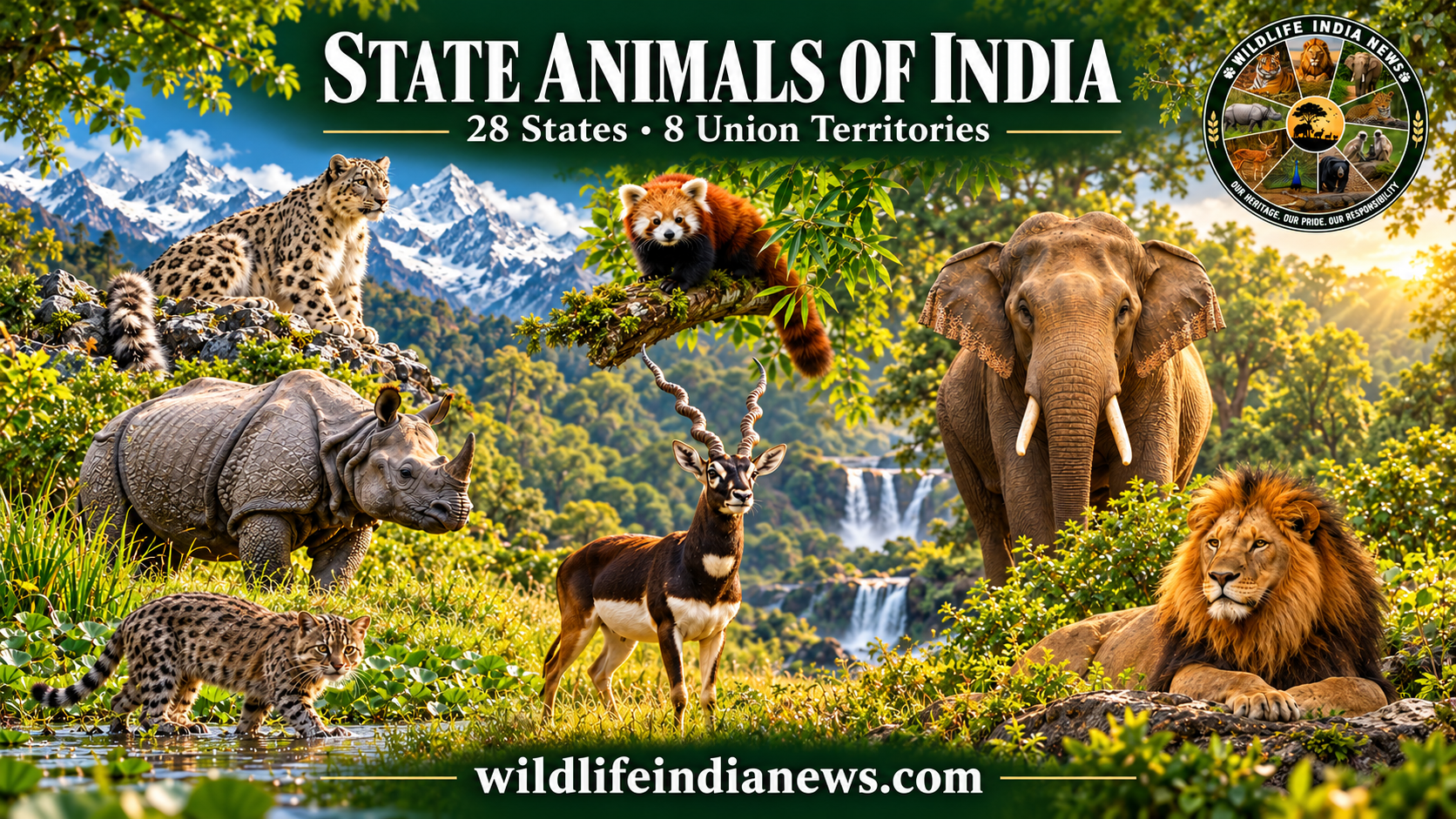
From the snow leopard of Ladakh to the dugong of the Andaman and Nicobar Islands, India’s animal emblems reflect an extraordinary range of landscapes. This report covers all 28 states and all 8 union territories, explaining what each designated animal is, where it lives and why it matters locally.
Indian states
1 Andhra Pradesh

Blackbuck | Antilope cervicapra
About the animal: A swift antelope known locally as Krishna Jinka. Mature males have dark upperparts, white underparts and spiral horns; females are usually tan.
Habitat: Open grasslands, scrub and agricultural mosaics, including the Rollapadu landscape.
Regional significance: The Chief Minister’s office described its quickness and ability to overcome uncertainty as symbolic of the state and its people in 2018. Ecologically, it represents Andhra Pradesh’s often overlooked grasslands.
Conservation: Loss of open habitat, fencing and poaching threaten local populations.
Sources [1], [2]
2 Arunachal Pradesh

Mithun or gayal | Bos frontalis
About the animal: A large, traditionally semi-domesticated bovine with a dark coat, pale lower legs and strong horns. It should not be confused with the wild gaur.
Habitat: Forested hills and community-managed woodland grazing areas of the eastern Himalaya.
Regional significance: Mithun is embedded in the livelihoods, ceremonies, customary exchanges and social identity of several Indigenous communities. Its symbolic importance is primarily cultural and economic, alongside its association with forest landscapes.
Conservation: Maintaining community forests, animal health and traditional husbandry helps preserve this living heritage.
Sources [3]
3 Assam

Greater one horned rhinoceros | Rhinoceros unicornis
About the animal: A massive herbivore distinguished by one horn and skin folds resembling armour. It grazes, browses and frequently wallows.
Habitat: Alluvial grasslands, wetlands and riverine forests of the Brahmaputra floodplain, notably Kaziranga, Pobitora, Orang and Manas.
Regional significance: Officially designated in 2003, the rhinoceros represents Assam’s floodplain wildlife and internationally important conservation work. This ecological connection explains its symbolic relevance; the notification itself does not give a detailed selection rationale.
Conservation: Poaching, habitat pressures and maintaining safe movement during floods remain important concerns.
Sources [4]
4 Bihar

Gaur | Bos gaurus
About the animal: The largest living wild cattle species, with a muscular shoulder ridge, curved horns and pale lower legs. Despite the nickname Indian bison, it is a gaur.
Habitat: Forested hills and grass-rich clearings, particularly the Valmiki landscape in northern Bihar.
Regional significance: Its local significance lies in Bihar’s surviving forest wildlife and the Himalayan foothill connection. This is an ecological interpretation of its symbolism. Bihar’s Gangetic dolphin is separately listed as the state aquatic animal.
Conservation: Protecting forest habitat and reducing disturbance and disease risks from livestock are priorities.
Sources [5], [6], [7]
5 Chhattisgarh

Wild water buffalo | Bubalus arnee
About the animal: A powerful wild bovine with exceptionally broad, sweeping horns. It is distinct from domestic buffalo and feral domestic herds.
Habitat: Grasslands and water-rich forest mosaics, associated with Udanti–Sitanadi and Indravati.
Regional significance: Declared the state animal in 2001, it represents a rare component of central Indian wildlife. Its surviving local populations also give the state a special conservation responsibility; this explains its ecological significance.
Conservation: Small populations, habitat degradation, livestock disease and interbreeding with domestic buffalo are major concerns.
Sources [8]
6 Goa

Gaur | Bos gaurus
About the animal: A large forest bovine with a dark body, strong shoulders, curved horns and conspicuous pale stockings. Herds feed on grasses and other vegetation.
Habitat: Moist deciduous, semi-evergreen and evergreen forests, especially Goa’s eastern Western Ghats.
Regional significance: Its relevance is the forested interior of a state often associated mainly with beaches. As a large native herbivore, the gaur represents Goa’s Western Ghats biodiversity; this is an ecological explanation rather than a quoted adoption reason.
Conservation: Forest fragmentation and encounters with people at forest edges require attention.
Sources [9]
7 Gujarat

Asiatic lion | Panthera leo persica, traditionally used
About the animal: A social big cat; males generally have a less extensive mane than many African lions. A longitudinal belly fold is a characteristic feature.
Designation unconfirmed | Not applicable
Habitat: Dry deciduous forests, scrub, grasslands and human-used landscapes of Gir and greater Saurashtra.
Regional significance: Gujarat supports the only surviving wild population of Asiatic lions. The animal therefore has an exceptional connection with the state’s natural heritage and conservation identity.
Conservation: Disease, road and rail collisions, open wells and dependence on one regional population remain conservation challenges.
Sources [10]
8 Haryana

Blackbuck | Antilope cervicapra
About the animal: An elegant grassland antelope with long spiral horns in males. It relies on speed and visibility in open country.
Habitat: Semi-arid plains, grasslands, scrub and cultivated landscapes where undisturbed open space remains.
Regional significance: Haryana’s official blackbuck notification dates to 1983. Its ecological relevance lies in the state’s open plains and grassland heritage; that connection should not be presented as a verbatim government selection reason.
Conservation: Habitat conversion, fencing, dogs and poaching can affect fragmented local populations.
Sources [11]
9 Himachal Pradesh

Snow leopard | Panthera uncia
About the animal: A pale, spotted mountain cat with a thick coat, broad paws and a long tail that helps it balance on steep slopes.
Habitat: Rocky alpine and trans-Himalayan terrain, including Spiti, Lahaul and high Kinnaur.
Regional significance: The snow leopard represents Himachal Pradesh’s high mountain wildlife and the ecological importance of its cold landscapes. This is its regional significance, rather than a documented original adoption rationale.
Conservation: Protecting wild prey and reducing livestock-related conflict are essential, alongside long-term habitat protection.
Sources [12]
10 Jharkhand

Indian elephant | Elephas maximus indicus
About the animal: A highly social herbivore that travels widely, disperses seeds and shapes vegetation through feeding and movement.
Habitat: Sal-dominated forests and connected forest mosaics, including the Singhbhum and Dalma landscapes.
Regional significance: The state government’s explanation of its emblem links the elephant with Jharkhand’s natural wealth and prosperity. Its presence also expresses the state’s close association with forests.
Conservation: Habitat fragmentation, blocked movement routes, electrocution and conflict with people demand sustained action.
Sources [13], [14]
11 Karnataka

Indian elephant | Elephas maximus indicus
About the animal: A large, intelligent mammal whose family groups are usually led by experienced females. It needs extensive habitat and reliable water.
Habitat: Western Ghats forests and adjoining landscapes, especially Bandipur, Nagarahole and the connected Nilgiri region.
Regional significance: Karnataka is a major stronghold for wild Asian elephants. The animal’s symbolism is closely connected with this forest heritage and its long cultural presence in the state. This is an interpretation of local significance.
Conservation: Keeping corridors connected and reducing dangerous encounters at forest edges are key priorities.
Sources [15], [16]
12 Kerala

Indian elephant | Elephas maximus indicus
About the animal: A forest herbivore with a trunk, large body and complex social behaviour. Wild elephants support seed dispersal and forest regeneration.
Habitat: Western Ghats evergreen, semi-evergreen and moist deciduous forests, including Wayanad and Periyar.
Regional significance: Elephants have a prominent place in Kerala’s cultural life, while wild populations are integral to its forest ecosystems. These connections explain the animal’s symbolic importance, without establishing the original government’s selection reasoning.
Conservation: Wildlife corridors, conflict reduction and habitat security matter; captive elephant welfare is a separate responsibility.
Sources [17]
13 Madhya Pradesh

Hard ground barasingha | Rucervus duvaucelii branderi
About the animal: A distinctive subspecies of swamp deer, with many-branched antlers in males, adapted to firm ground rather than permanently marshy terrain.
Habitat: Grasslands and meadows within central Indian forest mosaics, most famously Kanha; reintroduction has also supported recovery elsewhere.
Regional significance: Its strongest connection is the celebrated conservation recovery at Kanha. It represents both Madhya Pradesh’s meadow habitats and the value of rescuing a threatened native animal.
Conservation: Maintaining suitable grasslands, multiple secure populations and protection from disease and disturbance remains important.
Sources [18]
14 Maharashtra

Indian giant squirrel or Shekru | Ratufa indica
About the animal: A large, often richly coloured tree squirrel with a long bushy tail. It leaps between branches; it is not a flying squirrel.
Habitat: Tall forests with connected tree crowns, particularly the Western Ghats, including Bhimashankar.
Regional significance: Shekru represents Maharashtra’s forest canopy wildlife. Bhimashankar’s association with the animal strengthens its local conservation identity; this is an explanation of regional significance.
Conservation: Tree loss and breaks in canopy connectivity reduce shelter, feeding opportunities and safe movement.
Sources [19]
15 Manipur

Sangai | Rucervus eldii eldii
About the animal: The Manipur subspecies of Eld’s deer, often called the dancing deer because of its careful movement across floating vegetation.
Habitat: The phumdi floating meadows of Keibul Lamjao National Park in the Loktak Lake system.
Regional significance: Sangai has a uniquely close association with Manipur and is deeply woven into its cultural identity. WII describes it as symbolising a sacred link between people and nature.
Conservation: Its restricted natural range makes healthy phumdi, suitable water regimes and secure additional populations particularly important.
Sources [20]
16 Meghalaya

Clouded leopard | Neofelis nebulosa
About the animal: A secretive cat with cloud-shaped coat markings, a long tail and unusually large canine teeth. It is an agile climber.
Habitat: Forests with substantial tree cover, including Meghalaya’s evergreen and semi-evergreen hill forests.
Regional significance: It represents the state’s rich forest biodiversity and the need to retain connected habitats. The biodiversity board identifies it as the state’s pride; the ecological symbolism is not an original notification rationale.
Conservation: Forest fragmentation, hunting and loss of prey threaten its survival.
Sources [21]
17 Mizoram

Serow or Saza | Capricornis species; official references vary
About the animal: A sturdy goat-antelope with short horns and a coarse coat, well adapted to moving through steep, forested country.
Habitat: Wooded hills and rocky slopes, including the Phawngpui landscape and other protected forests.
Regional significance: The serow represents Mizoram’s rugged hill forests and characteristic native fauna. This is an ecological interpretation. Official materials use inconsistent species names, so a single modern species identification should not be asserted without clarification.
Conservation: Hunting and degradation of forested slopes are key concerns.
Sources [22], [23]
18 Nagaland

Mithun or gayal | Bos frontalis
About the animal: A forest-associated, traditionally semi-domesticated bovine, often dark-coated with pale stockings. Communities commonly rear it under free-ranging systems.
Habitat: Community-managed hill forests and woodland grazing areas.
Regional significance: Mithun is a symbol of social status, communal relationships and cultural heritage among Naga communities. Official accounts emphasise its economic, social and emotional importance, making its connection with the state unusually well documented.
Conservation: Maintaining forest grazing resources, animal health and community-based husbandry is central to conservation of this livestock heritage.
Sources [3], [24]
19 Odisha

Sambar | Rusa unicolor
About the animal: A large, brown deer with a shaggy neck and three-tined antlers in adult males. It browses and grazes and is important prey for large carnivores.
Habitat: Deciduous and mixed forests with water and undergrowth, including Similipal and Satkosia.
Regional significance: An Odisha government publication explains that declaring the sambar a state animal helps generate wildlife awareness, especially among children. Its ecological relevance is the state’s forest food web.
Conservation: Hunting and habitat degradation affect populations and the predators that depend on them.
Sources [25]
20 Punjab

Blackbuck | Antilope cervicapra
About the animal: A fast antelope of open plains; mature males show contrasting dark and white colouring and spiral horns.
Habitat: Semi-arid farmland and open vegetation, especially the Abohar landscape in Fazilka.
Regional significance: Its Punjab connection is strongly associated with Bishnoi communities, whose protection allows blackbuck to live in a working agricultural landscape. This community conservation relationship explains its local significance, rather than proving the original adoption rationale.
Conservation: Retaining safe open habitat and managing crop-related pressures helps sustain coexistence.
Sources [26], [27]
21 Rajasthan


Chinkara and Camel | Gazella bennettii; Camelus dromedarius
About the animal: The chinkara is a slender wild gazelle with facial stripes. The dromedary camel is a domesticated, single-humped animal adapted to desert life.
Habitat: Chinkara uses dry scrub, desert grasslands and dunes. Camels are reared across arid and semi-arid pastoral landscapes.
Regional significance: Chinkara is recognised in the wild animal category; the camel, declared in 2014, represents the domestic category. Together they express Rajasthan’s desert ecology and pastoral heritage.
Conservation: Chinkara needs intact open habitat; camel conservation depends on viable herding livelihoods and grazing access.
Sources [28], [29]
22 Sikkim

Red panda | Ailurus fulgens
About the animal: A small, reddish mammal with a ringed bushy tail, white facial markings and strong climbing ability. Bamboo forms a major part of its diet.
Habitat: Cool broadleaved and conifer forests with bamboo undergrowth, including protected eastern Himalayan forests.
Regional significance: The red panda represents Sikkim’s temperate forest biodiversity and Himalayan identity. This ecological connection explains its symbolic relevance; it is not a verbatim official adoption rationale.
Conservation: Protecting connected forests, bamboo resources and old trees is important as habitat pressures and climate conditions change.
Sources [30]
23 Tamil Nadu

Nilgiri tahr or Varaiyadu | Nilgiritragus hylocrius
About the animal: A stocky mountain ungulate with backward-curving horns. Mature males can develop a pale saddle patch on their backs.
Habitat: Montane grasslands and rocky cliffs of the southern Western Ghats, including the Nilgiri and Anamalai landscapes.
Regional significance: Tamil Nadu’s Project Nilgiri Tahr documentation highlights both its ecological importance and its place in Tamil literary heritage. It is closely associated with the state’s mountain landscapes.
Conservation: Grassland loss, invasive vegetation and isolated populations make habitat restoration and monitoring important.
Sources [31]
24 Telangana

Spotted deer or chital | Axis axis
About the animal: A reddish-brown deer with white spots and three-tined antlers in adult males. Herds graze and browse.
Habitat: Deciduous forests, grassy clearings and wooded landscapes, including the Nallamala region.
Regional significance: The official state-symbols page calls the animal Jinka and links the deer with the Ramayana, grace, sensitivity and innocence. The designated species is the spotted deer; the public explanation uses the broader term deer.
Conservation: Forest protection and prevention of hunting sustain its role in local food webs.
Sources [32], [27]
25 Tripura

Phayre’s langur | Trachypithecus phayrei
About the animal: A long-tailed leaf monkey recognisable by pale rings around its eyes, giving it a spectacled appearance. It feeds mainly on foliage.
Habitat: Forest canopies, including evergreen, semi-evergreen and secondary forests; Sepahijala is a documented local habitat.
Regional significance: It represents Tripura’s distinctive northeastern primate fauna and forest heritage. This is an ecological explanation of its state symbolism rather than a verified original selection reason.
Conservation: Hunting, tree-cover loss and fragmented canopies threaten its populations.
Sources [33], [34]
26 Uttar Pradesh

Swamp deer or barasingha | Rucervus duvaucelii
About the animal: A large deer whose adult males carry many-branched antlers. Northern populations are associated with wet grasslands.
Habitat: Terai grasslands, marshes and riverine mosaics, including Dudhwa–Kishanpur and parts of the Ganga floodplain.
Regional significance: The swamp deer represents Uttar Pradesh’s wet grassland wildlife. Hastinapur Sanctuary was established in part to protect this state animal, illustrating its conservation significance.
Conservation: Drainage, conversion of grasslands and disturbance can reduce the habitat needed for secure herds.
Sources [35]
27 Uttarakhand

Musk deer | Moschus chrysogaster in state-symbol references
About the animal: A small, shy, antlerless ungulate. Adult males have elongated upper canine teeth and a musk gland, making them vulnerable to illegal hunting.
Habitat: High Himalayan forest, subalpine scrub and meadow edges, including the Kedarnath landscape.
Regional significance: It represents Uttarakhand’s high mountain fauna and conservation responsibilities. Scientific usage varies: state-symbol material uses alpine musk deer, while WII identifies Himalayan musk deer, Moschus leucogaster, at Kedarnath.
Conservation: Poaching for musk and habitat disturbance are central concerns; the two scientific names should not be treated as simple synonyms.
Sources [36], [37]
28 West Bengal

Fishing cat or Baghrol | Prionailurus viverrinus
About the animal: A stocky, spotted wild cat adapted to hunting around water. It catches fish and also eats other aquatic and terrestrial prey.
Habitat: Wetlands, reedbeds, marshes and mangrove edges, including southern Bengal and the Sundarbans landscape.
Regional significance: The fishing cat represents West Bengal’s close ecological relationship with wetlands. This is an interpretation of its regional symbolism; the official biodiversity database confirms its designation and habitat.
Conservation: Wetland conversion, persecution and urban expansion threaten the spaces it depends on.
Sources [38]
Indian union territories
1 Andaman and Nicobar Islands

Dugong or sea cow | Dugong dugon
About the animal: A gentle marine mammal that feeds primarily on seagrass. Its rounded body and fluked tail are adapted to life in shallow coastal water.
Habitat: Sheltered coastal waters with seagrass meadows around parts of the island group.
Regional significance: Its designation highlights the islands’ marine natural heritage. WII identifies the dugong as a coastal conservation flagship: protecting it also supports seagrass ecosystems.
Conservation: Fishing-net entanglement, seagrass degradation and other coastal pressures threaten small populations.
Sources [39], [40]
2 Chandigarh

Indian grey mongoose | Urva edwardsii; formerly Herpestes edwardsii
About the animal: A slender, grey-brown carnivore with a long tail. It eats insects, rodents and other small animals.
Habitat: Scrub, woodland edges and mixed open habitats, including Chandigarh’s Shivalik foothill surroundings.
Regional significance: Its symbolism can be understood as recognition of smaller native wildlife within an urban territory. The official ENVIS source confirms the designation but does not explain the original selection decision.
Conservation: Retaining natural cover and preventing illegal capture help protect local wildlife.
Sources [41]
3 Dadra and Nagar Haveli and Daman and Diu
About the animal: No state or territory animal is assigned
4 Delhi

Nilgai or blue bull | Boselaphus tragocamelus
About the animal: India’s largest antelope. Mature males are blue-grey and have short horns, while females are generally tawny. It is an antelope, despite its common name.
Habitat: Scrub, open woodland and semi-natural spaces, including Delhi’s Ridge and Asola–Bhatti landscape.
Regional significance: It represents native large mammals surviving alongside the capital’s urban growth. This is an ecological interpretation; the Delhi Forest Department explicitly confirms its state-animal status.
Conservation: Traffic, habitat fragmentation and unsafe movement into built-up areas create rescue and conservation challenges.
Sources [42]
5 Jammu and Kashmir

Hangul or Kashmir stag | Cervus hanglu hanglu
About the animal: A reddish-brown deer with impressive branched antlers in males. Older sources place it under Cervus elaphus.
Habitat: Temperate forests, grass-rich openings and mountain slopes, centred on Dachigam and adjoining Kashmir landscapes.
Regional significance: Its close association with Kashmir makes it a distinctive regional wildlife symbol. Conserving hangul protects a rare native deer and the habitats with which it is identified. This explains its significance, rather than an original adoption rationale.
Conservation: Restricted distribution, disturbance, grazing pressure and habitat fragmentation remain concerns.
Sources [43]
6 Ladakh

Snow leopard | Panthera uncia
About the animal: A thick-coated mountain predator with a pale spotted coat and a long balancing tail. It hunts wild mountain ungulates.
Habitat: Cold arid mountains, rocky slopes and high valleys of the trans-Himalaya, including Hemis and surrounding landscapes.
Regional significance: Ladakh notified it as the territory animal on 31 August 2021. An official affidavit links the choice of state symbols to ecological and cultural value, threatened status and focused conservation attention.
Conservation: Wild prey protection, livestock coexistence and safeguarding mountain habitat are key needs.
Sources [44], [45]
7 Lakshadweep

Threadfin butterflyfish | Chaetodon auriga
About the animal: A colourful reef fish with diagonal markings, a dark eye band and a thread-like extension on its dorsal fin. It is a fish, not a marine mammal.
Habitat: Shallow tropical coral reefs and lagoons around Lakshadweep’s atolls.
Regional significance: The National Fisheries Development Board identifies this species as the state animal and notes butterflyfish imagery in the territory’s official seal. It represents Lakshadweep’s coral reef heritage.
Conservation: Reef degradation, coral bleaching and damaging collection practices can affect its habitat.
Sources [46]
8 Puducherry

Indian palm squirrel | Funambulus palmarum
About the animal: A small, agile squirrel with three pale stripes on its back. It feeds on plant material and other available foods.
Habitat: Tree-covered gardens, groves, settlements and woodland patches.
Regional significance: An official Puducherry newsletter explains the designation in terms of concern about local decline and exploitation. Its everyday familiarity also makes it an accessible symbol for public awareness. The newsletter’s old legal and threat-status statements should not be repeated as current classifications.
Conservation: Retaining trees and preventing capture and persecution supports local populations.
Sources [47]
Sources and further reading
Numbered references support the designations and regional details. Older publications are used for historical or descriptive information; their population counts, legal schedules and conservation categories are not presented as current data. Some government pages themselves contain outdated names or editorial errors. Scientific names and explanations above are qualified where necessary.
[1] Andhra Pradesh Forest Department — State animal
[2] Indian Express — Andhra Pradesh retains blackbuck, quoting the Chief Minister’s office, 1 June 2018
[3] Press Information Bureau — Cultural significance of mithun, 7 October 2021
[4] Assam Forest Department — Compendium including state-symbol notification of 31 March 2003
[5] Madhya Pradesh State Biodiversity Board — State biodiversity quiz reference identifying Bihar’s gaur
[6] Bihar State Biodiversity Board — Gangetic dolphin listed as state aquatic animal
[7] Bihar Forest Department — Valmiki faunal diversity
[8] CCMB LaCONES and partners — Wild buffalo technical report, 2020
[9] Goa Forest Department — State symbols and forest habitats
[10] Central Zoo Authority — Ex situ newsletter on Gujarat’s state animal
[11] Haryana Forest Department — Blackbuck notification, 1983
[12] Himachal Pradesh Government — State profile and symbols
[13] Jharkhand Government — State profile
[14] Chief Minister of Jharkhand — Explanation of the state emblem, 2020
[15] CRPF — Karnataka state profile identifying the Indian elephant
[16] Wildlife Institute of India — Bandipur elephant landscape
[17] Kerala Forest Department — Kerala at a glance
[18] Madhya Pradesh Forest Department booking portal — Kanha and hard ground barasingha
[19] Maharashtra Tourism — Bhimashankar and Shekru
[20] Wildlife Institute of India — Sangai habitat and cultural significance
[21] Meghalaya Biodiversity Board — Clouded leopard
[22] Mizoram Forest Department — State of Environment Report 2016, serow designation
[23] Lawngtlai District Administration — Phawngpui and serow
[24] ICAR — Nagami mithun and community forest rearing, 21 December 2025
[25] Government of Odisha — Sambar the State Animal of Orissa, December 2005
[26] Fazilka District Administration — Abohar and Bishnoi protection of blackbuck
[27] Indian Express — Consolidated state animal list, 7 March 2025
[28] Rajasthan Forest Department — Chinkara as state animal of the desert
[29] Lok Sabha parliamentary answer — Camel designation and conservation measures, 2026
[30] Sikkim Forest Department — Four state symbols including red panda
[31] Tamil Nadu Green Climate Company — Project Nilgiri Tahr booklet
[32] Telangana Government — State symbols and official explanation of Jinka
[33] Tripura Department of Science Technology and Environment — State symbols
[34] Wildlife Institute of India — Phayre’s langur study in Sepahijala, 2015
[35] Wildlife Institute of India — Hastinapur and Uttar Pradesh’s swamp deer
[36] Uttarakhand Biodiversity Board — Annual Report 2023–24, state musk deer
[37] Wildlife Institute of India — Kedarnath and Himalayan musk deer
[38] West Bengal Biodiversity Information System — Fishing cat habitat and designation
[39] Andaman and Nicobar Forest Department — Dugong state animal
[40] Wildlife Institute of India — Dugong distribution habitat and risks
[41] Chandigarh ENVIS — Indian grey mongoose state animal
[42] Delhi Forest Department — Delhi’s Forest at a Glance 2022, nilgai protocol
[43] Ministry of Home Affairs — Saving the Hangul
[44] Ladakh Administration — State animal and bird notification, 31 August 2021
[45] Ladakh Pollution Control Committee affidavit — Ecological and cultural reasons for state symbols
[46] National Fisheries Development Board — State Fishes and Aquatic Animals of India 2024
[47] Puducherry Pollution Control Committee — Squirrel as state animal, April–June 2017
Leave a Reply