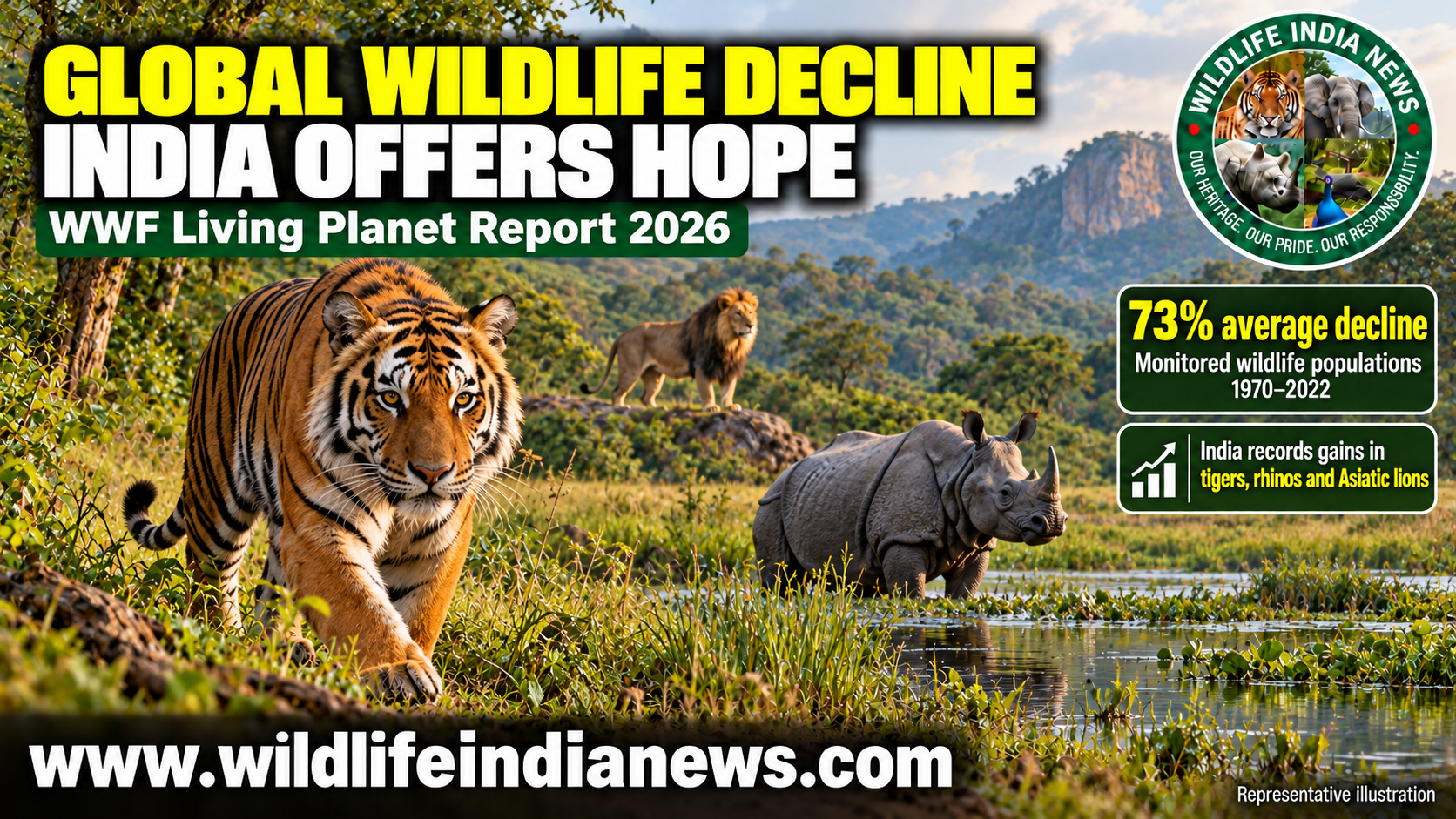
The world has witnessed a substantial decline in wildlife over the past five decades, even as successful conservation programmes demonstrate that recovery is possible. WWF’s Living Planet Report 2026, titled The Science of Hope, records a 73% decline in the average size of monitored vertebrate wildlife populations between 1970 and 2022.
Against this global backdrop, India has recorded encouraging results for several species, including tigers, greater one-horned rhinoceroses and Asiatic lions. However, experts caution that these achievements must be supported by stronger habitat protection and conservation beyond national parks and sanctuaries.
What the Global Decline Actually Measures
The report draws on the Living Planet Index, compiled by the Zoological Society of London. Its latest assessment includes 35,803 population trends representing 5,790 species of mammals, birds, reptiles, amphibians and fish.
The 73% figure describes the average proportional change in monitored population sizes. It does not mean that 73% of all individual wild animals have disappeared, or that 73% of wildlife species have become extinct.
The index provides an important measure of wildlife abundance, but does not cover every species or capture every aspect of biodiversity.
Freshwater Wildlife Suffers the Steepest Decline
The global figures reveal substantial differences between ecosystems:
- Freshwater populations: an average decline of 85%.
- Terrestrial populations: an average decline of 69%.
- Marine populations: an average decline of 59%.
These findings underline the vulnerability of wildlife dependent on rivers, lakes and wetlands, alongside serious losses on land and in the oceans.
Regional Data Reveals Uneven Losses
The 2026 assessment records the following average declines in monitored wildlife populations between 1970 and 2022:
- Latin America and the Caribbean: 95%.
- Africa: 80%.
- Asia-Pacific: 49%.
- North America: 28%.
- Europe and Central Asia: 23%.
WWF cautions that the smaller declines in Europe and North America should be read in historical context: extensive damage to nature had already occurred before the index’s 1970 baseline.
India’s Wildlife Figures Provide Encouragement
Down To Earth’s coverage highlights several Indian wildlife assessments:
- Tigers: an estimated 3,682 in the 2022 national assessment.
- Greater one-horned rhinoceroses: more than 3,300.
- Leopards: an estimated 13,874 in the assessed range.
- Asiatic lions: 891 in 2025, compared with 674 in 2020.
- Snow leopards: an estimated 718 in India’s first national assessment.
- Ganges river dolphins: an estimated 6,324 across the surveyed range.
These figures come from different assessments and years. First-time estimates, such as those for snow leopards and river dolphins, establish valuable baselines; they do not, by themselves, demonstrate population growth.
Recovery Is Also Visible Elsewhere
The global picture includes important successes. WWF reports that wild tiger numbers increased by more than 70% between 2010 and 2025, from approximately 3,200 to around 5,700.
The report also highlights recoveries in green sea turtles, Atlantic and Pacific bluefin tuna, and southern African elephant populations. These examples show that sustained protection and coordinated action can reverse declines.
Around half of the populations included in the index are stable or increasing: 7% are stable and 43% are increasing. Nevertheless, the scale of losses among declining populations outweighs these gains, producing the strongly negative global result.
Habitat Loss Remains a Major Threat
Habitat destruction and degradation are the most frequently reported pressures on monitored wildlife populations. Other threats include overexploitation, climate change, pollution, invasive species and disease.
WWF argues that lasting recovery requires changes to the food, energy and financial systems driving these pressures. Protecting individual species will be insufficient if the wider conditions causing habitat loss remain in place.
India Must Protect Wildlife Beyond Reserve Boundaries
Experts consulted by Down To Earth identify the need for stronger conservation strategies for species living largely outside protected areas, including the Great Indian bustard, Indian wolf and foxes.
They also warn that human-wildlife conflict places a disproportionate burden on poorer communities. Conservation gains must therefore be accompanied by measures that protect livelihoods and help people coexist with wildlife.
Why the Unchanged Headline Figure Needs Careful Reading
The 2024 and 2026 reports both record a 73% global decline, but this does not establish that wildlife losses stopped between the two editions.
The latest index includes additional populations and species and extends the monitoring period to 2022. WWF cautions that successive editions are not directly comparable because their datasets change.
The central message is both urgent and hopeful: wildlife recovery is achievable, but sustaining it requires action across habitats, communities and the economic systems that shape nature’s future.
Sources: Down To Earth; WWF Living Planet Report 2026; WWF-US and WWF-UK report announcements; Zoological Society of London.
Leave a Reply