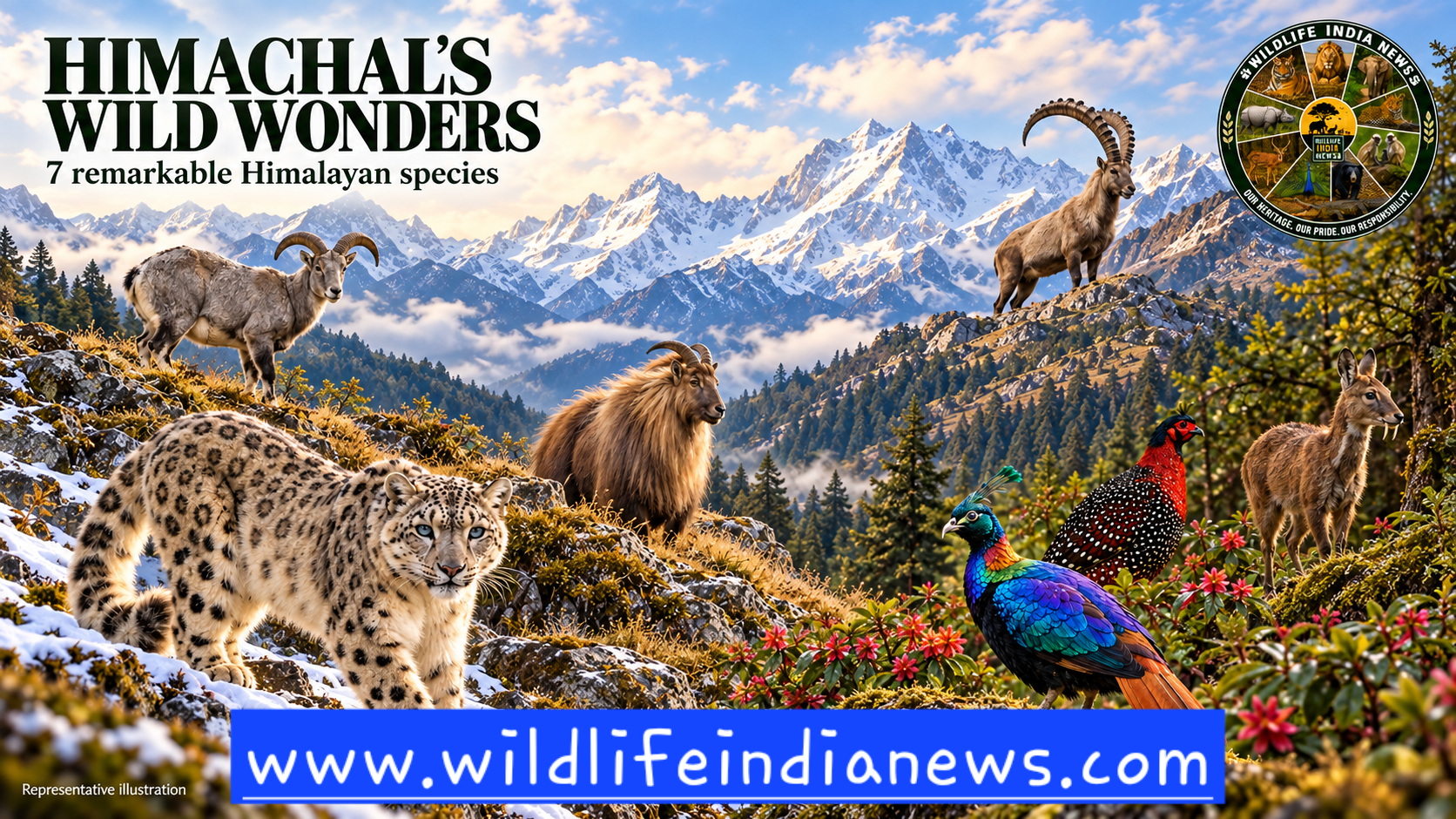
Himachal Pradesh’s wildlife changes with its landscape. Dense mountain forests give way to alpine meadows, rocky slopes and cold deserts, each supporting animals adapted to a different world.
A recent Indian Express feature highlights seven species that reveal this diversity—from the elusive snow leopard to colourful pheasants and sure-footed mountain herbivores.
Snow Leopard: The Elusive Mountain Predator

The snow leopard is among Himachal’s most captivating animals, associated particularly with the rugged landscapes of Spiti. Its pale, patterned coat blends into rocky surroundings, making an already secretive predator exceptionally difficult to spot.
Snow leopards prey on mountain herbivores, including bharal and ibex. Protecting them therefore requires conserving both their habitat and the animals on which they depend.
Himalayan Monal: Colour Among the Forests

The male Himalayan monal is unmistakable, with shimmering multicoloured plumage and a metallic green crest. Females have more subdued colouring.
These pheasants inhabit mountain forests and grassy slopes, digging for roots, tubers and other food. Their beauty makes them a highlight of Himalayan birdwatching.
Himalayan Ibex: A Cold-Desert Specialist

The Himalayan ibex is a wild goat associated with Himachal’s cold-desert terrain. Its presence adds another dimension to landscapes that can appear almost empty at first glance.
Watching these animals negotiate rugged ground offers a glimpse of the specialised wildlife that survives in the high mountains.
Western Tragopan: A Hidden Forest Treasure

The western tragopan is a striking pheasant known locally as Jujurana, meaning “King of Birds”. Males have prominent white spotting and vivid colour around the head and neck.
It favours dense mountain forests, including areas with bamboo undergrowth. The Great Himalayan National Park is an important stronghold for this elusive bird.
Bharal: The Blue Sheep of Rocky Slopes

Bharal, commonly called blue sheep, are characteristic herbivores of Himachal’s high-altitude terrain. Their importance extends beyond their own survival: they form part of the prey base supporting snow leopards.
The relationship between these animals illustrates how closely Himalayan wildlife is connected.
Himalayan Tahr: A Mountain Herbivore

The Himalayan tahr is another distinctive wild goat of the region. The Great Himalayan National Park supports this species across its varied mountain habitats.
Tahr, alongside other herbivores, help sustain large predators, linking the vegetation of mountain slopes to the wider food web.
Himalayan Musk Deer: A Secretive Forest Resident

Unlike the conspicuous pheasants, the Himalayan musk deer lives a largely solitary life amid thick vegetation. The Great Himalayan National Park describes it as inhabiting moist, densely vegetated gorges.
Its elusive habits make sightings difficult, but its presence is an important part of the region’s forest biodiversity.
Protecting a Connected Mountain Landscape
These seven species occupy different habitats and cannot all be expected in one place. Together, they show why conservation must encompass forests, alpine pastures and cold-desert landscapes.
Their appeal also carries a responsibility: wildlife encounters should leave animals undisturbed and their habitats intact.
Source credit: The Indian Express, October 4, 2026. Additional species background: Great Himalayan National Park and WWF India.
Leave a Reply