Another Major Milestone for Project Cheetah
India’s ambitious cheetah reintroduction programme has achieved another significant milestone, with an Indian-born female cheetah giving birth to five healthy cubs at Kuno National Park in Madhya Pradesh.
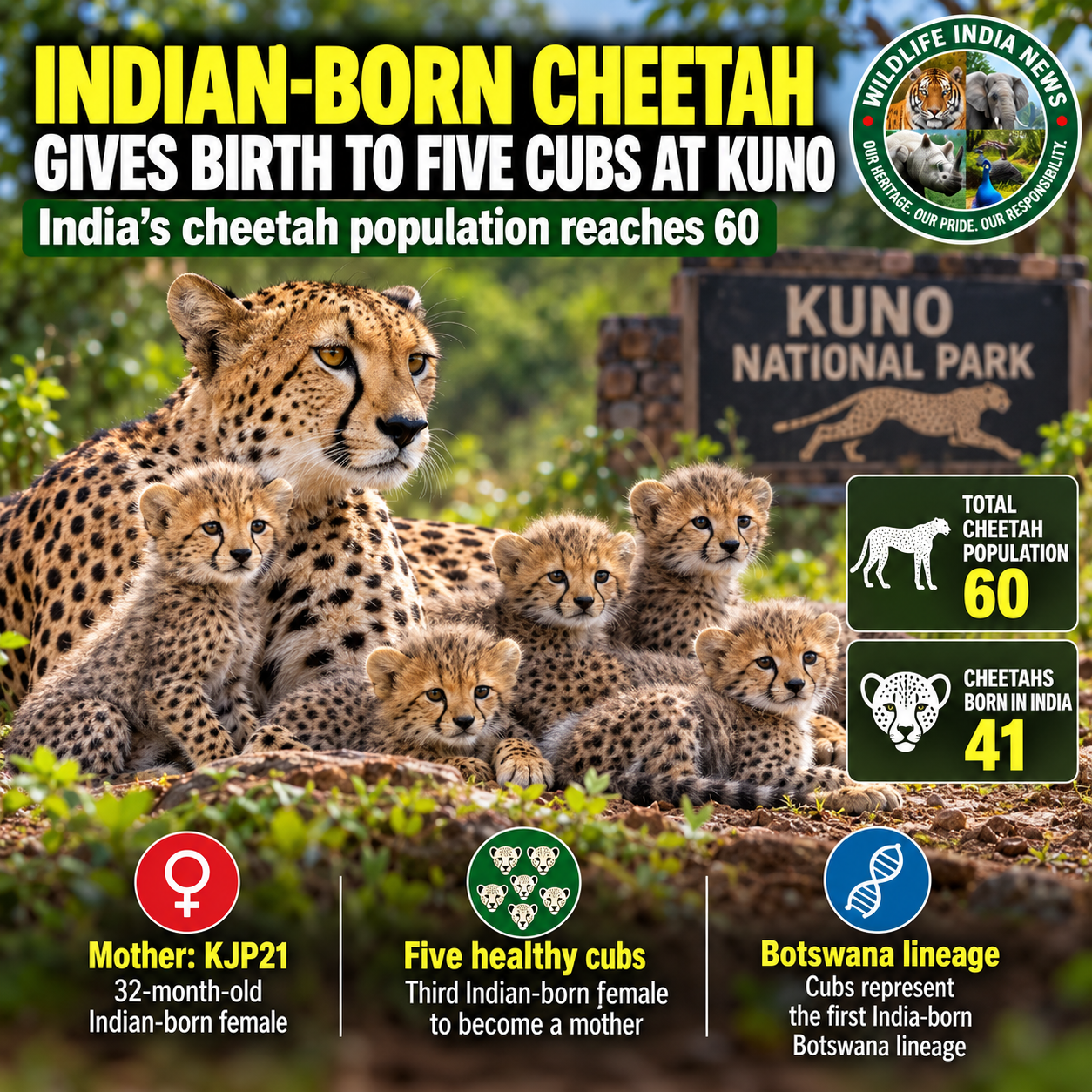
The mother, identified as KJP21, is a 32-month-old cheetah born on Indian soil. With the arrival of her five cubs, India’s total cheetah population has risen to 60, of which 41 have been born in India.
Third Indian-Born Female to Become a Mother
KJP21 has become the third Indian-born female cheetah to reproduce successfully, following Mukhi and KGP12.
The development is particularly important for Project Cheetah because it demonstrates that animals born after the reintroduction programme began are themselves reaching reproductive age and producing another generation.
This represents an important step towards the programme’s longer-term objective of establishing a breeding and eventually self-sustaining cheetah population in India.
Cubs Introduce Botswana Lineage in India
The five newborns carry another distinction. Their father is a male cheetah brought to India from Botswana, making these cubs the first India-born animals representing the Botswana lineage.
Union Environment, Forest and Climate Change Minister Bhupender Yadav said this adds a new genetic lineage to India’s growing cheetah population.
The genetic significance of the litter is important as India works to establish a viable founder population incorporating animals of different African origins.
India Now Has 60 Cheetahs
The latest births have pushed India’s cheetah population to a notable landmark:
Total cheetah population: 60
Cheetahs born in India: 41
The figures illustrate how breeding on Indian soil has increasingly become an important component of the country’s restored cheetah population.
From Reintroduction to a New Generation
Project Cheetah began with the historic arrival of eight cheetahs from Namibia in September 2022, more than seven decades after the cheetah became extinct in India. A second group subsequently arrived from South Africa.
The programme has faced significant challenges, including deaths of adult cheetahs and cubs. But repeated successful breeding at Kuno has also demonstrated that the African cheetahs can reproduce under Indian conditions.
The birth of cubs to females that were themselves born in India is especially noteworthy because the project is gradually moving beyond simply maintaining translocated African animals towards creating successive generations born in India.
Kuno Team Congratulated
Bhupender Yadav described the latest births as a major milestone for Project Cheetah and congratulated the veterinarians, field staff, managers and others involved in the programme.
Madhya Pradesh Chief Minister Mohan Yadav also welcomed the development, describing it as a proud moment for Project Cheetah and India’s efforts to restore the species.
A Significant Step in India’s Cheetah Comeback
The arrival of KJP21’s five cubs carries significance beyond the increase in numbers.
An Indian-born cheetah has now produced another generation on Indian soil, while the Botswana parentage introduces an additional lineage into the population.
The immediate priority will be the survival and healthy development of the newborn cubs. The early months remain a particularly vulnerable period for young cheetahs, making continued monitoring by the Kuno management and veterinary teams crucial.
If the cubs continue to thrive, their birth will represent another important step in India’s long-term effort to establish a viable cheetah population decades after the species disappeared from the country’s wilderness.
Source: ANI, Ministry of Environment, Forest and Climate Change/PIB and other reports.
Leave a Reply