Srinagar, Jammu & Kashmir | October 3, 2026
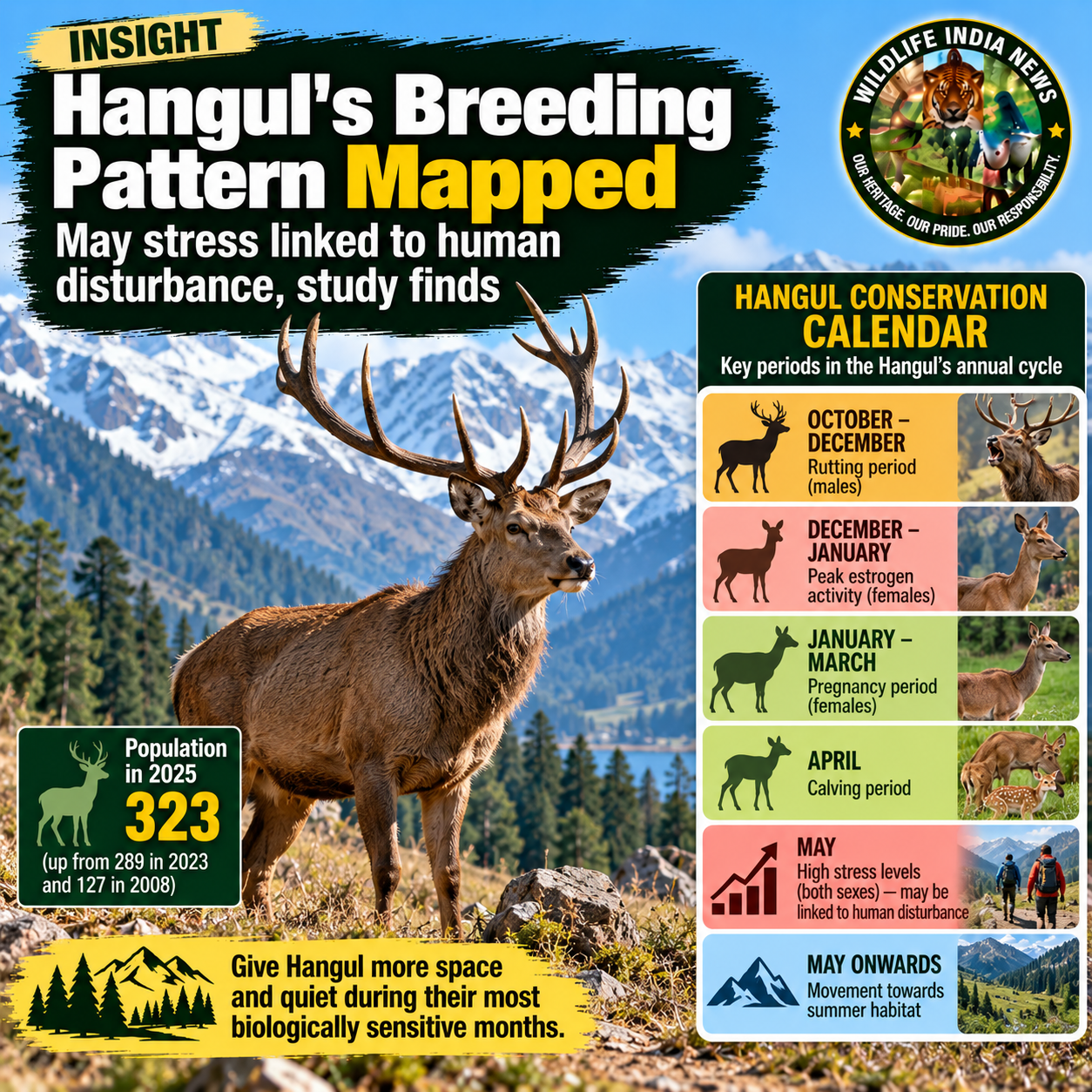
The Hangul has survived hunting, habitat loss, fragmentation and decades of pressure in the Kashmir Valley. Its numbers are now showing signs of recovery: the 2025 census counted 323 animals, up from 289 in 2023 and just 127 in 2008. Yet a new understanding of the animal’s biology suggests that simply increasing its numbers may not be enough.
Scientists have effectively produced a biological calendar for the Kashmir stag — identifying when males enter the rut, when females become pregnant, when calves are born and when physiological stress reaches its highest levels.
The implications extend well beyond academic interest.
They could tell wildlife managers when Hangul habitat most needs to be left undisturbed.
Scientists Read Hormones From 1,172 Droppings
Studying reproduction in a critically endangered wild deer presents an obvious problem: repeatedly capturing animals to collect biological samples would itself create stress.
Researchers therefore used a remarkably unobtrusive alternative — faeces.
Scientists from the Laboratory for the Conservation of Endangered Species at the CSIR-Centre for Cellular and Molecular Biology and collaborators monitored 11 permanent trails in lower Dachigam National Park between September 2019 and August 2020.
They collected 1,172 fresh faecal samples. Of these, 539 were identified as female and 333 as male; another 300 could not reliably be assigned a sex and were excluded from the relevant analysis.
By measuring metabolites associated with estrogen, progesterone, testosterone and glucocorticoids, the researchers reconstructed the animals’ reproductive and stress cycles without having to capture them.
It is the first physiological profile of reproduction and stress in wild Hangul.
October to December: The Stags Enter the Rut
For males, the reproductive calendar was comparatively clear.
Testosterone increased during autumn and early winter, with October to December emerging as the principal rutting period and November as the peak.
Stress hormones rose alongside reproductive hormones.
That is not necessarily surprising. Hangul are polygynous: males compete with one another for access to females during the rut, and that competition itself carries considerable physiological cost.
Anyone who has watched a mature Hangul stag during autumn knows how dramatically its behaviour changes. The rut is the season of calling, displaying, guarding females and confronting rival males.
For conservation purposes, however, the important message is simple:
October–December is not an ordinary period in the Hangul’s year.
Disturbance during these months occurs when successful mating will help determine the next generation.
Females Follow a Different Calendar
The females produced a more intriguing result.
Unlike some northern red-deer populations with tightly synchronised reproductive seasons, female Hangul showed a much more dispersed estrous period.
Estrogen metabolites peaked around December and January, but some non-pregnant females continued showing indications of estrus considerably later.
Researchers suggest the difference may partly reflect the Hangul’s environment and feeding ecology. As a mixed feeder living at a comparatively lower latitude than many northern red-deer populations, Hangul can have access to suitable food for a longer part of the year.
In other words, Kashmir’s stag does not simply follow the reproductive timetable of its European relatives.
It has evolved a calendar suited to Kashmir.

April: The Next Generation Arrives
Progesterone patterns provided another crucial clue.
Levels increased from January through March, consistent with pregnancy, before falling sharply in April.
The researchers interpret that decline as indicating that April is the principal period for calving.
That timing makes ecological sense.
Vegetation productivity rises rapidly during spring and peaks around May–June, providing females with better nutrition precisely when mothers and growing calves need it.
It is an elegant evolutionary arrangement: birth and spring growth are timed to meet.
But it is also a vulnerable arrangement.
If changing climate alters vegetation cycles, or disturbance prevents females from using the best feeding and calving areas, the biological synchronisation between birth and food could potentially be disrupted. The study identifies such environmental change as an important conservation concern rather than establishing that this disruption is already occurring.
Then Comes May — and a Mysterious Stress Spike
Perhaps the most important finding comes immediately after the main birthing period.
Researchers detected a pronounced increase in glucocorticoid metabolites — used as an indicator of physiological stress — in both males and females during May.
For females, some increase can be associated with late pregnancy and parturition.
But males were not reproductively active at that time.
So why were they stressed too?
May is also when Hangul begin moving towards their summer habitats — and when migratory livestock herders move towards higher elevations with sheep, goats and guard dogs.
The coincidence is striking.
But it must be interpreted carefully.
Human Disturbance Is a Suspect — Not Yet a Proven Cause
It would be tempting to conclude that livestock and people are responsible for the May stress peak.
The researchers themselves are more cautious.
Their study was designed primarily to examine reproductive physiology; it did not explicitly measure human disturbance in a way that establishes causation.
They therefore describe disturbance associated with migratory herders, livestock and dogs as a possible explanation requiring further investigation.
That distinction matters.
The science currently tells us:
Hangul stress rises sharply in May. Human and livestock activity in their summer landscape also increases around this period. The two coincide, but the study does not prove that one causes the other.
Previous research indicating that Hangul have shifted their summer habitat towards comparatively lower elevations in response to disturbance makes the question particularly important to investigate.
The Conservation Calendar Is Becoming Clear
Put the findings together and an extraordinary picture emerges:
October–December: principal male rut
December–January: peak female estrogen activity
January–March: pregnancy indicated in females
April: principal calving period
April–May: elevated stress associated with parturition
May: significant stress increase in both sexes
May onward: movement towards summer habitat overlaps with seasonal human, livestock and dog presence
For wildlife managers, this calendar provides something that population counts alone cannot: timing.
Protecting a species is not only about protecting where it lives.
Sometimes it means protecting when it needs to be left alone.
A Population of 323 Is Still Fragile
There is encouraging news.
The official 2025 census recorded 323 Hangul, compared with 289 two years earlier.
But 323 animals remain a very small population.
Hangul are now largely concentrated in Dachigam National Park and adjoining landscapes, despite having historically occupied a much broader geographical range. Habitat fragmentation, limited connectivity, livestock pressure, free-ranging dogs and low recruitment have all been identified as conservation concerns.
For such a small population, protecting reproductive success becomes particularly important.
A disturbance that might have relatively little consequence for an abundant species can matter considerably when every successful pregnancy and surviving calf contributes to the future of a population numbering only a few hundred.
Conservation May Need ‘Quiet Seasons’
The study therefore points towards a relatively simple management principle:
give Hangul more space and quiet during their most biologically sensitive months.
The researchers specifically recommend minimising anthropogenic disturbance during mating and parturition and say their physiological baseline can also support future conservation-breeding programmes.
That could eventually inform decisions about tourism, grazing, infrastructure activity and other forms of disturbance in important Hangul habitat.
The objective need not be to remove people permanently from the wider landscape. More sophisticated conservation could instead recognise that the same activity may carry different ecological consequences at different times of year.
A road, trekking route, grazing area or construction activity that produces manageable disturbance in one season might become much more consequential beside a calving area in another.
INSIGHT: Hangul Conservation Is Moving From Counting Deer to Understanding Deer
For decades, one question dominated discussion of the Hangul:
How many are left?
That question remains essential.
But the new research allows conservationists to ask more sophisticated questions:
When do they mate?
When do females give birth?
When are they physiologically stressed?
Where do they move during those periods?
And what human activities overlap with those moments?
That represents an important evolution in Hangul conservation.
Population censuses tell us whether the species is recovering.
Physiology begins to tell us why it may—or may not—continue recovering.
The May stress peak now deserves targeted research that simultaneously measures Hangul hormones, livestock presence, dogs, tourism, human movement, habitat use and environmental conditions. Only then can scientists separate natural reproductive stress from stress associated with external disturbance.
But managers do not need to wait for every uncertainty to disappear before recognising the broader lesson.
For one of India’s rarest large mammals, space alone may not be enough.
Dachigam must provide the Hangul something equally precious:
undisturbed time.
Source: Kashmir Life, October 2, 2026; study published in Scientific Reports, “Establishing reproductive seasons for the conservation of the critically endangered Kashmir red deer Cervus hanglu.”
Leave a Reply