
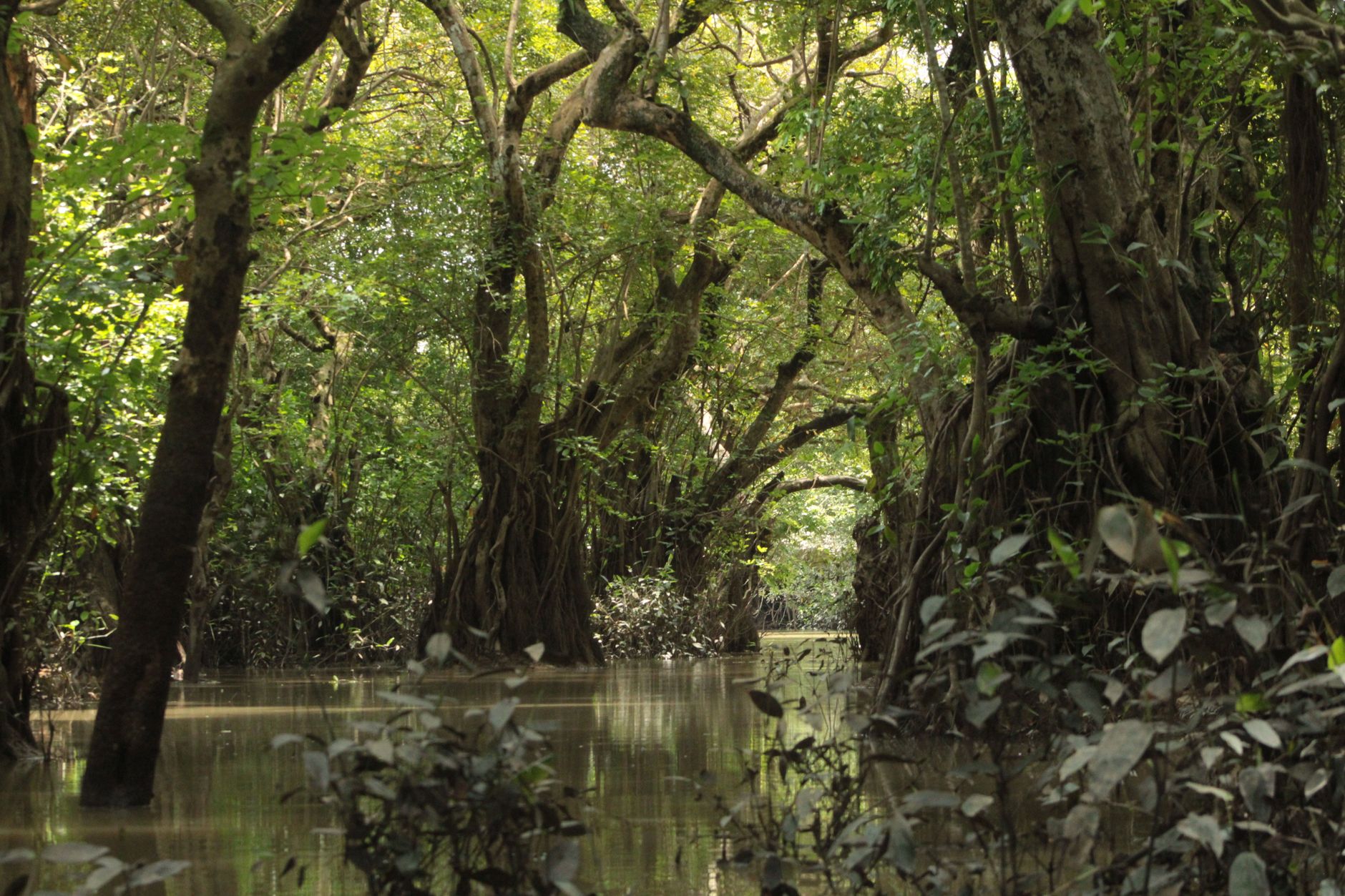
Sundarbans, West Bengal | September 30, 2026
Tigers inhabit forests, grasslands and mountainous landscapes across Asia. But there is only one mangrove ecosystem in the world where a wild tiger population survives and breeds—the Sundarbans.
Spread across India and Bangladesh in the Ganges-Brahmaputra-Meghna delta, the Sundarbans is also the world’s largest mangrove forest. UNESCO describes it as the world’s only mangrove forest inhabited by tigers.

Tigers Adapted to a Tidal World
The Sundarbans bears little resemblance to conventional tiger country.
Mangrove roots rise from saline mud, innumerable creeks divide the forest into islands, and large areas are inundated twice daily by tides. Riverbanks constantly erode while sediment creates new land elsewhere.
Yet the Royal Bengal Tiger (Panthera tigris tigris) has adapted remarkably well to this environment.
Perhaps its most striking adaptation is its relationship with water. Although all tigers are capable swimmers, Sundarbans tigers routinely swim across tidal channels and between islands as part of their normal movements.
UNESCO describes them as having adapted to an “almost amphibious life.”
An Unusual Menu
Spotted deer, wild pigs and rhesus macaques remain important prey for Sundarbans tigers. But their tidal environment also provides opportunities rarely associated with tiger diets.
UNESCO records Sundarbans tigers consuming fish, crabs and water monitor lizards, demonstrating their ability to exploit the resources of this unusual ecosystem.
Tigers Are Holding On
Monitoring tigers in the Sundarbans is exceptionally difficult because researchers must contend with tides, creeks, salinity, humidity and difficult access.
India’s 2022 national tiger assessment photo-captured 100 individual tigers across the Indian Sundarbans landscape.
During the 2024–25 monitoring exercise, camera traps photographed 81 tigers in the Sundarban Tiger Reserve and 20 in adjoining South 24 Parganas territorial forests, with one tiger detected in both areas. These photographic detections should not be treated simply as a final population estimate because further scientific analysis of the data is required.
More Than a Tiger Habitat

The Sundarbans supports an extraordinary mixture of terrestrial and aquatic wildlife, including estuarine crocodiles, Irrawaddy dolphins, Ganges river dolphins, marine turtles and the endangered northern river terrapin.
Mangrove waterways also act as nurseries for fish and other aquatic organisms.
The tiger therefore occupies the top of a remarkably interconnected food web in which land, river and sea meet.
Why Only the Sundarbans?
Mangrove forests occur across tropical regions of the world, including other parts of India. Yet none supports a resident wild tiger population today.
The Sundarbans lies within the tiger’s historic South Asian range and has retained an extensive mangrove wilderness with sufficient prey, vegetation, water and interconnected habitat to support a breeding population.
Its importance extends across an international boundary. Roughly two-thirds of the overall Sundarbans mangrove forest lies in Bangladesh and about one-third in India, making protection of this ecosystem inherently transboundary.
Tigers and People Share a Difficult Landscape
The same waterways used by tigers are also important to communities dependent on fishing, crab collection, honey gathering and other natural resources.
That overlap has produced a long history of human-tiger conflict.
Forest authorities consequently employ measures including patrolling, camera surveillance and nylon-net fencing along vulnerable forest boundaries to discourage tigers from entering settlements.
Protecting people living around the forest is therefore inseparable from protecting the tiger.

Climate Change: The Growing Threat
The Sundarbans faces another challenge that distinguishes it from most inland tiger habitats.
Much of the delta lies only slightly above sea level. Sea-level rise, increasing salinity, erosion, cyclones and changing sediment patterns can alter or destroy the islands on which tigers and their prey depend.
Mangroves themselves provide an important natural defence, reducing the impact of cyclones and storm surges on communities behind the forest. Protecting the Sundarbans therefore safeguards both wildlife habitat and people.
The World’s Mangrove Tiger

A Royal Bengal Tiger swimming across a Sundarbans creek represents one of the most remarkable examples of wildlife adaptation.
The same species that stalks deer through India’s dry forests and sal woodlands has learned here to negotiate saline creeks, mangrove roots, tidal mudflats and constantly shifting islands.
It swims between islands, hunts within the tidal forest and continues to reproduce in this demanding environment.
And that is what makes the Sundarbans globally exceptional:
Of all the mangrove forests on Earth, the Sundarbans alone supports a resident, breeding population of wild tigers.
Protecting it means conserving not simply another tiger population, but an ecological phenomenon that exists nowhere else in the world.
Source Credit: Press Information Bureau, Government of India; The Hans India; UNESCO World Heritage Centre; National Tiger Conservation Authority and Wildlife Institute of India.
Leave a Reply