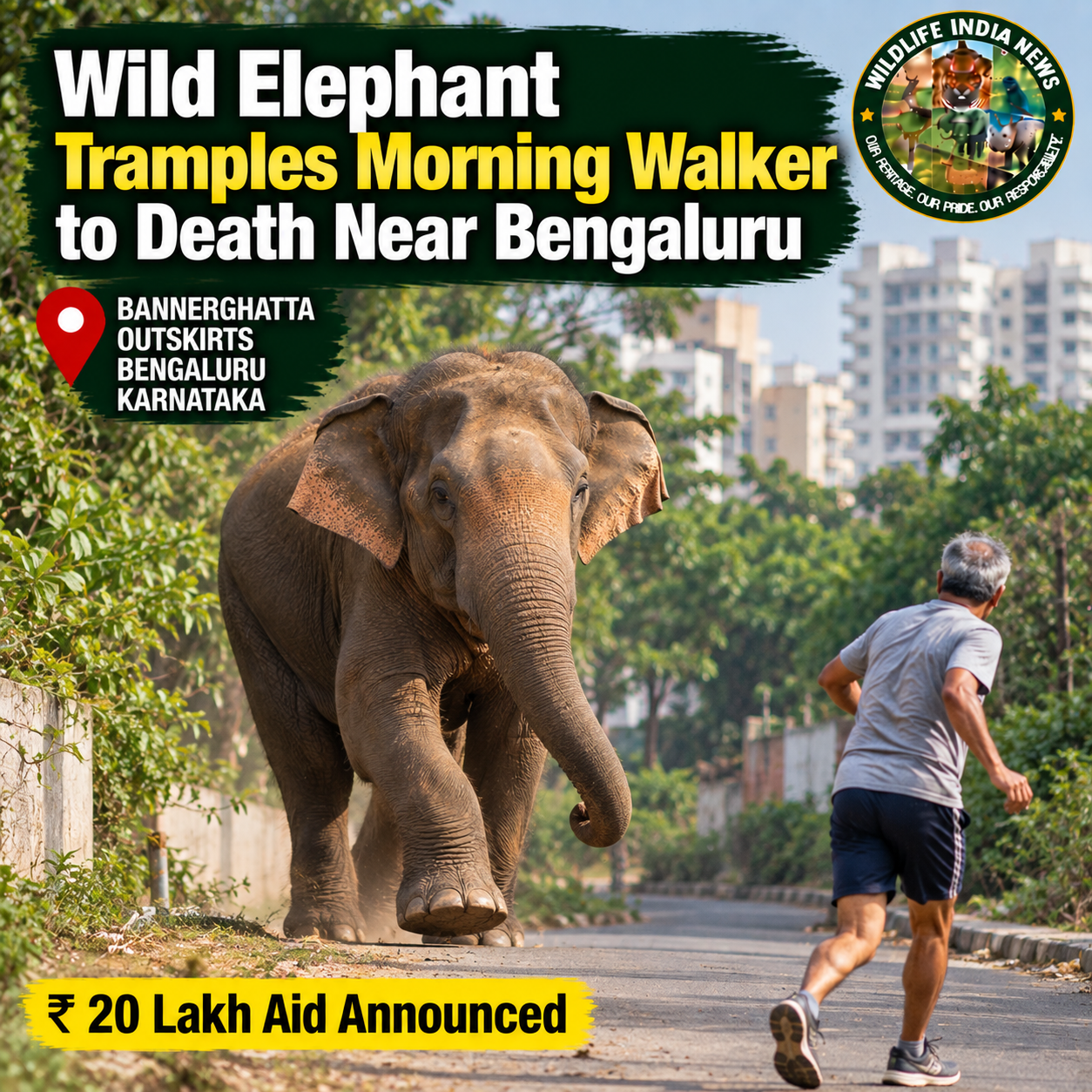
A 60-year-old man was killed after a wild elephant strayed several kilometres from the Bannerghatta forest landscape into a residential area near Mysuru Road. More than 100 forest personnel have now been deployed to track and capture the animal.
Bengaluru, Karnataka | September 28, 2026
A routine early-morning walk ended in tragedy on Monday when a 60-year-old man was attacked and killed by a wild elephant at Anchepalya, on the southwestern outskirts of Bengaluru.
The victim, identified as Nagaraj (also reported as Nagaraju), was returning from his morning walk when the elephant emerged near a residential area and attacked him. He was rushed to Rajarajeshwari Hospital, where he was declared dead.
The Karnataka government has announced ₹20 lakh compensation for his family, while the Forest Department has mounted a large-scale operation to locate and capture the elephant.
Morning Walk Turns Fatal
Nagaraj had gone for his regular morning walk at around 5 am along with his daughter Bhagya, according to Free Press Journal.
His daughter finished her walk earlier and returned home, while Nagaraj continued walking near Varahi Vivera Apartment.
The elephant reportedly emerged from bushes beside the road and attacked him. Security guards from the apartment complex noticed the incident and alerted nearby residents, who rushed him to hospital.
Another report places the attack at around 5.30 am behind Rajarajeshwari Hospital on Mysuru Road.
Elephant Had Strayed Close to Bengaluru
Forest officials believe the elephant moved out of the Bannerghatta forest landscape and travelled roughly five kilometres beyond the forest area before reaching the populated zone.
The animal has been described by officials as a makhna—a male Asian elephant that naturally lacks tusks.
Its appearance so close to densely populated Bengaluru is unusual. Forest officials told The Times of India that while elephant encounters occur in more interior parts of south Bengaluru, this was the first such human conflict involving an elephant so close to the city.
CCTV Captures Elephant’s Movement
CCTV footage from the locality provided important evidence of the elephant’s movements.
Surveillance footage reportedly showed the animal moving rapidly through the area shortly before the fatal encounter. Another morning walker had a narrow escape, passing through the same stretch only moments before the elephant arrived.
Residents have also reported elephants appearing near residential complexes in the area at night on previous occasions.
More Than 100 Forest Personnel Join Operation
Following the death, the Karnataka Forest Department launched a major operation to track and capture the elephant.
Around 100 forest personnel, including specialised teams, have been deployed. Teams from Bannerghatta, Ramanagara and Bengaluru are involved, and drone surveillance is being used to follow the animal’s movements.
Trained elephants from the Dubare Elephant Camp are also being brought in to assist the operation.
Forest Minister Ramalinga Reddy said the elephant had been traced to the BM Kaval area and that teams were monitoring its movements before attempting capture.
Residents have meanwhile been advised to avoid venturing into the affected area while the operation continues.
₹20 Lakh Compensation for Victim’s Family
Reddy visited the hospital and met members of Nagaraj’s family following the incident.
The state government subsequently announced ₹20 lakh in compensation for the bereaved family.
The incident also triggered anger among some residents, with family members and local people protesting and raising questions about measures to prevent elephants from entering populated areas.
An Old Elephant Landscape Now Surrounded by Development
The circumstances surrounding the attack point towards a much broader conservation problem.
According to the Free Press Journal, the Mysuru Road landscape between Pattanagere and BM Kaval has historically been used by elephants, but extensive residential development has taken place in parts of the area over the past 10–15 years.
Large patches of vacant land and the nearby BM Kaval forest still provide vegetation and cover.
The landscape is also connected with the Vrishabhavathi Valley, and elephants have reportedly moved through the region while accessing water.
As roads, apartment complexes and other development expand into such landscapes, traditional wildlife movement areas can increasingly intersect with places used intensively by people.
Bannerghatta’s Difficult Urban-Wildlife Interface
Bannerghatta represents one of India’s most striking examples of a major wildlife habitat existing immediately beside a huge metropolitan area.
The wider landscape supports Asian elephants, leopards and other wildlife, but Bengaluru’s continued outward expansion has created an increasingly complicated interface between forest habitat, agricultural land and urban development.
For elephants, maintaining connectivity between forest patches is particularly important because herds and solitary males can travel considerable distances.
When those movement routes become fragmented or surrounded by roads and settlements, encounters with people can become more frequent and more dangerous.
Capturing One Elephant Will Address the Immediate Threat — Not the Larger Problem
The immediate priority is understandably to locate the elephant and prevent another encounter.
But capturing this particular animal cannot by itself resolve the larger issue.
The death of Nagaraj highlights the need to identify and protect remaining elephant movement routes around Bannerghatta, improve early-warning systems for nearby communities and closely monitor animals moving towards densely inhabited areas.
Residents also need rapid alerts when elephants are detected near settlements—particularly because elephants moving before dawn or after dark can be extremely difficult for pedestrians to see.
For Nagaraj, Monday morning’s encounter proved fatal only a short distance from his home.
For Bengaluru, the tragedy is another warning that protecting people and conserving elephants will increasingly depend on how effectively the city manages the shrinking boundary between urban development and the wildlife landscape surrounding Bannerghatta.
Source Credit: Free Press Journal, “Wild Elephant Tramples Morning Walker To Death Near Bengaluru’s Bannerghatta, ₹20 Lakh Aid Announced,” September 28, 2026. Additional details cross-checked with The Times of India, India Today and Deccan Chronicle.
Leave a Reply