
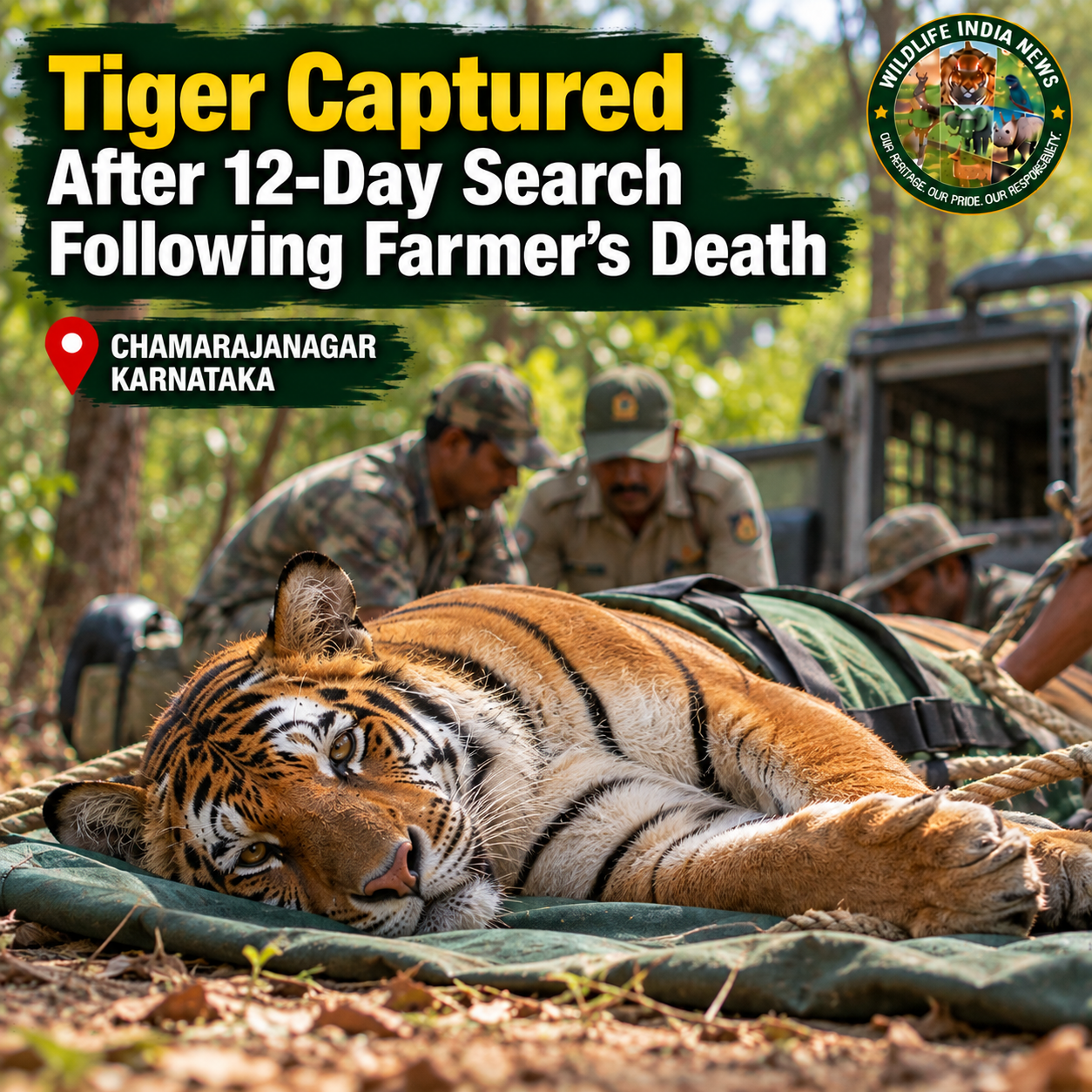
The five-year-old tiger was tranquilised near Tavarekatte Moole after an intensive operation involving 65 forest personnel, trained elephants and thermal drones. Officials suspect it may be the animal involved in farmer Basavanna’s death.
Chamarajanagar, Karnataka | September 27, 2026
A tiger has been successfully captured in Karnataka’s Chamarajanagar district after a 12-day search launched following the death of farmer Basavanna in a suspected tiger attack near the Biligiri Ranganathaswamy Temple (BRT) Tiger Reserve.
Forest officials tranquilised the tiger at around 6 am on Saturday, September 26, at Tavarekatte Moole, neighbouring Badagalapura village where the fatal incident had occurred. The animal is estimated to be around five years old, according to the main reports.
Farmer Killed While Working in Field
Basavanna was killed on September 14 while working in Badagalapura village in Chamarajanagar taluk, along the broader fringe landscape of the BRT Tiger Reserve.
Following the death, Forest Department teams began an operation on September 15 to locate the animal suspected of being responsible. Cameras and cages were installed around the attack site and adjoining forest areas as officials attempted to establish the tiger’s movements.
The search continued for nearly two weeks before the tiger was located and tranquilised at Tavarekatte Moole.
65 Forest Personnel Joined Operation
Capturing the tiger required a substantial operation.
Around 65 Forest Department personnel were deployed, supported by two trained elephants, Kanjan and Eshwara, two thermal drones, a veterinary officer and experienced tribal trackers. The operation was led by BRT Tiger Reserve Director and Deputy Conservator of Forests Shripathi B.
Thermal drones helped search for the animal while trained elephants allowed forest teams to operate through vegetation where approaching a tiger on foot could have been dangerous.
Is This the Tiger That Killed Basavanna?
Forest officials suspect that the captured tiger is the animal involved in Basavanna’s death, but the available reports do not establish that identification conclusively.
This distinction is important. A tiger being found in the vicinity of a conflict incident does not by itself prove that it was responsible for a particular attack.
One contemporaneous report describes the captured animal as a male estimated at six to seven years old, whereas other reports put its age at around five.
Tiger Shifted to Mysuru Rehabilitation Centre
After being tranquilised and secured, the tiger was transported to the Koorgalli rehabilitation centre in Mysuru.
The transfer was carried out following directions from the Principal Chief Conservator of Forests (Wildlife), Bengaluru. The animal will remain under observation and monitoring at the facility.
Tigers Increasingly Seen Outside BRT Boundary
The episode comes amid concern over tiger movements through villages and agricultural landscapes surrounding BRT Tiger Reserve.
Earlier this month, reserve authorities reported that a tigress with two cubs and a male tiger had been moving outside the reserve boundary. Camera traps and drones had recorded big-cat movements in fringe areas, while livestock kills were also being reported.
Forest officials have identified another unusual factor that may be contributing to the problem: abandoned farmland.
Agricultural plots left uncultivated for 10–15 years in some villages have developed thick vegetation. Officials say these areas can provide cover for prey as well as predators. Abandoned stone quarries containing accumulated water may provide additional wildlife habitat. Such sites have reportedly been identified around at least 12 villages.
Growing Challenge Beyond Protected Forests
The Chamarajanagar episode illustrates an increasingly important challenge for tiger conservation: what happens when tigers move beyond the boundaries of protected areas.
A tiger entering a mosaic of farms, scrubland, abandoned fields and villages can be extremely difficult to locate. At the same time, farmers continuing their normal agricultural activities may unknowingly find themselves close to a concealed big cat.
The 12-day operation following Basavanna’s death demonstrates how difficult managing such situations can become. Forest authorities must protect villagers while also capturing a legally protected predator without unnecessarily injuring it.
In this instance, the combination of camera surveillance, thermal drones, trained elephants, experienced trackers and a veterinary tranquilisation team eventually allowed the animal to be captured alive.
For communities around BRT Tiger Reserve, however, the larger challenge remains: reducing potentially dangerous encounters as tigers increasingly use landscapes where forest, farmland and human habitation meet.
Source credit: News Karnataka — “Chamarajanagar tiger rescued 12 days after farmer’s death”; reporting cross-checked with The Times of India
Leave a Reply