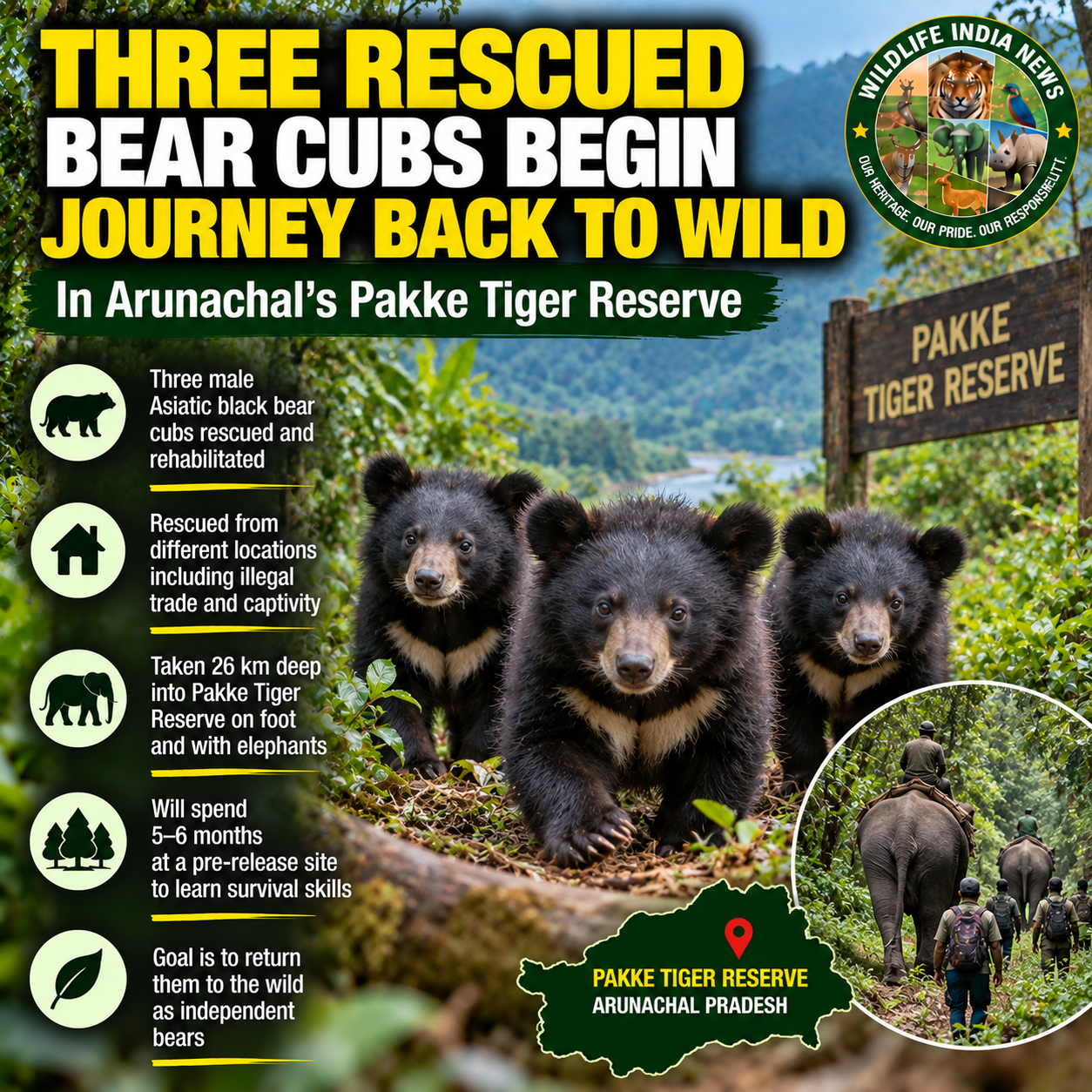
The three orphaned male cubs have been moved deep inside Arunachal Pradesh’s Pakke Tiger Reserve, where they will spend the next five to six months learning to live independently before their final release into the wild.
Pakke Tiger Reserve, Arunachal Pradesh | September 26, 2026
Three rescued Asiatic black bear cubs have entered a crucial new stage in their rehabilitation, beginning a carefully managed return to the wild inside Arunachal Pradesh’s Pakke Tiger Reserve.
The three male cubs were transferred on September 24 from the Centre for Bear Rehabilitation and Conservation (CBRC) to a pre-release site inside the tiger reserve. Rather than being released immediately, they will undergo a “soft-release” programme intended to gradually prepare them for independent life in the forest.
A 26-Kilometre Journey Into Pakke
Getting the young bears to their new home is itself a significant operation.
A joint team from the Wildlife Trust of India (WTI) and Arunachal Pradesh’s Department of Environment, Forest and Climate Change is accompanying the cubs on a 26-kilometre journey deep into Pakke Tiger Reserve.
The difficult journey is being undertaken partly on foot and partly with elephants to reach the designated acclimatisation site.
Pakke Tiger Reserve DFO Dhawan Kumar Rawat described the transfer as an important step in taking the young bears from rescue and rehabilitation towards an eventual return to their natural environment.
Three Cubs, Three Different Rescue Stories
Each of the bears arrived at the rehabilitation centre under different circumstances.
The first cub was rescued in late March when it was only about four to five weeks old. Reports say the animal was recovered after individuals were allegedly attempting to sell it.
The second cub, approximately one month old, was found alone in an agricultural field and handed over to the Forest Department by a local resident.
The third cub was rescued in June when it was around two to three months old. Authorities traced the animal after discovering a social-media post indicating that it was being kept as a pet.
Without intervention, cubs of such a young age would have little chance of surviving independently.
Why They Cannot Simply Be Released
Rescuing an orphaned bear cub is only the beginning.
Young Asiatic black bears normally spend a long period with their mothers, during which they learn how to find natural food, navigate forests, recognise threats and survive without assistance.
WTI’s rehabilitation programme attempts to reproduce some of that learning process while minimising the cubs’ dependence on people.
Earlier this year, WTI explained that its rehabilitation protocol includes hand-raising very young animals, gradually shifting them to natural diets and exposing them to forest environments so that their survival instincts can develop before release.
Five to Six Months of Forest Training Ahead
The three cubs will now spend approximately five to six months at the pre-release site.
During this period they will gradually explore the surrounding forest under the supervision of wildlife specialists and experienced animal keepers.
WTI veterinarian Dr Panjit Basumatary said the objective is for the animals to become fully acclimatised and eventually capable of surviving independently.
The process is deliberately gradual.
Instead of suddenly transferring captive-reared animals into an unfamiliar forest and leaving them to survive, soft release gives them time to become accustomed to their surroundings while trained personnel can still monitor their progress.
Keeping Wild Bears Wild
One of the most important challenges in raising orphaned wildlife is preventing animals from becoming excessively accustomed to people.
A bear that associates humans with food or security may have difficulty living independently and could eventually become involved in human-wildlife conflict.
The rehabilitation process therefore aims to provide necessary care while allowing the cubs to develop the behaviours they will need as wild animals.
The goal is straightforward but demanding: the bears should ultimately no longer need their human caregivers.
Pakke’s Long-Running Bear Rehabilitation Programme
The three cubs are being rehabilitated through the Centre for Bear Rehabilitation and Conservation, located near Pakke Tiger Reserve.
Established in 2002, CBRC is described by WTI as India’s first specialised rehabilitation centre for Asiatic black bears. It is operated through a partnership involving the Arunachal Pradesh Forest Department, WTI and the International Fund for Animal Welfare.
The centre was specifically created to give displaced and orphaned bear cubs an opportunity to return to the wild rather than spend the rest of their lives in captivity.
WTI currently says nearly 60 bears have been successfully rehabilitated and returned to the wild through the programme.
Asiatic Black Bears Face Multiple Threats
The Asiatic black bear (Ursus thibetanus) occurs across the Himalayan and northeastern regions of India.
WTI identifies hunting, trade in bear body parts, habitat destruction and human-bear conflict among the threats facing the species. In Arunachal Pradesh, orphaned cubs sometimes reach authorities after being confiscated from hunters or surrendered by people who had kept them.
The species is listed as Vulnerable on the IUCN Red List and receives Schedule I protection under India’s Wild Life (Protection) Act.
Rescue Will Be Complete Only When the Bears Can Survive Alone
Moving the cubs into Pakke is an encouraging milestone, but it should not yet be confused with their final release.
Over the coming months, wildlife specialists will assess how successfully the animals adapt to forest conditions and whether they develop the skills required to survive independently.
Only when the team considers them ready will the bears make the final transition to an independent life in the wild.
For three cubs that began their lives separated from their mothers — including animals reportedly caught up in the illegal wildlife trade and captivity — the 26-kilometre journey into Pakke represents something much larger.
It is the beginning of their transformation from rescued animals dependent on human care back into truly wild bears.
Source credit: . Additional information cross-checked with and The Arunachal Times.
Leave a Reply