India’s tiger recovery is creating a new conservation challenge. In some of the country’s most productive reserves, tiger densities are high and young animals are increasingly dispersing into farms, villages and territorial forests. Yet large areas of potentially suitable tiger habitat elsewhere remain thinly populated or empty. The emerging problem, therefore, is less that India as a whole has “too many tigers” and more that its tigers are unevenly distributed across a fragmented landscape.
Wildlife India News Special Report | September 25, 2026
For decades, the central question in Indian tiger conservation was straightforward: How do we prevent the tiger from disappearing?
Today, conservationists are confronting an almost opposite question.
What happens when tiger conservation succeeds so well in certain forests that there is no longer enough territorial space for all the tigers being produced there?
India’s tiger population has risen dramatically. The official national estimate increased from 1,411 in 2006 to 3,682 in 2022, although the NTCA also reports the 2022 estimate as 3,652 under one statistical presentation, with a range of 3,167–3,925. Crucially, approximately one-third of India’s tigers now occur outside tiger reserves.
Recent encounters — tigers appearing in villages, cattle sheds, agricultural fields and forest fringes — have brought the issue into sharper focus.
But does this mean India’s forests have reached their tiger carrying capacity?
At the national level, the evidence says no. In some individual reserves and landscapes, however, the answer may be much closer to yes.
Tigers Are Territorial — And That Changes Everything
A tiger reserve cannot simply accommodate an unlimited number of tigers because prey is abundant.
Tigers are territorial animals.
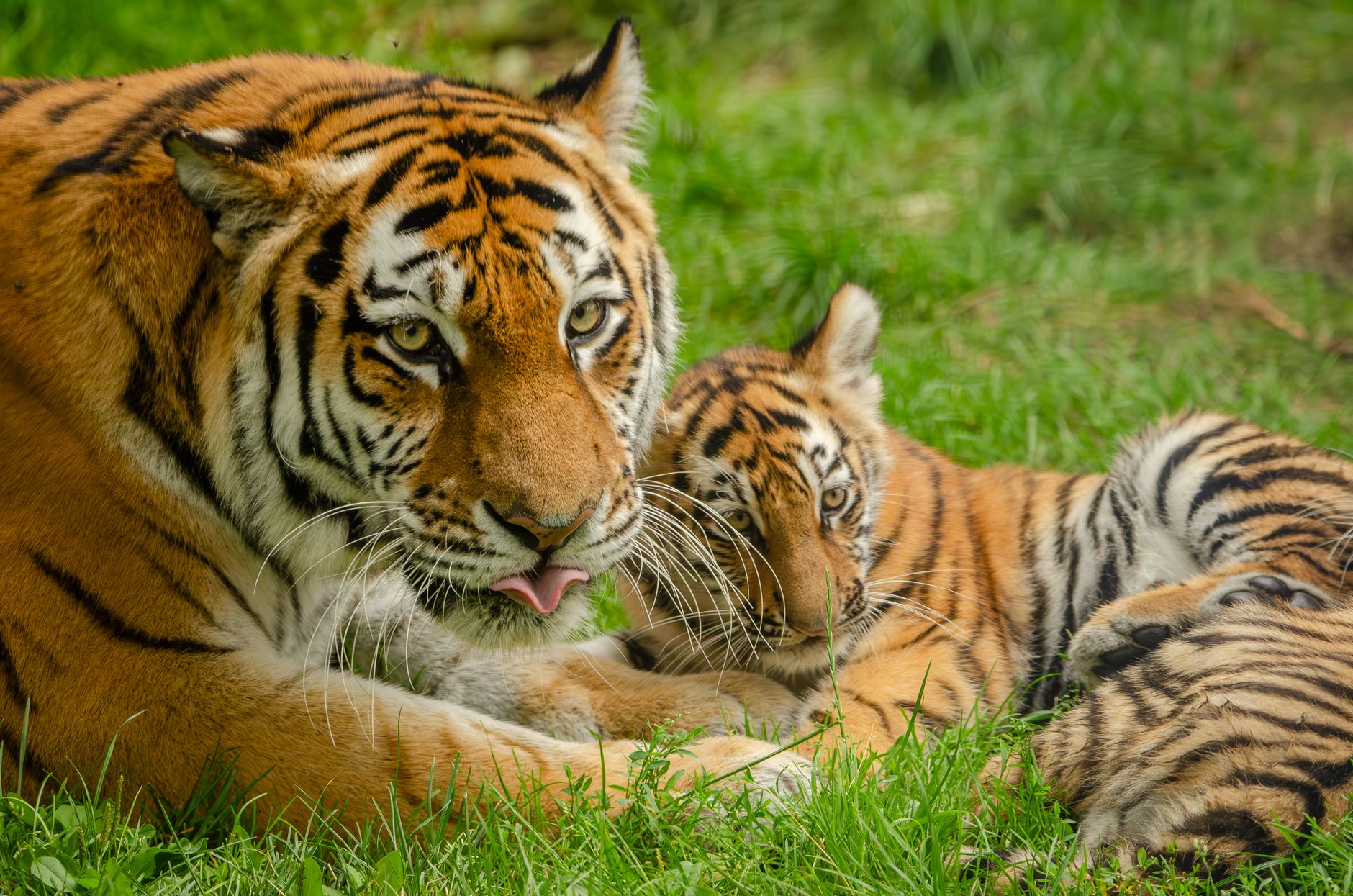
Adult females establish home ranges providing adequate prey and cover to raise cubs. Adult males generally occupy much larger territories overlapping those of several females and defend them against rival males.
When cubs grow into sub-adults, they eventually have to leave their mothers.
That is when dispersal begins.
A young tiger may travel tens or even hundreds of kilometres searching for vacant territory. If suitable connected forest exists, this is entirely natural and beneficial: dispersal establishes new populations and maintains genetic exchange.
The problem arises when a tiger leaves a crowded reserve and encounters highways, railway lines, canals, mines, farms, towns and densely populated villages instead of another connected forest.
What looks to people like a tiger “straying” may actually be a young animal doing exactly what tiger biology requires it to do.
Some Tiger Reserves Really Are Becoming Crowded
There is strong evidence that certain highly productive reserves are approaching their ecological limits.
Mongabay’s recent investigation cites former NTCA chairperson S.P. Yadav Mathur as saying that reserves such as Bandipur and Nagarhole in the Western Ghats are reaching their carrying capacity.
Bandipur, for example, was estimated to support roughly 154–175 tigers in 2024, according to NTCA figures cited by Mongabay.
These reserves contain productive forests, substantial prey populations and decades of intensive tiger protection.
That produces an inevitable biological consequence.
More surviving breeding females produce more cubs. More cubs survive to become sub-adults. Established adults occupy the best territories.
The younger generation must leave.
In this sense, tigers spilling out of a successful reserve can actually be a sign of conservation success rather than ecological failure.
But India Has Not Run Out of Space for Tigers
This is the critical distinction.
A handful of crowded reserves should not be confused with India’s entire tiger landscape reaching saturation.
The 2022 tiger assessment found expansion of tiger occupancy into territorial forest divisions of Madhya Pradesh and Maharashtra and warned that this expansion requires greater preparedness for negative human-tiger interactions.
At the same time, tiger occupancy declined in Jharkhand, Odisha, Chhattisgarh and Telangana. The assessment concluded that protected areas in these states retain potential for tiger recovery if prey, habitat and protection improve.
India therefore has a striking contradiction:
Some forests are producing more tigers than they can comfortably retain, while other forests capable of supporting tigers contain very few — or none.
India Has a Tiger Distribution Problem
This may be the most important conclusion.
Conservation biologist K. Ullas Karanth told Mongabay that India’s tiger population is extremely unevenly distributed.
He estimated that India potentially possesses habitat capable of supporting substantially more tigers than it does today, while suggesting that a large proportion of potential habitat remains vacant or supports very low tiger densities.
Whether any particular national maximum estimate ultimately proves correct requires detailed ecological assessment.
But the broad pattern is difficult to dispute.
At one end are landscapes such as parts of the Western Ghats and central India with strong tiger populations.
At the other are reserves and forests where tiger numbers remain extremely low despite potentially suitable habitat.
So India’s problem is not simply:
Too many tigers.
But if that tiger’s territory extends into villages containing thousands of people and livestock, the social carrying capacity may already have been exceeded even when ecological carrying capacity has not.
It is increasingly:
Many tigers concentrated in relatively few successful landscapes.
What Exactly Is “Carrying Capacity”?
The term is often misunderstood.
It does not mean that a forest suddenly becomes “full” when it reaches a predetermined number of tigers.
Wildlife Institute of India scientist K. Ramesh told Mongabay that carrying capacity should be considered in at least three dimensions:
Numerical carrying capacity — how many tigers a landscape can physically accommodate.
Ecological carrying capacity — how many tigers its prey, water, vegetation, territory and ecological processes can sustainably support.
Social carrying capacity — how many tigers can coexist in a landscape containing people before conflict and public intolerance become unacceptable.
That third dimension is becoming increasingly important in India.
A forest might biologically support another tiger.
There Is No Universal “X Tigers per 100 sq km” Rule
Tiger density varies enormously between habitats.
A prey-rich forest can support much smaller tiger territories than a dry or prey-poor landscape.
According to Ramesh, tiger home ranges may vary from approximately 20 to 200 square kilometres, depending on habitat quality and food availability.
That means calculating carrying capacity by simply dividing forest area by a standard tiger territory size can be misleading.
A 1,000-square-kilometre productive Terai or Western Ghats landscape cannot automatically be compared with 1,000 square kilometres of dry forest.
Prey density is often the fundamental currency of tiger carrying capacity.
More deer, wild pigs, gaur and other suitable prey generally allow more tigers to occupy a landscape.
Have We Made Some Reserves Artificially Too Productive?
This is a more controversial question.
Tiger reserves frequently undertake habitat-management measures intended to improve conditions for herbivores and consequently predators.
But intensive manipulation can have unintended consequences.
Mathur told Mongabay that excessive habitat manipulation could artificially increase prey populations and therefore predator density beyond the landscape’s natural carrying capacity. The consequences could include greater tiger dispersal into neighbouring human-dominated areas and increased territorial conflict among tigers themselves.
This does not mean habitat management should stop.
Rather, once a reserve approaches carrying capacity, management may need to shift from continually trying to increase tiger numbers toward maintaining ecological balance.
That represents a significant change in philosophy.
The One-Third Outside Reserves Figure Changes the Conservation Debate
Perhaps the most important statistic in this discussion is not India’s total tiger population.
It is this:
Approximately one-third of India’s tigers are already living outside tiger reserves.
That means tiger conservation can no longer be treated principally as the management of 58 isolated protected islands.
Tigers do not recognise reserve boundaries.
They move through reserve forests, territorial forests, revenue land, plantations, farmland and sometimes village outskirts.
The NTCA’s existing guidelines recognise this and call for wildlife concerns to be incorporated into tiger-bearing forests outside reserves, including corridor restoration, monitoring, anti-poaching work and human-wildlife conflict mitigation.
The government has also moved toward a dedicated Management of Tigers Outside Tiger Reserves initiative. Mongabay reports an allocation of ₹88.7 crore for monitoring, conflict mitigation, training, awareness and prey-management measures.
Corridors May Now Matter Almost as Much as Core Reserves
India spent decades protecting tiger source populations.
The next phase may depend increasingly on connecting them.
Imagine a productive tiger reserve as a reservoir filling with water.
As its population grows, surplus animals naturally disperse.
If a functioning wildlife corridor connects that reserve to another suitable forest, those animals can establish territories elsewhere.
If the corridor has been severed by development, however, the dispersing tiger enters farmland, highways and settlements.
The biological pressure to disperse remains.
Only the safe route has disappeared.
This is why protecting forest corridors between tiger populations has become critical.
Roads and Railways Can Turn Natural Dispersal Into Conflict
Infrastructure is particularly important.
A tiger leaving its natal territory may have to cross highways, railway tracks, canals or densely settled agricultural areas before reaching another forest.
Every broken corridor increases the probability of encounters with people.
It also increases risks to the tiger through vehicle collisions, electrocution, poisoning, retaliatory killing or capture.
Thus, an apparent “problem tiger” may sometimes be better understood as a dispersing tiger trapped in a badly connected landscape.
Why Don’t Tigers Simply Move Into Empty Reserves?
This seems like the obvious solution.
If Bandipur has many tigers while another reserve has almost none, why don’t the excess animals naturally move there?
Because the two forests may be hundreds or thousands of kilometres apart.
Tigers cannot teleport between suitable habitats.
An empty reserve surrounded by highways, settlements and degraded forest may be biologically suitable inside its boundary but effectively inaccessible to a dispersing tiger.
There may also be other reasons for low tiger numbers — depleted prey, poaching, livestock pressure, human disturbance or inadequate protection.
Simply having forest on a map does not make it viable tiger habitat.
Translocation Could Help — But It Is Not a Universal Solution
India has already experimented with moving tigers between landscapes.
The current programme to shift additional tigers from Corbett to Rajaji, for example, reflects the idea that animals from a strong source population can help rebuild a depleted population elsewhere.
Such interventions may have a role where habitat is suitable but natural recolonisation is difficult.
But translocation cannot compensate indefinitely for poor habitat.
Before moving tigers, managers need to establish that the destination has sufficient prey, protection, territory, community acceptance and long-term connectivity.
Otherwise, conservation merely moves the problem from one location to another.
More Tigers Outside Reserves Means More Human-Tiger Encounters
This is already becoming visible.
Mongabay reports that Karnataka recorded 30 tiger captures between September 2025 and May 2026. Most were subsequently released into the wild.
Such interventions raise difficult questions.
When should a tiger be captured?
When should it be allowed to continue dispersing?
When should it be relocated?
And when does repeated capture itself interfere with natural tiger ecology?
There cannot be one answer for every situation.
A tiger merely crossing farmland is fundamentally different from an animal repeatedly entering houses or one confirmed to have attacked people.
Management therefore needs to be based on the behaviour and circumstances of the individual animal rather than automatically treating every tiger outside a reserve as dangerous.
Tiger Conservation May Need a New Measure of Success
For decades, increasing tiger numbers was understandably regarded as the clearest measure of success.
India’s recovery from an estimated 1,411 tigers in 2006 to around 3,682 in 2022 is a major conservation achievement.
But continued success cannot be measured by numbers alone.
The next generation of tiger conservation may need to ask:
Are populations genetically connected?
Are prey populations healthy?
Can young tigers disperse safely?
Are empty habitats being restored?
Are local communities benefiting from conservation?
Are livestock losses compensated rapidly?
Are conflict-prone villages receiving adequate protection?
And are people willing to continue living alongside tigers?
A country could theoretically have more tigers while simultaneously creating a less secure future for them if social tolerance collapses.
So, Have Indian Forests Exceeded Their Tiger Carrying Capacity?
Not collectively.
Available evidence does not support the conclusion that India’s forests as a whole contain more tigers than they can support.
Instead, the country appears to have reached — or be approaching — carrying capacity in certain exceptionally productive source populations, while substantial potential tiger habitat elsewhere remains vacant or sparsely occupied.
That distinction changes the solution.
If India simply had too many tigers, the problem would be numbers.
But if India has too many tigers in some places and too few in others, the problem is distribution, connectivity, habitat quality and coexistence.
India’s Next Tiger Challenge
Project Tiger’s first great challenge was preventing extinction.
Its second was rebuilding tiger populations.
India is now entering a third and arguably more complicated phase:
learning how to manage the success it has created.
The tiger can no longer be conserved solely inside a tiger reserve.
The future lies in protecting entire landscapes — source populations, buffer forests, corridors, dispersal routes and the human communities through which some of those routes inevitably pass.
A tiger leaving a reserve is not necessarily evidence that conservation has failed.
Often, it means precisely the opposite.
The real warning sign is when that tiger has nowhere safe to go.
Source credit: , September 2026. National tiger-population and outside-reserve figures cross-checked against the and the .
Leave a Reply