Mandsaur, Madhya Pradesh | September 20, 2026
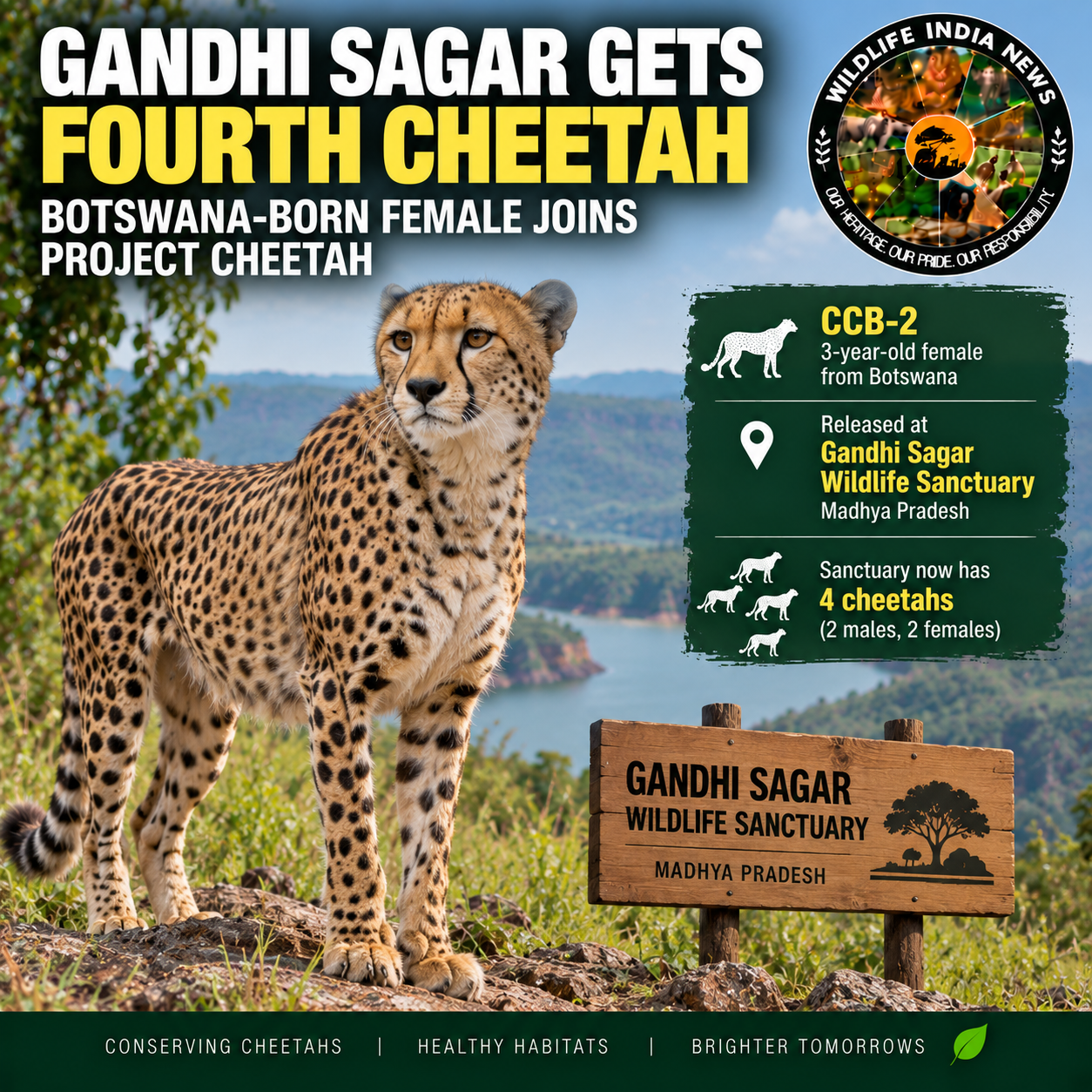
India’s cheetah reintroduction programme has taken another step forward with the arrival of a three-year-old female cheetah from Botswana at Gandhi Sagar Wildlife Sanctuary in Madhya Pradesh.
The cheetah, identified as CCB-2, was transferred from Kuno National Park and released into a soft-release enclosure by Chief Minister Mohan Yadav on Sunday.
Her arrival raises Gandhi Sagar’s cheetah population from three to four, strengthening efforts to establish the sanctuary as India’s second major cheetah conservation site.
A new female joins Gandhi Sagar
CCB-2 was among nine cheetahs brought from Botswana to Kuno National Park on February 28, 2026.
She is the first member of that group to be transferred to another Indian habitat.
Gandhi Sagar already houses three South African cheetahs: two males, Prabhas and Pawak, and a female named Dheera.
The two males were relocated from Kuno in April 2025, while Dheera arrived in September of the same year.
With CCB-2’s arrival, the sanctuary now has two males and two females.
Why was CCB-2 selected?
Project Cheetah officials had considered two candidates for the transfer: Nirva, a six-year-old South African female, and a younger female from Botswana.
CCB-2 was ultimately selected because of her younger age and the programme’s objective of broadening the genetic diversity of future cheetah generations.
Breeding between suitable, genetically distinct individuals is an important consideration in managing a small reintroduced population.
However, the presence of males and females in the same sanctuary does not guarantee successful breeding. Compatibility, health, reproductive behaviour and appropriate management will all influence the outcome.
Separate enclosures for careful monitoring
The sanctuary’s cheetahs are currently housed in separate soft-release enclosures.
The enclosures occupied by the Prabhas–Pawak coalition, Dheera and CCB-2 are approximately six to eight kilometres apart.
This arrangement allows officials to monitor the animals and manage their adaptation before deciding on further releases or introductions.
Gandhi Sagar, situated along the Madhya Pradesh–Rajasthan border, is being developed as a second cheetah habitat to reduce the programme’s dependence on Kuno National Park alone.
Project Cheetah enters its fifth year
The latest transfer comes just three days after Project Cheetah completed four years.
The programme began on September 17, 2022, with the arrival of eight cheetahs from Namibia. Subsequent groups arrived from South Africa in 2023 and Botswana in 2026.
A four-year status review released on September 17 reported 52 cheetahs in India, including 32 born in the country.
Following the birth of four cubs to India-born female KGP12 at Kuno on September 18, the reported national population increased to 56.
The transfer of CCB-2 changes the distribution of cheetahs between Kuno and Gandhi Sagar but does not increase the national total.
Building a second breeding population
The arrival of a second female gives Gandhi Sagar another opportunity to develop a breeding population.
The sanctuary’s long-term role will depend on whether cheetahs can adapt to the habitat, hunt successfully, reproduce and eventually establish a population capable of surviving with progressively less intensive management.
Its development is also part of a broader plan to establish cheetahs across multiple suitable landscapes rather than concentrating the entire population at Kuno.
For now, CCB-2 will remain under monitoring as she adjusts to her new surroundings.
The arrival of Gandhi Sagar’s fourth cheetah marks progress in expanding Project Cheetah. The next significant milestone will be successful breeding and the establishment of a stable, free-ranging population at India’s second cheetah habitat.
Source credit: The New Indian Express, September 20, 2026, with additional reporting from The Indian Express and the Free Press Journal.
Leave a Reply