New Delhi | September 13, 2026
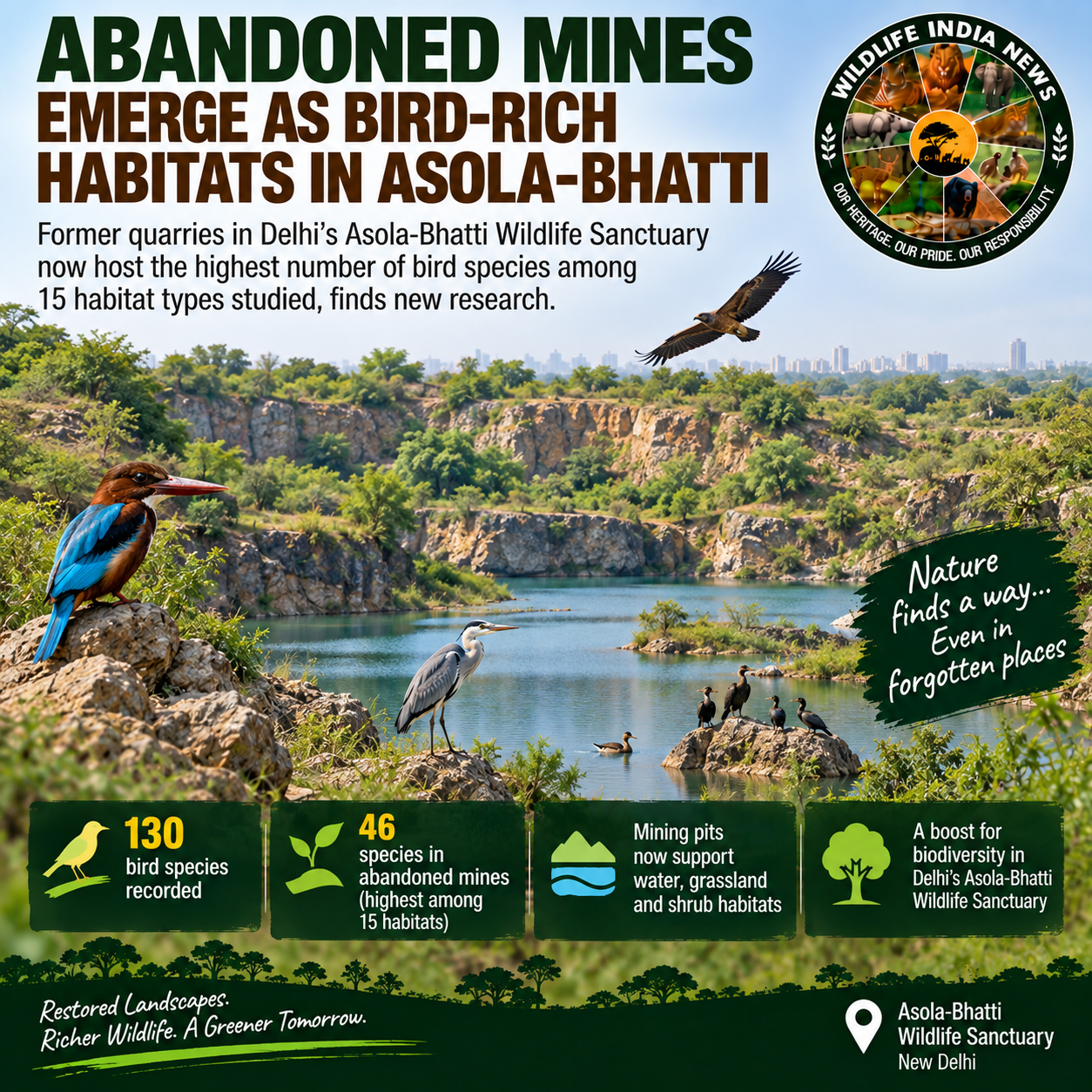
Once scarred by intensive mining, abandoned quarries inside Delhi’s Asola-Bhatti Wildlife Sanctuary are undergoing a remarkable ecological transformation. A new study by researchers from the Wildlife Institute of India has found that these former mining sites have become the most bird-rich habitat among 15 different habitat types studied in the sanctuary.
Researchers recorded 130 bird species belonging to 55 families and 20 orders during surveys conducted between January and December 2024. Most strikingly, the abandoned mining habitat was estimated to support around 46 bird species, narrowly ahead of Deep Lake, which supported around 45.
When mining stopped, nature returned
The transformation began after mining operations ceased.
Without constant excavation and other human disturbance, vegetation gradually returned to the damaged landscape. Shrubs and grasses colonised open areas, while some deep mining pits collected water and developed into permanent or seasonal pools.
The result is an unusual patchwork of water, exposed rock, open ground, grass and scrub vegetation.
Instead of being ecologically uniform, the abandoned mines now offer many different microhabitats within a relatively small area. That variety appears to be one of the main reasons so many different birds are able to use them.
Wildlife Institute of India researcher Parvaiz Yousuf told PTI that after mining stopped and human disturbance declined, vegetation began recovering and many mining pits filled with water.
Abandoned mines outperform other habitats
The researchers compared bird communities across 15 habitat types.
The abandoned mine habitat emerged on top with an estimated 46 species, followed closely by Deep Lake with about 45.
At the other end of the spectrum, areas dominated by the invasive Lantana camara supported an estimated 13 species, while sewage wetlands had around 15.
The researchers believe the richness of the old mines is associated with their recovering, or early-successional, condition.
A recovering quarry can simultaneously contain bare ground preferred by some birds, bushes used for shelter and nesting, grassland for insect-feeding species, rocky terrain for others and pools that attract water-dependent birds.
In effect, the scars left behind by mining have gradually developed into a complex mosaic of habitats.
130 species—but no single habitat supports them all
Another important finding of the study is that different parts of Asola-Bhatti support distinctly different bird communities.
Wetlands, native woodland, plantations, shrublands and even some human-modified areas each attracted different combinations of species.
That means protecting only the most species-rich abandoned mines would not be enough.
Researchers found that no single habitat contained the sanctuary’s entire bird community. Maintaining a diverse mosaic of grasslands, wetlands, scrub, rocky areas and native woodland is therefore critical to conserving Asola-Bhatti’s overall bird diversity.
Even Delhi’s urban edge supports birds
Asola-Bhatti occupies an unusual position on the southern edge of one of the world’s largest metropolitan regions.
The study found that even settlements, roads and other urban or semi-urban habitats could support more than 30 bird species.
But researchers cautioned against interpreting this as evidence that natural habitat can simply be replaced by urban landscapes.
Modified environments may support certain adaptable species, but they cannot substitute for native woodland, wetlands, grasslands and other natural ecosystems, particularly for birds with specialised habitat requirements.
A wildlife refuge beside a megacity
The importance of Asola-Bhatti extends well beyond the latest study.
Situated on the northernmost extension of the ancient Aravalli Hills, the sanctuary covers roughly 32 square kilometres and represents an important wildlife refuge within the heavily urbanised Delhi-Haryana landscape.
Previous surveys cited by the sanctuary authorities have documented around 250 bird species and two subspecies, including globally threatened raptors such as the Red-headed Vulture, Egyptian Vulture, Steppe Eagle and Greater Spotted Eagle. The sanctuary also supports mammals including leopards, striped hyenas, nilgai, golden jackals and jungle cats.
The new Wildlife Institute of India study should therefore not be interpreted as a complete inventory of Asola-Bhatti’s birds. Its 130 species represent those recorded during this particular year-long habitat study.
From ecological scars to wildlife habitat
Asola-Bhatti’s mining legacy was once among its greatest environmental problems.
Today, however, some of those same excavated landscapes are demonstrating nature’s ability to recover when destructive pressure is removed.
The Delhi Forest Department has also undertaken ecological restoration measures in former mining areas, including natural regeneration, native planting, invasive-plant management, grassland development and restoration of water bodies.
But the lesson from the latest research is not that mining is beneficial for biodiversity. Mining severely degraded these landscapes in the first place.
Rather, the important finding is what happened after mining stopped: reduced disturbance allowed natural succession to begin, while water-filled pits and recovering vegetation gradually created a surprisingly diverse landscape.
An important lesson in ecological restoration
The study provides an encouraging example for restoration projects elsewhere in India.
Severely disturbed land does not necessarily have to remain biologically impoverished forever. Given protection, time and appropriate management, even an abandoned industrial landscape can develop considerable ecological value.
The Wildlife Institute of India research was funded by the Delhi Forest Department as part of work towards an integrated management plan for Asola-Bhatti Wildlife Sanctuary.
For Delhi, the findings carry a particularly powerful message.
In a landscape surrounded by expanding roads, settlements and urban infrastructure, old mining pits that once represented environmental destruction are now providing refuge for dozens of bird species.
At Asola-Bhatti, nature has begun turning the scars of mining into habitat—and the birds have returned to claim it.
Source credit: Rediff/PTI; additional background from the Wildlife Institute of India and Delhi Forest & Wildlife Department.
Leave a Reply