Assam | September 13, 2026
One of India’s smallest mammals is becoming the centrepiece of an extraordinary conservation story in Assam.
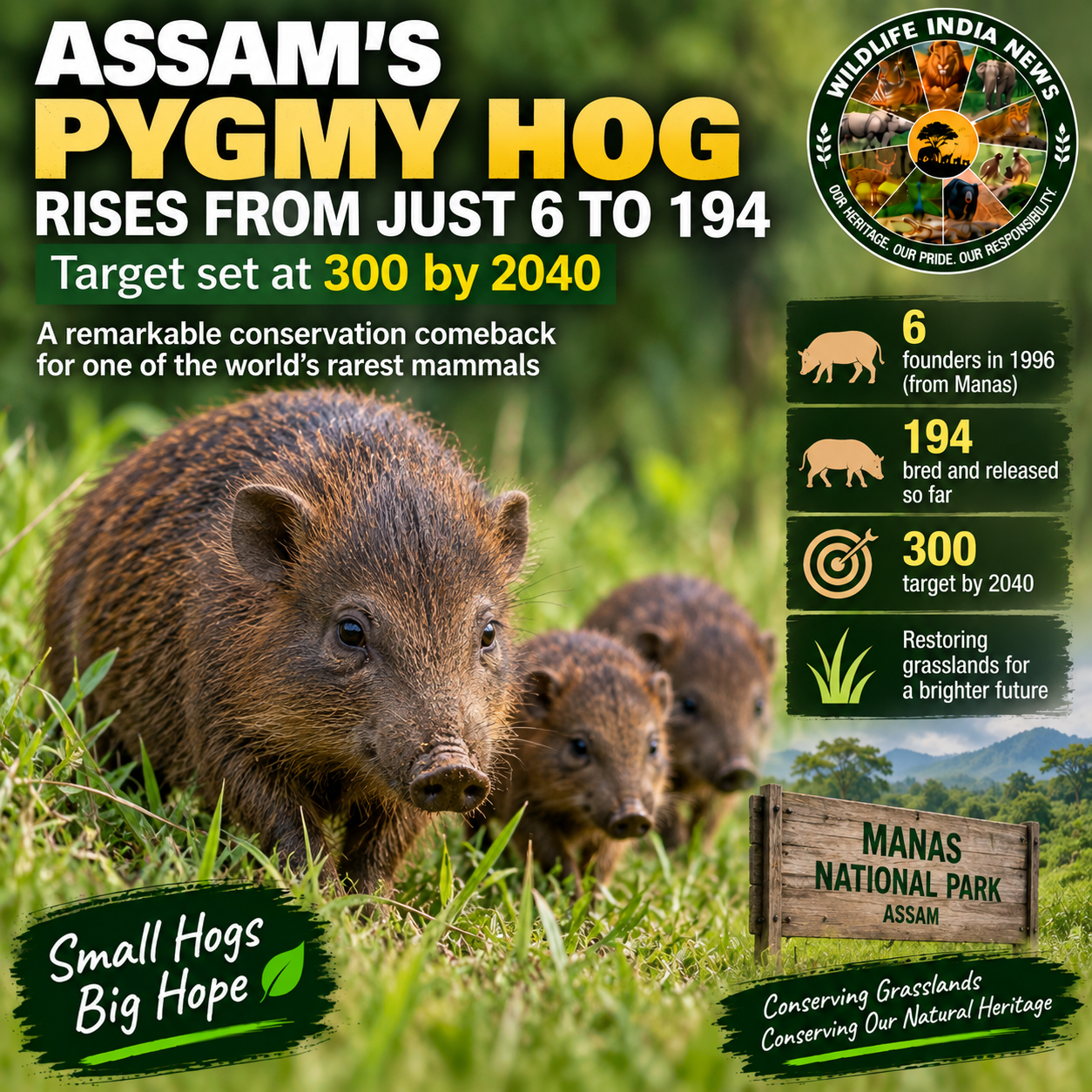
The pygmy hog (Porcula salvania), the world’s smallest and one of its rarest wild pigs, was once pushed perilously close to extinction. A conservation-breeding programme started in 1996 with just six animals—two males and four females—taken from Manas. Three decades later, the programme has successfully bred and released 194 pygmy hogs into protected grasslands of Assam, with conservationists now working towards a wild population of around 300 by 2040.
Assam Chief Minister Himanta Biswa Sarma highlighted the recovery on September 12, describing it as the result of decades of conservation and patience and setting the 300-animal target for 2040.
A species that came frighteningly close to disappearing
Pygmy hogs once occupied tall grasslands along the Himalayan foothills, but destruction and degradation of these habitats caused their range to collapse dramatically.
The species depends on dense, relatively undisturbed tall grassland. Dry-season burning, agricultural encroachment, settlements, flood-control measures and interaction with domestic livestock are among the pressures identified by conservation specialists.
By the 1990s, its survival had become so precarious that conservationists decided a captive population was essential.
In 1996, six wild pygmy hogs were collected from the Kuribeel grasslands of Manas to establish a conservation breeding population. Those six animals became the founders of a programme that would ultimately allow pygmy hogs to be returned to several protected landscapes.
Breeding was only the beginning
Saving the pygmy hog was never simply a matter of producing more animals in captivity.
The ultimate objective was to create self-sustaining populations in the wild.
Before release, captive-bred animals are prepared to survive independently. After release, conservation teams monitor them through methods including field signs, camera traps and radio telemetry. Earlier reintroductions demonstrated that released animals could reproduce and expand their populations in the wild.
Over the years, pygmy hogs have consequently been returned to suitable grasslands in Assam.
The conservation effort has now bred and released 194 animals, an extraordinary achievement for a programme that began with only six founders.
A special homecoming to Manas in 2026
One of the most significant moments in the programme occurred this June.
On June 7, 2026, 15 captive-bred pygmy hogs—nine females and six males—were released into the Kuribeel grasslands of Manas National Park.
The location made the release particularly symbolic.
Kuribeel is the same landscape from which the six founding animals had been collected approximately 30 years earlier. Pygmy hogs were therefore returning to the place where their modern conservation story began. No confirmed signs of the species had been recorded at the site for nine years.
The release brought the number of pygmy hogs released into Manas since 2020 to 78, while the overall number bred and reintroduced by the programme reached 194.
The next goal: 300 pygmy hogs by 2040
Conservationists are now looking beyond simply preventing extinction.
The long-term ambition is to establish a viable wild population of approximately 300 pygmy hogs by 2040.
Around 80 more animals are planned for release in Manas over the next five years, according to reporting on the conservation programme.
But increasing numbers alone will not guarantee the species’ future.
Its survival is inseparable from the survival of Assam’s grasslands.
Saving a hog means saving a grassland
Pygmy hogs are particularly valuable from a conservation perspective because they can serve as indicators of the condition of tall alluvial grasslands.
If these tiny mammals can survive, breed and establish populations, it suggests that the grassland ecosystem they depend upon is functioning sufficiently well to support them.
Those same grasslands are important for many other animals.
Restoring pygmy-hog habitat therefore has benefits extending far beyond a single endangered species. Conservation work in Manas has increasingly combined species recovery with grassland restoration, including efforts to improve native grass habitat.
That makes the pygmy hog’s comeback a story not just about captive breeding, but about rebuilding an ecosystem.
Three decades of cooperation
The recovery has required unusually sustained collaboration.
The Pygmy Hog Conservation Programme (PHCP) brings together the Assam Forest Department, Durrell Wildlife Conservation Trust, the IUCN SSC Wild Pig Specialist Group, Ecosystems-India and Aaranyak, with conservation work extending across breeding, reintroduction, monitoring and habitat management.
Such long-term commitment is particularly important for species recovery programmes because results may take decades rather than years.
The pygmy hog is a striking example.
In 1996, conservationists were working with only six wild founders and trying to prevent the disappearance of a species.
Thirty years later, their descendants are once again running through the tall grasslands of Assam.
Small animal, enormous conservation achievement
The pygmy hog will remain vulnerable as long as its grasslands remain under pressure. Releasing animals is therefore only part of the task ahead. Their habitats must remain large, connected and properly managed if the reintroduced populations are to become genuinely self-sustaining.
But the transformation is nevertheless remarkable.
A species once feared to be slipping towards extinction has been bred successfully, prepared for life in the wild and returned to landscapes from which it had disappeared.
From six founders in Manas to 194 pygmy hogs bred and released—and now a target of around 300 animals in the wild by 2040—Assam has demonstrated what patient, science-based conservation can accomplish.
For one of the world’s smallest wild pigs, it is an exceptionally big comeback.
Source credit: India Today NE, with additional information from the Pygmy Hog Conservation Programme, IUCN SSC Wild Pig Specialist Group and Durrell Wildlife Conservation Trust.
Leave a Reply