
September 7, 2026
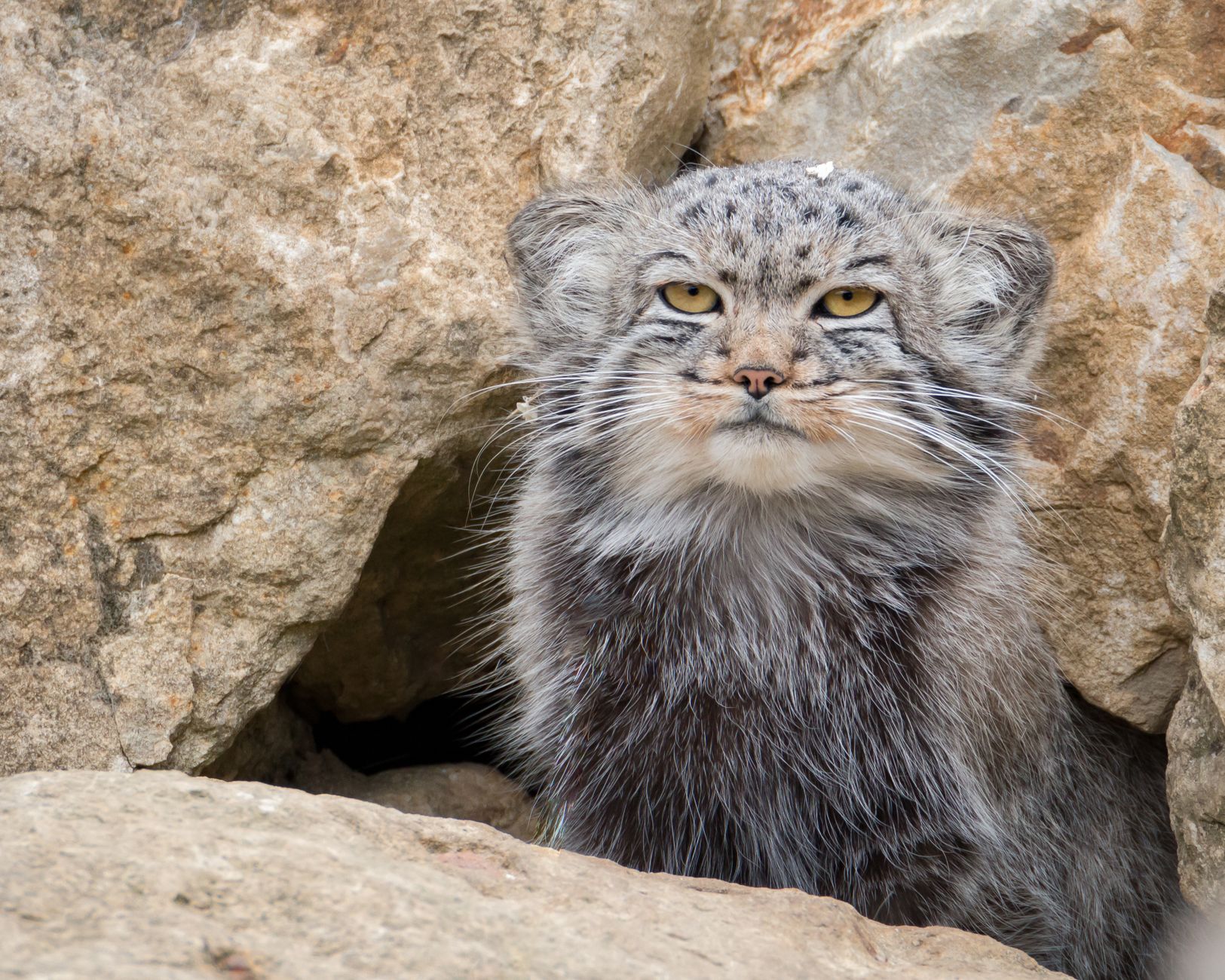
With its extraordinarily thick coat, round face, tiny ears and permanently stern-looking expression, the Pallas’s cat could easily be mistaken for an oversized domestic cat. But this remarkable little feline is a highly specialised wild predator capable of surviving in some of the coldest and most inhospitable landscapes of the Indian Himalayas.
Scientifically known as Otocolobus manul and also called the manul, the Pallas’s cat remains one of India’s least-studied wild cats. Recent camera-trap discoveries and genetic evidence are now gradually revealing that its Indian range is broader than once believed.
A cat built for life at 5,000 metres
Pallas’s cats inhabit cold, dry and largely treeless environments—rocky slopes, alpine grasslands, shrublands and high-altitude steppe.
Everything about their appearance helps them survive there. Their extremely dense coat provides insulation, while particularly long fur on the underside of the body protects them from the frozen ground. Their compact body and short legs help minimise heat loss, while their low-set rounded ears make them less conspicuous when moving among rocks.
Their greyish, buff-coloured fur also provides excellent camouflage against rocks and dry Himalayan vegetation.
Some Indian records have come from extraordinary elevations. A Pallas’s cat recorded on the Tso Lhamo Plateau in North Sikkim in September 2007 was observed at around 5,073 metres above sea level.
Ladakh: India’s best-known Pallas’s cat country
India’s first reported record of the species came from the upper Indus Valley in Ladakh in 1991. Subsequent observations have established Ladakh as the country’s best-known landscape for the species, particularly around areas such as Changthang and Hanle.
Yet even in Ladakh, scientists are still discovering previously undocumented populations.
In March 2026, researchers reported the first confirmed Pallas’s cat record from Karakoram Wildlife Sanctuary in northern Ladakh.
Intriguingly, they did not see or photograph the animal.
Instead, researchers collected a carnivore scat sample in Nubra Valley whose identity could not be established visually. Non-invasive DNA analysis subsequently confirmed that it belonged to a Pallas’s cat. The scat also contained remains of pika and Himalayan marmot.
The discovery extended the cat’s confirmed distribution farther north within Ladakh and demonstrated how genetic techniques can reveal species that conventional wildlife surveys may miss.
Camera traps reveal the cat in Himachal Pradesh
Another important discovery occurred in Upper Kinnaur, Himachal Pradesh.
Researchers conducting a snow leopard population survey installed 56 camera traps between March and May 2024. Instead of only photographing the animals they were primarily looking for, the cameras captured Pallas’s cats at three independent sites in Hangrang Valley.
The animals were photographed at elevations of approximately 3,900 to 4,100 metres, providing the first photographic evidence of Pallas’s cat in Himachal Pradesh.
It is an excellent example of how monitoring one elusive Himalayan predator can unexpectedly reveal another.
From Uttarakhand to Sikkim
Evidence has also accumulated elsewhere along the Himalayan arc.
In Nelang Valley in Gangotri National Park, Uttarakhand, researchers recorded a Pallas’s cat at approximately 4,800 metres, providing the state’s first record in a report published in 2019.
Farther east, the 2007 observation from the Tso Lhamo Plateau provided the first confirmed record for Sikkim.
Together with the records from Ladakh and Himachal Pradesh, these findings indicate that India’s high-altitude landscapes may support a considerably wider distribution of Pallas’s cats than the small number of observations might suggest.
Arunachal Pradesh produces another surprise
One of the biggest recent discoveries came from the extreme eastern Himalayas.
Between July and September 2024, WWF-India and the Arunachal Pradesh Forest Department deployed 136 camera traps at 83 high-altitude sites, surveying roughly 2,000 sq km across West Kameng and Tawang.
A camera trap photographed a Pallas’s cat at approximately 4,992 metres, providing the first photographic evidence of the species in Arunachal Pradesh.
The survey also documented an extraordinary collection of other felids, demonstrating the importance of these remote high-altitude landscapes for Himalayan carnivores.
Why is it so difficult to find?
The scarcity of Pallas’s cat records doesn’t necessarily mean that only a handful survive in India.
The problem is that the species is exceptionally difficult to study.
Pallas’s cats are small, solitary and superbly camouflaged. They occur naturally at relatively low densities and occupy vast, rugged landscapes where field surveys are extremely difficult.
Unlike the snow leopard—which has become one of the flagship species of Himalayan conservation—the much smaller Pallas’s cat has historically received relatively little dedicated research attention in India. Consequently, scientists still lack reliable information about its population size, distribution, movements and ecology in the country.
A patient hunter of the mountains
Despite its cuddly appearance, the Pallas’s cat is an accomplished predator.
Rather than pursuing prey across long distances, it generally relies on stealth and ambush.
Its principal prey includes pikas, rodents and other small mammals, although birds and reptiles may also be taken.
This makes healthy high-altitude grasslands particularly important. If populations of small mammals decline, the impact can move directly up the food chain to predators such as the Pallas’s cat.
Threats in a rapidly changing Himalaya
Living at extreme altitude does not insulate the species from human pressures.
Potential threats identified across its range include habitat fragmentation, livestock pressure, infrastructure development, mining, herding dogs, declining prey populations and indiscriminate rodent-control programmes.
Rodent poisoning could be especially problematic for a predator whose survival depends heavily on small mammals.
Development in Himalayan landscapes therefore presents a conservation challenge extending well beyond better-known species such as the snow leopard.
India’s forgotten Himalayan cat finally getting noticed
The emerging records from Ladakh, Himachal Pradesh, Uttarakhand, Sikkim and Arunachal Pradesh are beginning to transform our understanding of this elusive animal.
Camera traps are detecting animals that researchers rarely encounter directly. DNA analysis can confirm their presence even when no photograph exists. And surveys designed for snow leopards are simultaneously uncovering information about smaller and far less studied carnivores.
Yet the biggest unanswered question remains surprisingly basic:
How many Pallas’s cats actually live in India?
At present, science does not have a reliable answer.
That knowledge gap makes systematic surveys of India’s Trans-Himalayan and high-altitude ecosystems increasingly important. The Pallas’s cat may be exceptionally good at remaining invisible—but every new camera-trap image and genetic record suggests that India’s mountains still have wildlife secrets waiting to be discovered.
Source credit: Based primarily on Sriroopa Dutta’s September 6, 2026 report in The Better India, supplemented with published research and specialist sources on recent Indian records.
Leave a Reply