Srinagar | September 7, 2026
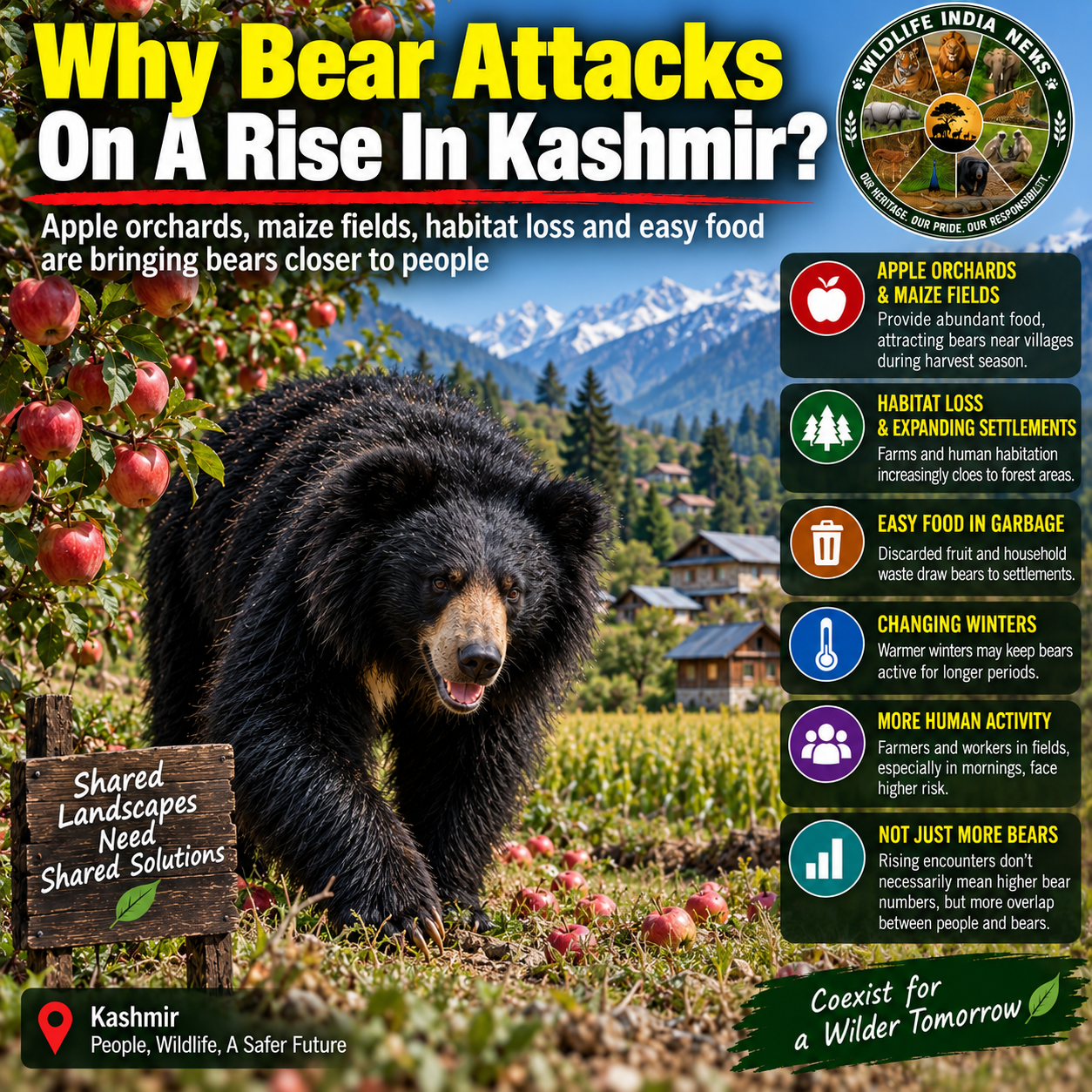
Bear encounters are becoming an increasingly serious concern across Kashmir, particularly in villages bordering forests and protected areas. But the explanation is more complex than simply assuming that there are more bears. A combination of apple and maize cultivation, shrinking or disturbed habitat, easily available food waste, expanding settlements and changing seasonal behaviour is bringing Asiatic black bears and people into contact more frequently.
Apple orchards and maize fields are becoming bear magnets
One of the clearest explanations lies in Kashmir’s changing rural landscape. Apple orchards and maize fields offer bears an abundant, calorie-rich food supply at precisely the time when the animals are feeding intensively.
Wildlife researcher and conservationist Kashif Farooq Bhat told Kashmir News Observer that discarded apples and other horticultural waste can draw bears towards villages. Maize, available during roughly the same season, provides another major attraction. Consequently, encounters become particularly frequent during the harvesting period.
The problem is especially pronounced where cultivation reaches the forest edge. Research and field observations indicate that maize grown in hilly areas adjoining forests is particularly vulnerable because bears can move quickly between natural cover and cropland.
The boundary between forests and villages is disappearing
The issue is not merely that bears are coming out of forests. In many places, human land use has moved closer to traditional bear habitat.
Former grazing areas surrounding protected forests have increasingly been converted into orchards, agricultural fields and settlements. This creates highly attractive feeding areas immediately alongside bear habitat and increases the chances of farmers, orchard workers and bears unexpectedly encountering one another.
Habitat disturbance and development around wildlife corridors further blur the distinction between human and bear landscapes. Conservationists describe this changing land-use pattern as an important underlying driver of the conflict.
Garbage provides another easy meal
Poor waste management adds to the problem.
Household garbage and horticultural waste—including apples rejected during sorting—are sometimes discarded in the open or along roads. For an opportunistic omnivore such as the Asiatic black bear, these become easily accessible food sources.
Once bears discover reliable food around settlements, they may repeatedly return to the same areas, increasing the likelihood of encounters with people.
Warmer winters may also be changing bear behaviour
There may also be a climatic dimension.
Asiatic black bears traditionally reduce their activity considerably during Kashmir’s coldest months. Conservationists, however, have reported signs of bears remaining active later into winter as snowfall becomes lighter or delayed in some years.
Field observers have reported winter pugmarks, scat and sightings around areas such as Dachigam. Shorter periods of winter inactivity potentially extend the part of the year during which bears and humans can encounter each other.
Why attacks often occur in the morning
The timing of human activity also matters. According to officials cited by KNO, many incidents occur during the morning hours when farmers and orchard workers arrive in fields.
Dense orchards can provide excellent concealment. A person entering an orchard may therefore approach a resting or feeding bear without knowing it is there. A surprised bear can respond defensively, turning an otherwise avoidable encounter into a serious attack.
A recent example involved 62-year-old Abdul Salam Teeli of Ahmadabad village in Kulgam, who was attacked after arriving at his apple orchard with family members. He suffered head injuries and required hospital treatment.
Conflict is widespread
The scale of the broader wildlife-conflict problem is considerable. Official figures cited in the report show 9,301 wild-animal attacks across Jammu and Kashmir in 2023–24, resulting in 18 deaths and 137 injuries. Another 6,360 incidents occurred in 2024–25, with 14 deaths and 213 injuries. These figures cover wild-animal attacks generally rather than bears alone, so they should not be interpreted as a bear-attack count.
Recent incidents illustrate how quickly localised bear conflict can intensify. In Khonmoh on Srinagar’s outskirts, for example, three bear attacks were reported within 24 hours in August. A wildlife official said corn fields and nearby habitation were factors attracting the animal.
Does this mean Kashmir has more bears?
Not necessarily.
This is an important distinction. An increase in reported encounters does not by itself prove that the Asiatic black bear population has increased.
Kashif Farooq Bhat cautioned that determining whether bear numbers are rising or falling requires scientific population estimation. More attacks could instead result from bears and people using the same places more frequently because of changing crops, food availability and habitat disturbance.
Managing the conflict
Authorities have established more than 50 wildlife-control rooms across Jammu and Kashmir, according to the KNO report. Equipment available across these facilities includes tranquilising and net guns, cages, protective equipment, camera traps, GPS devices, night-vision equipment, searchlights, drones and communication systems.
Long-term prevention, however, will require more than capturing individual bears. Better management of household and horticultural waste, protection of forest-edge habitat and wildlife corridors, safer agricultural practices and rapid-response systems are all likely to be important.
For residents, experts recommend avoiding solitary movement in high-risk areas, particularly around forest-edge orchards and fields; keeping surroundings illuminated where appropriate; properly disposing of fruit and household waste; and immediately contacting wildlife authorities when a bear is sighted rather than attempting to chase or surround it.
Ultimately, Kashmir’s rising bear conflict appears to be less a story of bears deliberately moving into human territory than of the boundary between the two becoming increasingly indistinct. Orchards, maize fields and settlements now offer food immediately alongside natural bear habitat. Add waste, habitat disturbance and potentially changing winters, and encounters become much more likely.
Reducing attacks will therefore depend on making that shared landscape safer—for both the people who depend on Kashmir’s orchards and fields and the Asiatic black bears that have inhabited its forests for generations.
Source credit: Based primarily on reporting by Umaisar Gull Ganie for Kashmir News Observer (KNO), published August 26, 2026, with additional context from recent reporting on Kashmir’s human-bear conflict.
Leave a Reply