Western Ghats | August 26, 2026
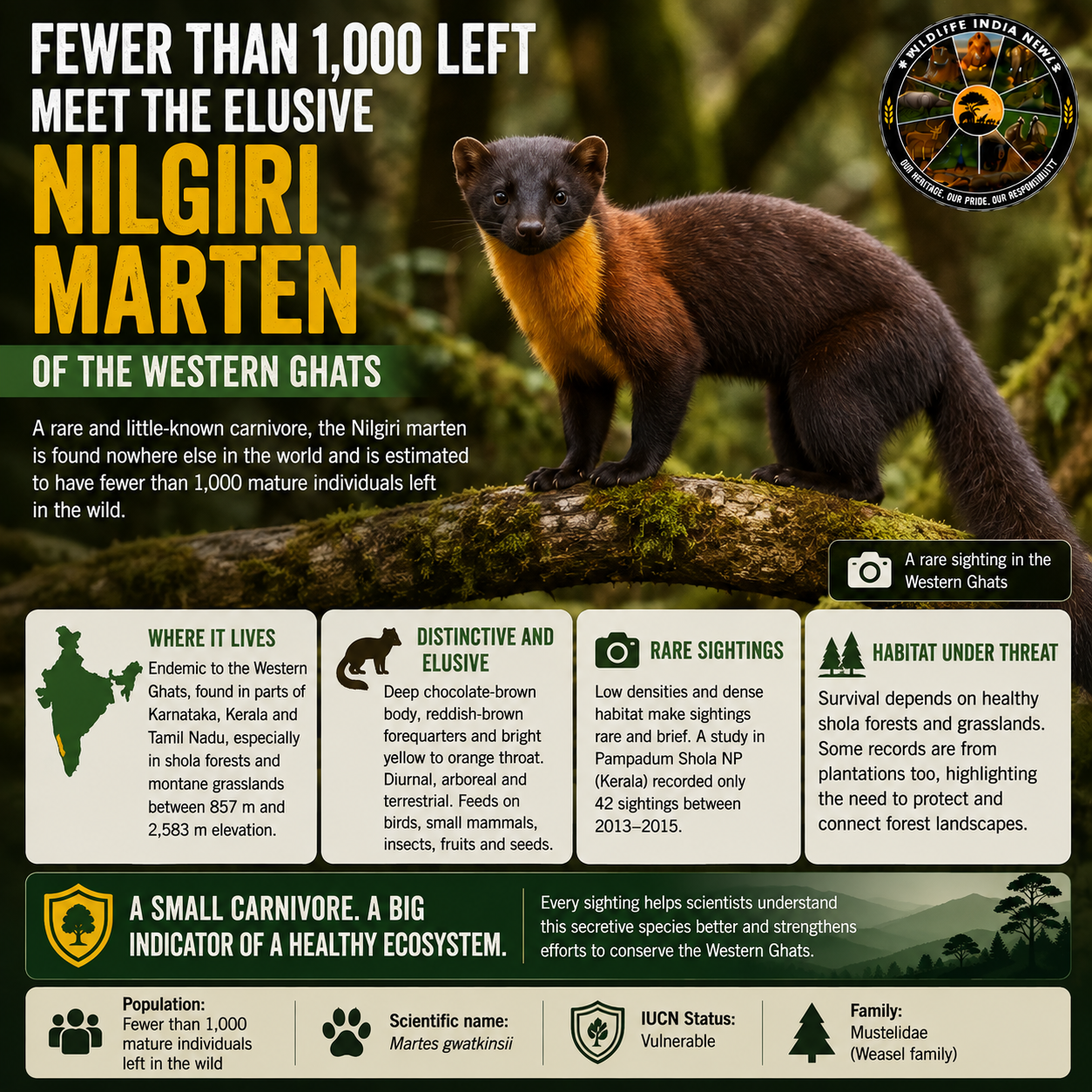
A recent photograph of the elusive Nilgiri marten (Martes gwatkinsii) has once again drawn attention to one of India’s least-known carnivores. Found nowhere else in the world, this rare mammal is closely associated with the high-elevation forests and grassland mosaics of the Western Ghats.
The species is estimated to have fewer than 1,000 mature individuals globally and is classified as Vulnerable by the IUCN. Despite its striking appearance and ecological importance, sightings remain uncommon, making every reliable record valuable for understanding its distribution and conservation needs.
A distinctive but elusive carnivore
The Nilgiri marten belongs to the weasel family (Mustelidae) and is the only marten native to southern India.
It has a distinctive deep chocolate-brown body, reddish-brown forequarters and a bright yellow-to-orange throat, making it relatively easy to recognise when seen clearly.
An adult typically measures around 55–65 cm from head to body, with a bushy tail adding another 40–45 cm. It weighs approximately 2 kg.
Unlike many carnivores that are active primarily at night, the Nilgiri marten is diurnal. It spends considerable time in trees but also moves along the forest floor while searching for food.
Its diet includes birds, small mammals and insects such as cicadas, while fruits and seeds also form part of its diet. This makes the species both a predator and a consumer of plant material within the forest ecosystem.
Strongly linked to shola forests
The Nilgiri marten’s survival is closely connected with the shola forests and montane grasslands of the Western Ghats.
A study that analysed 165 opportunistic records collected over a decade in the Nilgiris found that 67% of the records came from shola forest ecosystems and another 22% from grasslands.
The records covered elevations from approximately 857 metres to 2,583 metres, with most observations occurring around 2,000 metres.
These findings underline how important the high-altitude forest-grassland landscape is for the species.
Why sightings are so rare
The Nilgiri marten occurs at low densities and can move through dense vegetation without being detected.
Research at Pampadum Shola National Park in Kerala recorded 42 sightings between 2013 and 2015, but many encounters lasted less than a minute. Researchers have had to rely on a combination of direct observations, camera traps and reports from local observers to build a picture of the animal’s distribution and behaviour.
The scarcity of sightings does not necessarily mean the animal is absent from an area. Its secretive behaviour and difficult mountain habitat make it particularly challenging to survey.
Its range is limited
The Nilgiri marten is found only in parts of Karnataka, Kerala and Tamil Nadu, with the Nilgiri Hills forming an important part of its range.
Records have also been reported from areas including Charmadi Ghat, Neyyar Wildlife Sanctuary and Peppara Wildlife Sanctuary.
Recent research continues to add new records to the species’ known distribution, highlighting how much remains to be learned about this rare carnivore.
Habitat protection is crucial
The future of the Nilgiri marten is closely tied to the future of the Western Ghats’ remaining high-altitude forests and grasslands.
Importantly, not all sightings have occurred inside formally protected areas. The research cited by The Better India found that 11% of the 165 Nilgiri records came from plantations, while researchers also emphasised the need to survey and protect reserve forests adjoining Mukurthi National Park.
This makes landscape connectivity particularly important. Protecting isolated forest patches and maintaining connections between shola forests, grasslands and surrounding forest habitats could benefit the marten as well as numerous other species.
A small carnivore with a big conservation story
The Nilgiri marten may not have the public profile of a tiger, elephant or leopard, but its presence provides valuable information about the health of the Western Ghats’ mountain ecosystems.
Every confirmed sighting helps researchers understand where the species survives, what habitats it uses and how it responds to changes in its environment.
With fewer than 1,000 mature individuals estimated globally, protecting the remaining habitat of this secretive Western Ghats endemic is increasingly important.
The recent photograph is therefore more than an image of a rarely seen animal—it is a reminder that some of India’s most important wildlife stories involve species that remain almost invisible to the wider public.
Source credit: This story is based on The Better India’s report, “Fewer Than 1,000 Left: Meet the Elusive Nilgiri Marten of the Western Ghats,” by Sriroopa Dutta, edited by Vidya Gowri Venkatesh, published on August 26, 2026.
Leave a Reply