Dehradun, Uttarakhand | August 23, 2026
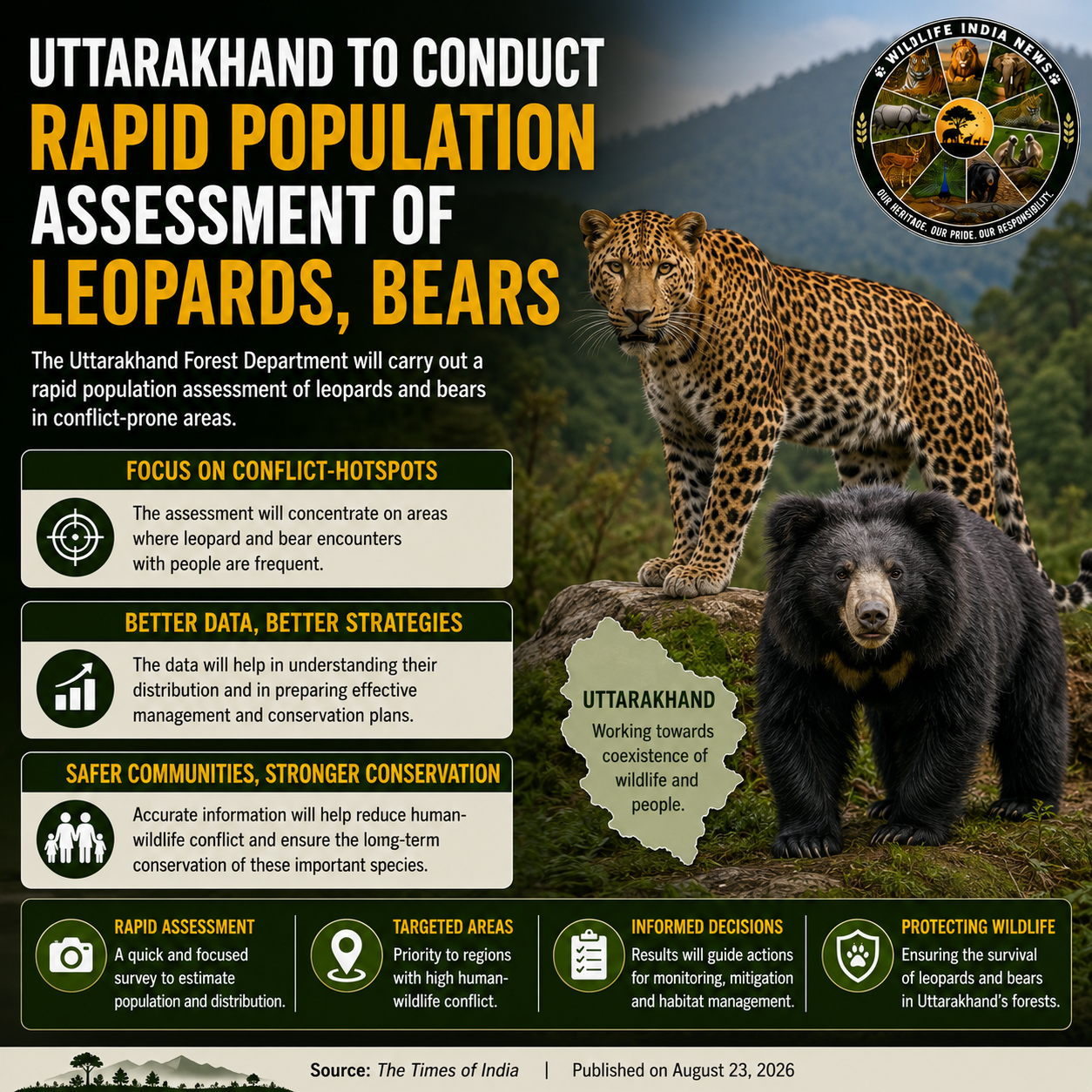
The Uttarakhand Forest Department is preparing to conduct a rapid population assessment of leopards and bears in areas that have emerged as hotspots for human-wildlife conflict.
The exercise is intended to provide a clearer picture of the number and distribution of these two important carnivore species in areas where encounters with people are becoming an increasing concern.
Focus on conflict-prone areas
Rather than attempting to immediately carry out a state-wide population estimation, the proposed assessment will concentrate particularly on locations where leopard and bear encounters with people are frequent.
Such data could help officials understand whether rising conflict is linked to higher animal densities, changes in animal movement or the increasing overlap between wildlife habitat and human settlements.
Data to guide future conservation
The population information gathered during the exercise is expected to help the Forest Department develop better wildlife-management and conservation strategies.
A clearer understanding of where leopards and bears are concentrated could also help authorities strengthen surveillance and response mechanisms in vulnerable areas.
For communities living close to forests, reliable population and distribution data could prove particularly useful in planning measures aimed at reducing potentially dangerous encounters.
Balancing wildlife and human safety
Uttarakhand has extensive forest and mountainous landscapes where villages, agricultural areas and wildlife habitats often exist in close proximity. This creates opportunities for animals such as leopards and bears to move through human-dominated areas.
The proposed assessment therefore has significance beyond simply counting animals. By identifying where wildlife populations are concentrated and where conflict is most intense, officials hope to improve the management of both wildlife and human safety.
The initiative represents an effort to move towards data-based management of human-wildlife conflict, while continuing to conserve Uttarakhand’s leopard and bear populations.
Source credit: This story is based on a report published by The Times of India, “U’khand to conduct rapid population assessment of leopards, bears,” published on August 23, 2026.
Uttarakhand Plans Rapid Leopard, Bear Population Assessment in Conflict Hotspots
Wildlifeindia News Desk
Leave a Reply