
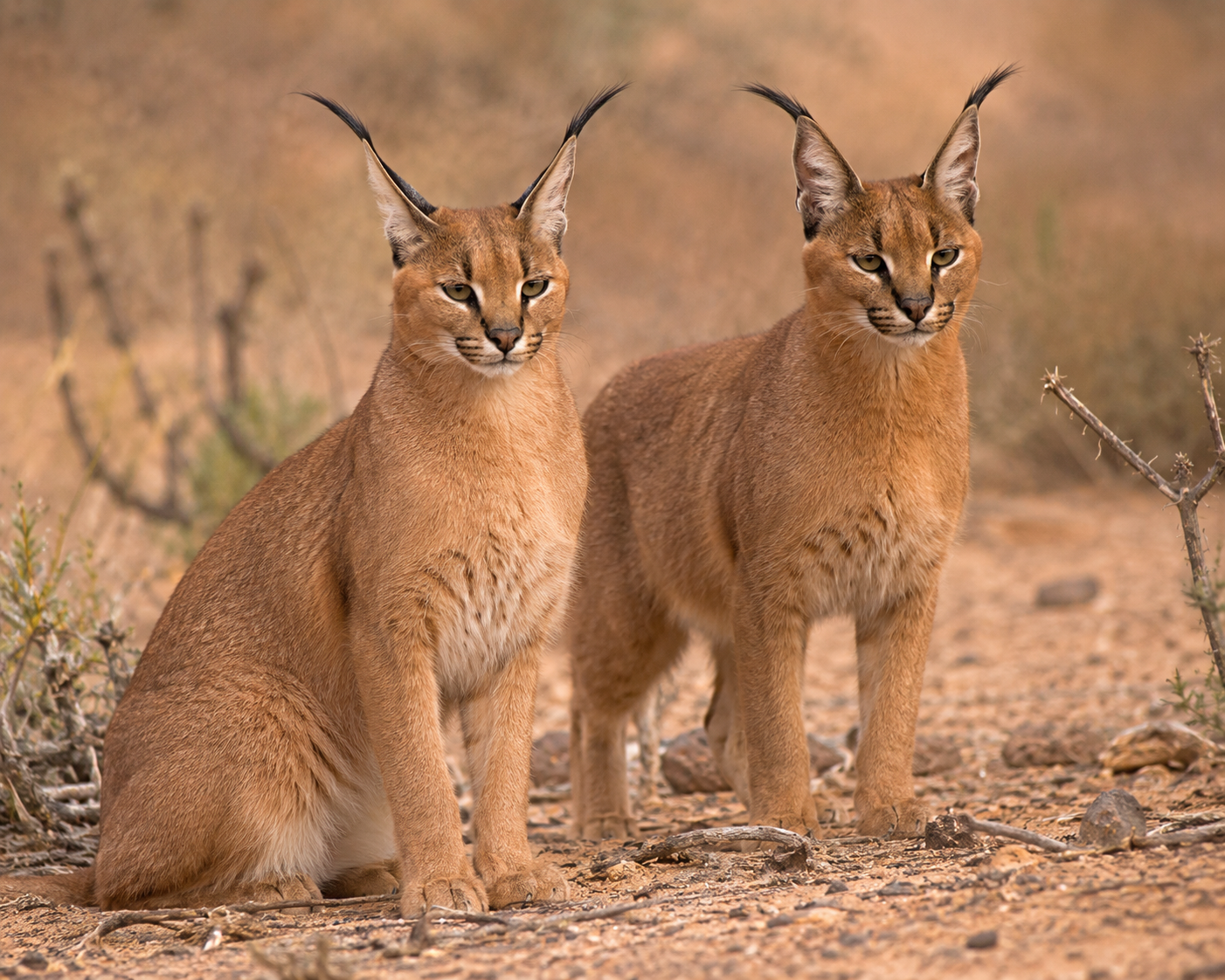
In a significant boost for wildlife conservation in India, forest officials and wildlife researchers have recorded a rare sighting of two caracals together in Rajasthan. The observation is being hailed as an encouraging sign for one of India’s most elusive and threatened wild cats, whose population has declined drastically over the past century.
The caracal (Caracal caracal) is a medium-sized wild cat easily identified by its reddish-brown coat and long black ear tufts. Nicknamed the “desert lynx,” it inhabits dry scrublands, grasslands and semi-arid landscapes. In India, its present-day distribution is largely confined to parts of Rajasthan, Gujarat and Madhya Pradesh, with the remaining population believed to be extremely small.
What makes this latest sighting especially noteworthy is that caracals are usually solitary animals. Seeing two individuals together suggests the possibility of a breeding pair or a healthy local population, offering fresh optimism for the species’ long-term survival. Conservationists believe the sighting indicates that suitable habitat and prey continue to exist in parts of Rajasthan.
Rajasthan has emerged as the country’s most important refuge for the species. Protected landscapes in the Thar region, including desert grasslands and scrub habitats, provide ideal conditions for caracals, along with prey such as hares, rodents and small antelopes. Recent camera-trap records have also highlighted the importance of these ecosystems for conserving the species.
Wildlife experts say the discovery underscores the need to strengthen habitat protection, improve scientific monitoring through camera traps and radio telemetry, and minimise threats such as habitat degradation and declining prey populations. Continued conservation efforts will be essential if India is to secure the future of this rare feline.
The sighting serves as a reminder that India’s lesser-known carnivores deserve as much conservation attention as its iconic tigers and leopards. For wildlife enthusiasts and conservationists alike, the appearance of this rare caracal duo represents a hopeful milestone in the effort to protect one of the country’s most enigmatic wild cats.
Leave a Reply