
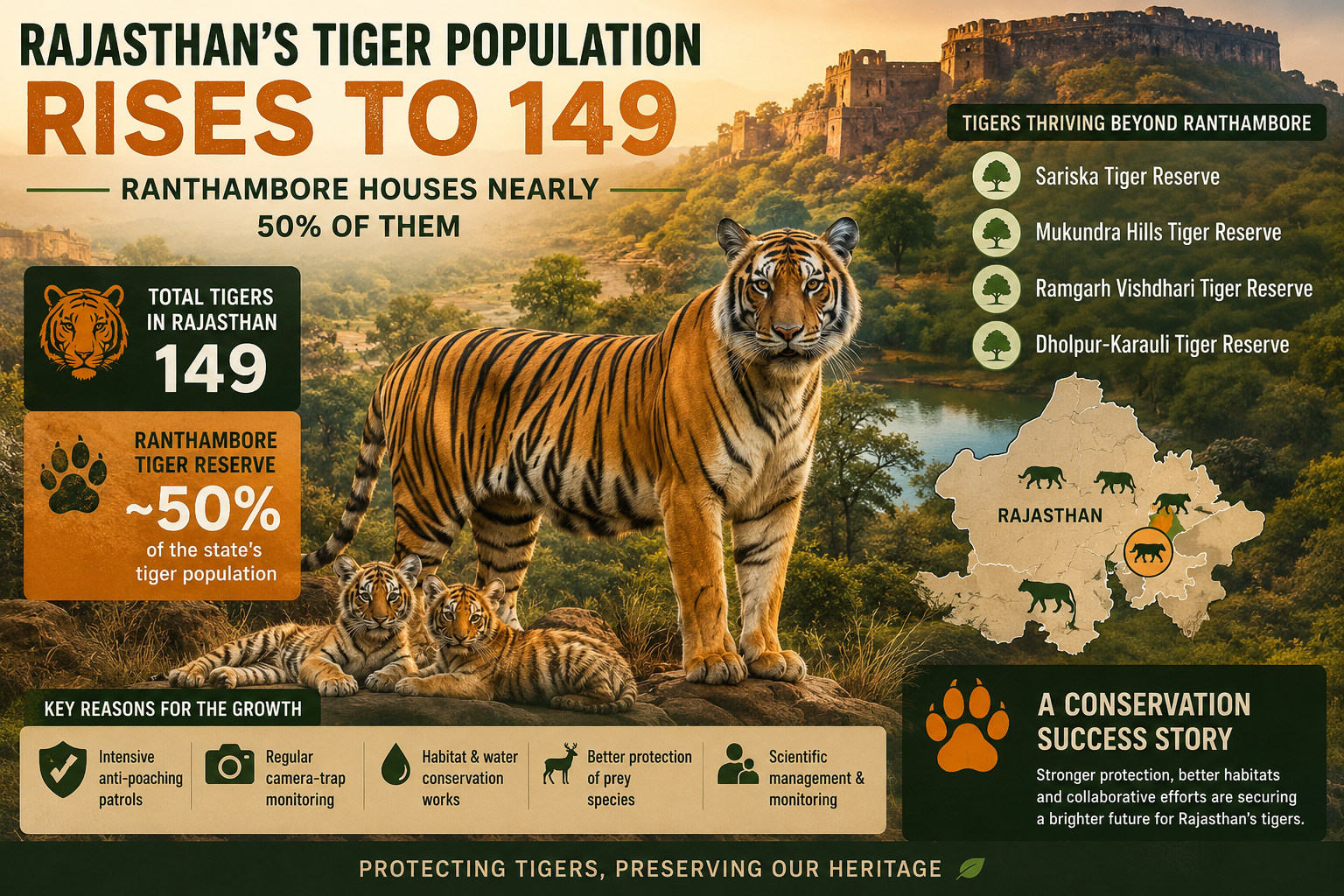
Rajasthan has reinforced its status as one of India’s leading tiger conservation states, with the state’s tiger population increasing to 149. Nearly half of these big cats are found in the Ranthambore landscape, highlighting the reserve’s enduring role as the backbone of tiger conservation in Rajasthan. The latest figures reflect years of habitat protection, anti-poaching efforts and scientific monitoring by the state’s forest department.
The Ranthambore Tiger Reserve remains Rajasthan’s premier tiger habitat, supporting around 50% of the state’s tiger population. Its mosaic of dry deciduous forests, rocky hills, lakes and grasslands provides ideal conditions for breeding tigers and sustaining a healthy prey base.
Over the past decade, Ranthambore has become one of India’s best-known tiger reserves, attracting wildlife enthusiasts and photographers from around the world. Several famous tigers and tigresses born here have established territories in neighbouring forests, helping expand the state’s tiger range.
With Ranthambore nearing its ecological carrying capacity, young tigers have increasingly dispersed into adjoining forest landscapes. This natural movement has helped strengthen populations in reserves such as:
Sariska Tiger Reserve
Mukundra Hills Tiger Reserve
Ramgarh Vishdhari Tiger Reserve
Dholpur-Karauli Tiger Reserve
These reserves are gradually emerging as important habitats, reducing pressure on Ranthambore while creating a connected tiger landscape across eastern Rajasthan. Wildlife managers view this expansion as a positive sign of a growing and healthy population.
Forest officials attribute the rise in tiger numbers to several long-term conservation initiatives, including:
Intensive anti-poaching patrols.
Regular camera-trap monitoring.
Habitat improvement and water conservation works.
Better protection of prey species such as deer, sambar and wild boar.
Scientific management of tiger dispersal and conflict-prone areas.
These efforts have improved breeding success and increased the survival of cubs, contributing to the steady growth in the state’s tiger numbers.
Despite the encouraging numbers, conservationists warn that success brings new challenges. As tiger density rises, young animals increasingly move outside protected forests in search of territory, leading to encounters with villages, livestock and roads.
Maintaining wildlife corridors between reserves, mitigating human-wildlife conflict, and securing additional habitats will be essential to sustain Rajasthan’s conservation gains. Experts also stress the need for continued monitoring of genetic diversity and habitat connectivity as tiger populations expand.
The increase to 149 tigers marks another milestone in Rajasthan’s wildlife conservation journey. While Ranthambore continues to be the state’s flagship tiger reserve, the gradual spread of tigers into other protected landscapes demonstrates that conservation efforts are beginning to benefit the wider ecosystem.
If habitat protection, community participation and scientific management continue at the current pace, Rajasthan is well positioned to strengthen its reputation as one of India’s most important strongholds for the Bengal tiger in the years ahead.
Leave a Reply