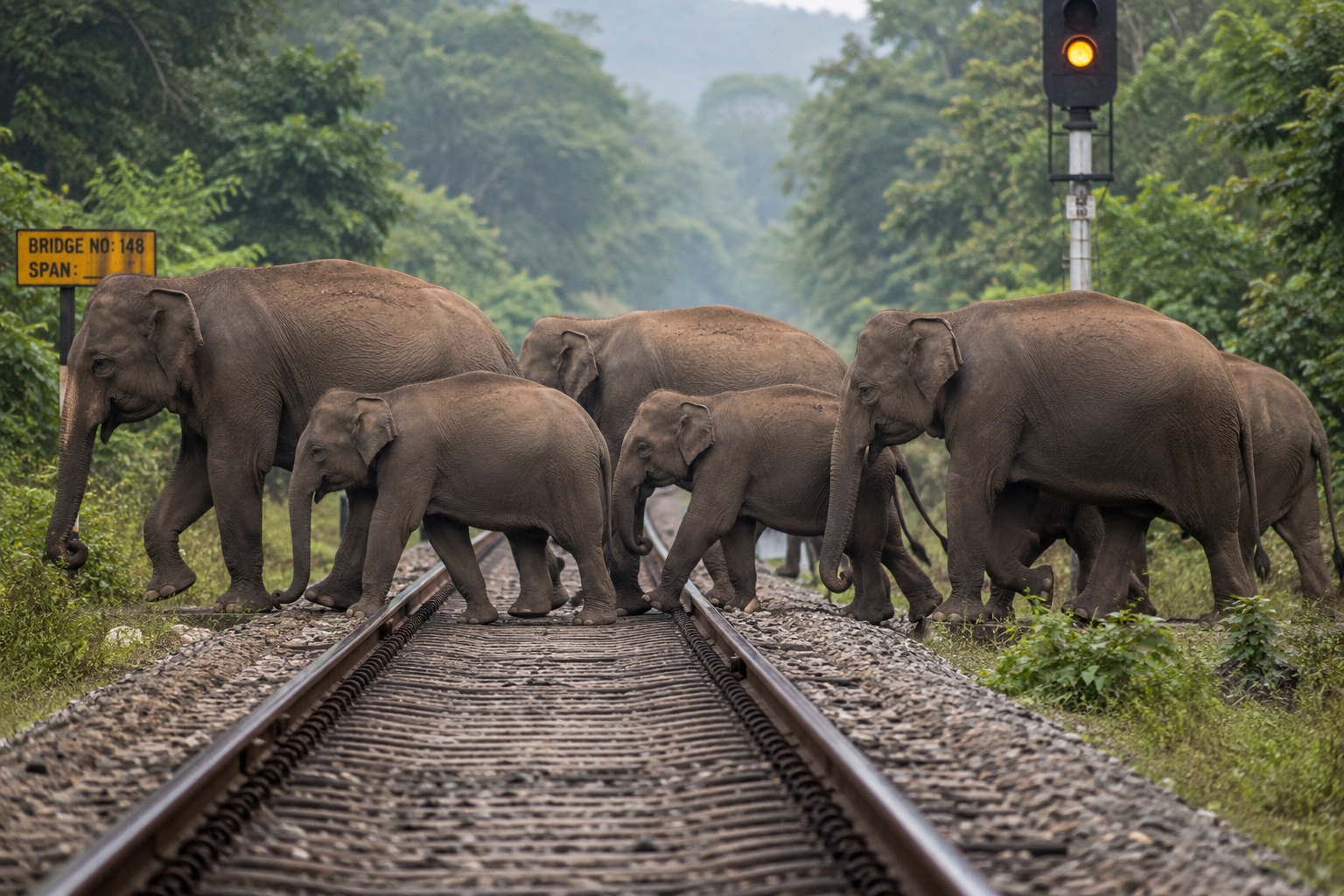
In a remarkable example of technology supporting wildlife conservation, Tamil Nadu’s AI-powered elephant surveillance system has emerged as a game-changer in preventing fatal train collisions with elephants. Installed along the vulnerable railway stretch in the Madukkarai forest range of Coimbatore, the system combines artificial intelligence, machine learning, and thermal imaging to detect elephants approaching railway tracks and instantly alert railway and forest officials.
The Madukkarai-Walayar railway section is one of the busiest elephant corridors in southern India. Nearly 130 trains pass through the area every day, while around 1,000 elephants cross these tracks annually. Between 2008 and 2023, at least 11 elephants lost their lives in train collisions on this stretch, prompting the Tamil Nadu Forest Department to seek a technological solution.
The AI-based system uses 12 surveillance towers equipped with thermal night-vision cameras that continuously monitor wildlife movement. As elephants approach the railway line, the AI identifies them in real time and generates automatic alerts. These warnings are transmitted to the control room, railway station masters, forest staff, and loco pilots, allowing trains to slow down or stop until the animals have crossed safely. The system can also detect other wildlife such as leopards, deer, gaur, dholes, and even king cobras.
The initiative was spearheaded by the Tamil Nadu Forest Department in collaboration with Indian Railways and has been strongly supported by Additional Chief Secretary for Environment, Climate Change and Forests, Supriya Sahu. Since becoming operational, it has demonstrated impressive results. According to the latest official figures, the system has enabled 9,481 safe elephant crossings over the past two-and-a-half years without a single elephant death on the monitored railway stretch. Thousands of AI-generated alerts have also prompted locomotive pilots to reduce speed or halt trains, significantly improving safety for both wildlife and railway operations.
Building on this success, Tamil Nadu has further strengthened the initiative by deploying AI-enabled drones to monitor areas beyond the fixed camera network. These drones provide wider surveillance, especially in locations where elephants may approach the tracks unnoticed, enabling faster response by forest personnel.
The Madukkarai project is now being regarded as one of India’s most successful examples of using artificial intelligence for wildlife conservation. It highlights how modern technology, when combined with effective coordination between forest and railway authorities, can significantly reduce human-wildlife conflict while safeguarding one of India’s most iconic species.
Leave a Reply