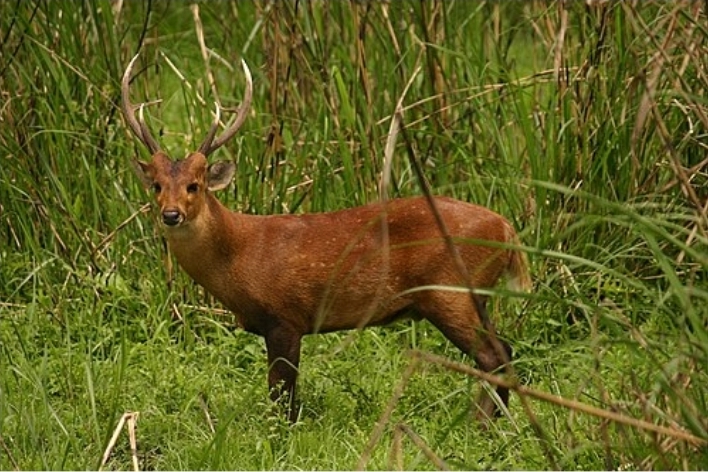
A new wildlife census has revealed a significant ecological shift in Keibul Lamjao National Park in Manipur—the world’s only floating national park. According to the Sangai Census Report 2026, the population of hog deer has risen to 375, surpassing the 172 endangered Sangai (Manipur brow-antlered deer) living in the park. The findings were released during the 77th Van Mahotsav celebrations in Imphal.
The Sangai (Rucervus eldii eldii), Manipur’s state animal, is listed as Endangered on the IUCN Red List and receives the highest level of protection under Schedule I of the Wildlife (Protection) Act, 1972. The species survives only in the 40 sq. km. Keibul Lamjao National Park, which lies within the vast Loktak Lake ecosystem, making it highly vulnerable to any ecological disturbance.
Conservationists have expressed concern that the growing hog deer population could intensify competition for food and habitat. The census report warns that the more adaptable hog deer may place additional ecological pressure on the already fragile Sangai population. To address this, the report recommends translocating a portion of the hog deer population to other suitable protected areas, thereby reducing competition within the park.
The report also highlights that the Sangai exists as a single isolated wild population, making it susceptible to inbreeding, loss of genetic diversity, disease outbreaks, demographic fluctuations, and environmental changes. It stresses the urgent need to establish a second wild population outside Keibul Lamjao and to strengthen conservation breeding programmes to secure the species’ long-term future.
While the census found the adult male-to-female ratio to be healthy, it noted a low number of juveniles and fawns, indicating poor recruitment. If this trend continues, the population could gradually age and decline despite current protection measures.
The report further proposes exploring an exchange programme with closely related Eld’s deer subspecies found in neighbouring South and Southeast Asian countries, in consultation with the Wildlife Institute of India and other scientific authorities. Such a programme could help improve the Sangai’s genetic diversity and strengthen the resilience of this iconic species.
The latest census underscores that conserving the Sangai will require not only continued habitat protection but also active ecological management. Balancing the populations of herbivores, improving genetic diversity, and creating additional secure habitats are likely to be crucial for ensuring the survival of one of India’s rarest and most culturally significant deer species.
 Wildlife India News
Leave a comment