Sheopur, Madhya Pradesh | September 18, 2026
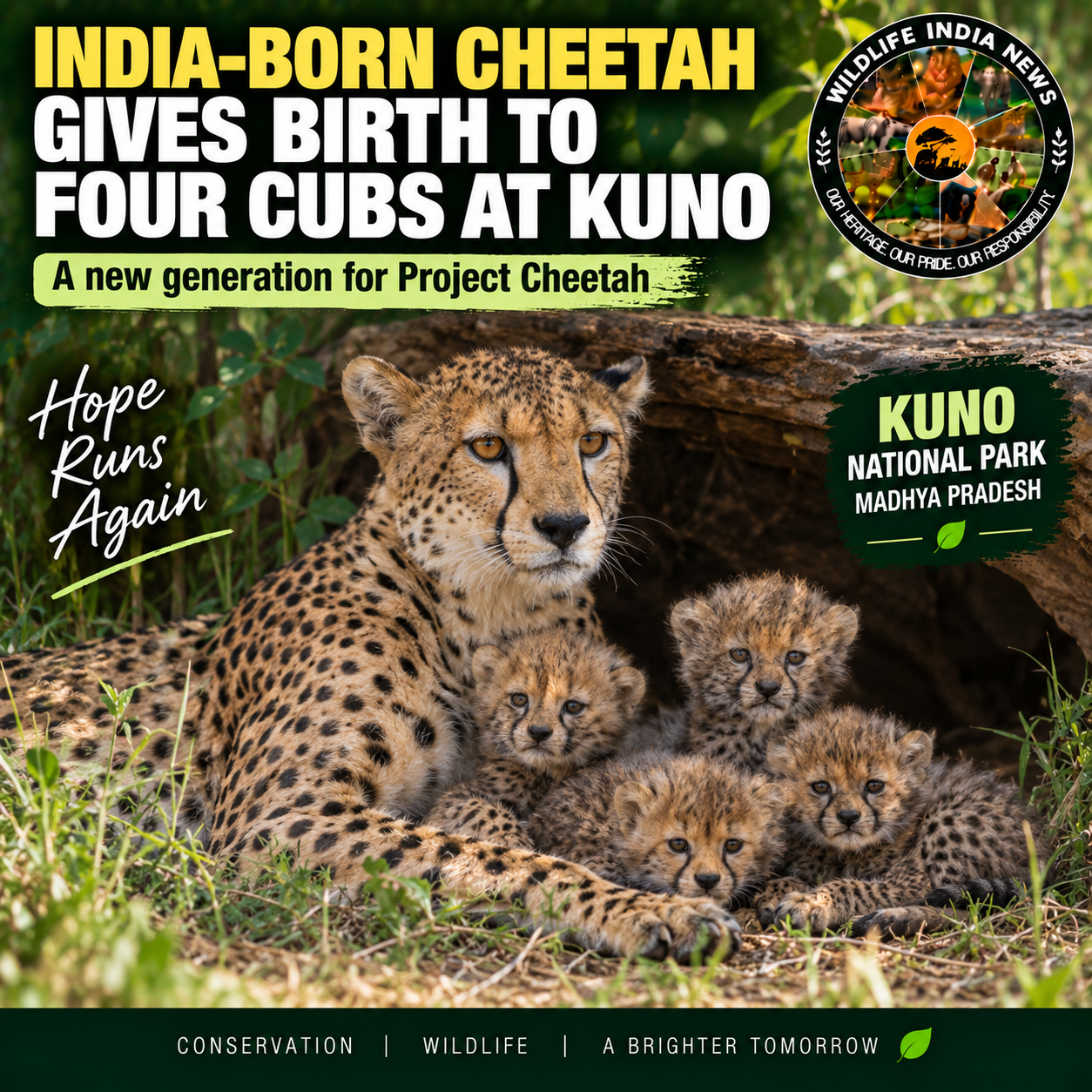
India’s cheetah reintroduction programme has recorded another important development, with an India-born female cheetah giving birth to four cubs at Kuno National Park in Madhya Pradesh.
The mother, identified as KGP12, is herself the daughter of Gamini, a cheetah brought to India from South Africa. The arrival of her four cubs comes just a day after Project Cheetah completed four years, highlighting the emergence of a new generation born to cheetahs that were themselves born in India.
Four new lives at Kuno
Union Environment Minister Bhupender Yadav announced the births on September 18, describing the development as an important moment for the conservation programme.
KGP12 belongs to Gamini’s first litter and represents a new generation of cheetahs produced through India’s reintroduction effort.
Her latest litter demonstrates that India-born cheetahs are reaching reproductive age and producing offspring of their own.
This is particularly significant because the programme’s long-term objective is not simply to maintain imported animals but to establish a population capable of reproducing and surviving in Indian habitats.
India’s cheetah population rises to 56
Latest population update
Total cheetahs
56
Born in India
36
Kuno National Park
53
Gandhi Sagar
3
Figures following the September 18 births, as reported by The Indian Express.
The four-year status review released on September 17 had placed India’s cheetah population at 52, including 32 born in the country.
With KGP12’s four newborn cubs, the reported population has increased to 56, of which 36 were born in India. Kuno now accounts for 53 cheetahs, while three are at Gandhi Sagar Wildlife Sanctuary.
A remarkable journey from Africa to India
Project Cheetah began on September 17, 2022, when eight cheetahs from Namibia were released into special enclosures at Kuno National Park.
Another 12 arrived from South Africa in February 2023, followed by nine from Botswana in February 2026.
The programme has since progressed through several stages, including the adaptation of imported cheetahs, the birth of cubs, the release of animals into open forest habitats and the emergence of India-born breeding females.
A milestone, but survival remains the real test
The latest births offer encouragement, but the arrival of cubs does not by itself guarantee their survival.
KGP12 had previously given birth to four cubs in the wild in April 2026. All four subsequently died, with forest officials suspecting a leopard attack.
That earlier loss illustrates the risks faced by young cheetahs in natural habitats.
The immediate priority will be to monitor the mother and her newborn cubs while allowing them to develop with minimal disturbance.
In the longer term, the programme must demonstrate that successive generations can survive, hunt, reproduce and establish themselves in suitable habitats without permanent dependence on intensive management.
A new chapter for India’s cheetahs
Four years after cheetahs returned to India following their extinction in the country in 1952, Project Cheetah is entering a new phase.
The birth of KGP12’s four cubs represents progress towards a population sustained by animals born in India rather than solely by imported founders.
The next milestone will be ensuring that these newborns survive and eventually contribute to a stable, free-ranging cheetah population.
Source credit: India Today, September 18, 2026 . Additional reporting: The Indian Express and DD India .
Leave a Reply