Wildlife India News | Insight Report | September 17, 2026
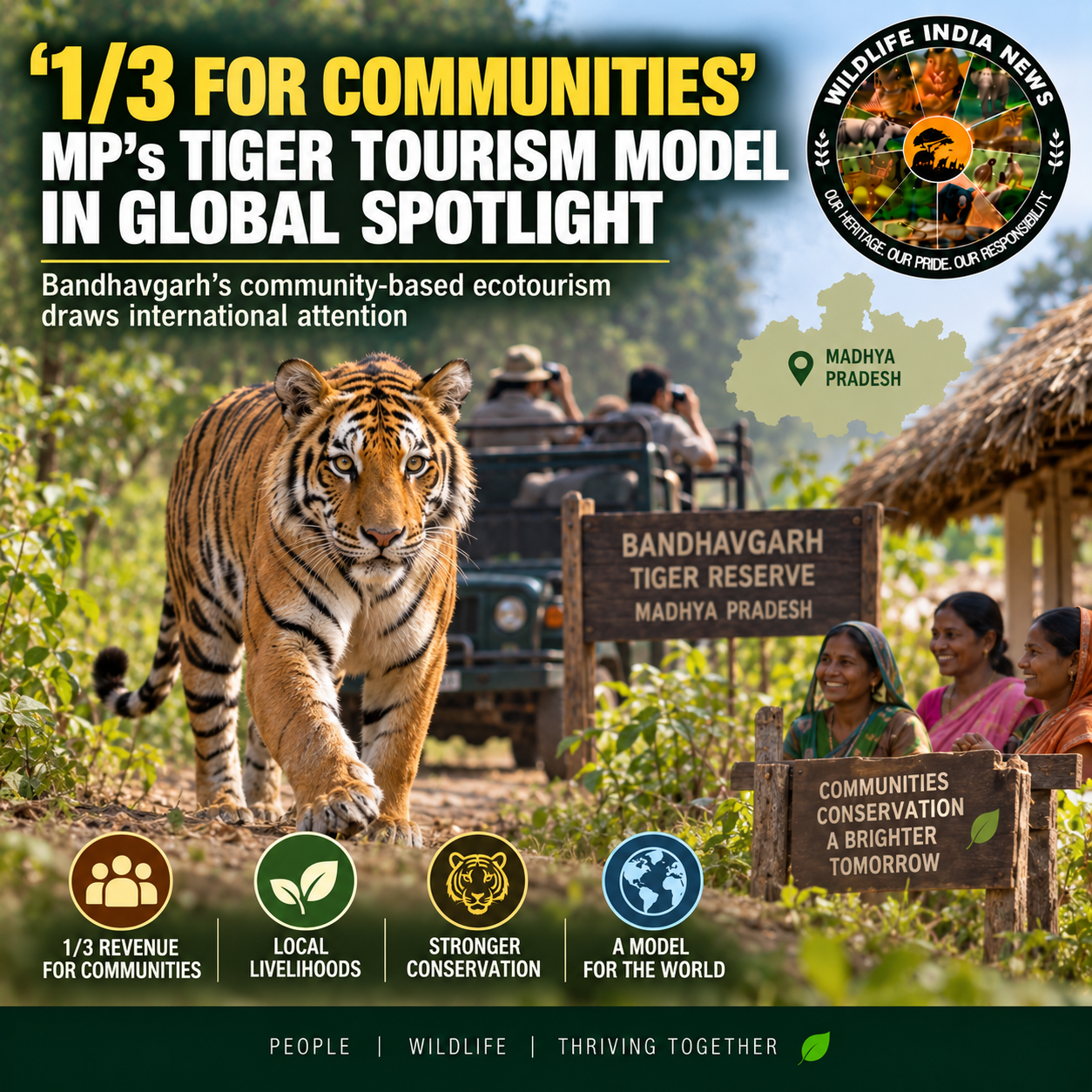
What if the people living closest to tiger reserves received a meaningful share of the money generated by wildlife tourism? Madhya Pradesh is showcasing a model built around precisely that idea.
At an international workshop in New Delhi, Bandhavgarh Tiger Reserve’s community-based ecotourism programme attracted attention for a revenue-sharing arrangement under which one-third of tourism-generated revenue is transferred to local communities.
The initiative offers an opportunity to examine a fundamental question in wildlife conservation: can tiger tourism create enough benefits for neighbouring villages to make them genuine partners in protecting forests?
Bandhavgarh takes its model to the international stage
The programme was presented by Bandhavgarh field director Dr Anupam Sahay at a two-day workshop titled Tiger Landscape: Conservation, Bio-economy, and Ecotourism, held in New Delhi on September 2–3, 2026.
The event was organised by the International Big Cat Alliance, Asian Development Bank and National Tiger Conservation Authority.
Delegates from India, Bhutan, Bangladesh, Cambodia, Nepal, Vietnam and Malaysia attended, alongside representatives of international conservation organisations.
The presentation highlighted how Madhya Pradesh is attempting to connect wildlife protection with employment and economic opportunities for people living around tiger reserves.
The central idea:
One-third of tourism revenue is transferred to local communities under the arrangement described by Madhya Pradesh officials.
The report does not provide a detailed financial breakdown of the revenue base, annual transfers or distribution among households.
Turning wildlife tourism into village livelihoods
A tiger sighting may be the main attraction for tourists, but the visitor economy extends far beyond the safari itself.
Local residents can participate through guiding, driving safari vehicles, running homestays, preparing traditional food and working in hotels and resorts.
Bandhavgarh’s model emphasises these opportunities while recognising that trained guides and drivers also have a conservation role.
They can explain park regulations, encourage responsible visitor behaviour and help tourists understand why wildlife habitats need protection.
The approach seeks to ensure that tourism benefits do not remain concentrated among a small number of operators while neighbouring villages receive little economic return.
Why revenue sharing matters for tiger conservation
Communities living around tiger reserves often experience the costs of conservation more directly than tourists do.
They may face livestock losses, restrictions on access to forest resources or disruption when wild animals move through agricultural land.
Meanwhile, tourism businesses can generate income from the wildlife those communities live alongside.
A transparent benefit-sharing mechanism offers one way to address this imbalance.
When residents earn income from guiding, transport, accommodation and other services, conserving wildlife can become connected to household livelihoods rather than appearing to benefit outsiders alone.
However, revenue sharing should not be treated as a substitute for timely compensation, public services or the protection of community rights. These remain separate responsibilities.
The important question is not simply how much tourism earns, but how fairly its benefits and costs are distributed.
The difference between tourism and ecotourism
Madhya Pradesh officials have also emphasised that ecotourism must involve local communities and minimise environmental damage.
The state’s approach includes visitor-management measures such as monitoring safari vehicle movement and speed, along with rules intended to prevent garbage disposal inside parks.
This distinction matters.
A growing number of visitors may increase revenue, but uncontrolled tourism can also disturb wildlife, create traffic, generate waste and place pressure on sensitive habitats.
The objective of ecotourism should therefore extend beyond attracting more visitors.
It should ensure that tourism operates within ecological limits while generating measurable benefits for conservation and local people.
Madhya Pradesh’s wildlife action plan calls for community training, locally managed ecotourism activities, benefit-sharing agreements and monitoring of tourism’s environmental and social impacts.
Can the model be replicated elsewhere?
Bandhavgarh’s experience could provide useful lessons for other tiger landscapes, particularly where villages are closely connected to tourism activities.
But replication requires more than announcing a revenue-sharing percentage.
Several practical questions need to be answered:
- How much money actually reaches villages each year?
- Are benefits distributed fairly, including among women and poorer households?
- Do local residents have a meaningful role in deciding how funds are used?
- Are tourism activities creating stable employment without damaging wildlife habitat?
The September workshop report does not provide enough financial or ecological data to answer these questions conclusively.
Independent monitoring and publicly accessible accounts would help establish whether the model delivers lasting benefits and whether it can be adapted to reserves with different tourism revenues and community needs.
A wider vision for tiger landscapes
The New Delhi workshop explored a broader conservation economy, including ecotourism, non-timber forest products and other nature-linked livelihood opportunities.
This reflects an important shift in thinking.
Tiger conservation cannot depend exclusively on protecting animals inside reserve boundaries. The surrounding landscape—and the people living within it—also influences the long-term future of tiger populations.
Community participation can help build local support for conservation, but it needs to be supported by fair institutions, ecological safeguards and dependable livelihood opportunities.
The debate around wildlife tourism also includes concerns about commercial expansion and the displacement of communities. These concerns underline why participation must involve genuine decision-making and not merely employment in tourism businesses.
The real measure of success
Madhya Pradesh’s one-third revenue-sharing arrangement has drawn international attention because it places local communities within the economic framework of tiger tourism.
Yet the ultimate measure of success will not be the number of delegates impressed by the presentation or the number of tourists visiting Bandhavgarh.
It will be whether neighbouring villages receive substantial, fairly distributed benefits while the reserve’s wildlife and habitats remain protected.
The larger lesson is that tiger tourism should not merely generate revenue from wildlife. It should also create enduring benefits for the people who share their landscapes with tigers.
That is the promise of community-centred ecotourism—and the standard against which Madhya Pradesh’s model deserves to be examined.
Source credit: The Times of India, September 7, 2026. Additional background: Madhya Pradesh Wildlife Action Plan and India Today.
Original report: ‘1/3 for communities’: MP’s tiger tourism model in global spotlight
Leave a Reply