Sheopur, Madhya Pradesh | September 15, 2026
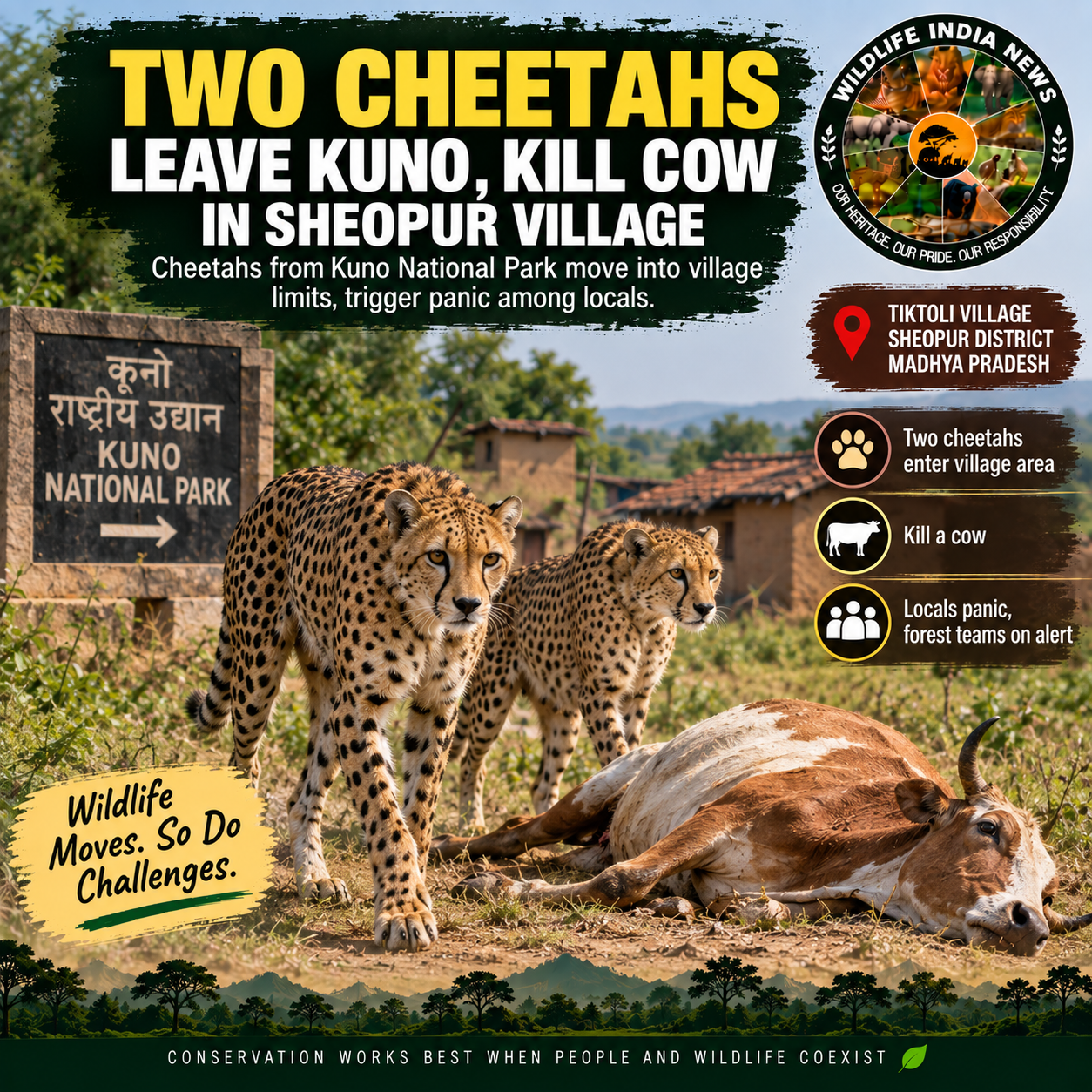
Two cheetahs from Kuno National Park moved into the limits of Tiktoli village in Madhya Pradesh’s Sheopur district and killed a cow, causing concern among residents and prompting Forest Department teams to begin tracking the animals.
Cheetahs enter Tiktoli village
The incident was reported from Tiktoli village in the Sesai Pura area. According to the Free Press Journal, the two cheetahs left the national park landscape, entered the village limits and attacked a cow.
After news of the cheetahs’ presence spread, villagers moved towards their homes and other safer places, fearing that the animals might venture farther into the inhabited area. No attack on a person was reported.
Forest Department personnel subsequently reached the area and began monitoring the cheetahs’ movements. Residents were advised to remain alert and avoid approaching the animals while officials worked to guide them away from the populated area.
Moving outside Kuno is not unprecedented
Cheetahs ranging beyond Kuno’s boundaries is not in itself unusual. Free-ranging animals can cover large distances while exploring territory and searching for prey.
Indeed, Kuno’s cheetahs have previously travelled through agricultural and village landscapes. In August 2025, female cheetah Gamini and one of her cubs entered Hasanpur village in Sheopur and killed a calf. Another group was recorded far outside Kuno near Pagara Dam in Morena district in June 2025.
The scale of free-ranging movement has continued to increase. A recent Kuno report said 18 radio-collared cheetahs were moving freely across a landscape spanning six districts, while another 12 radio-collared animals were in fenced natural-forest areas.
Monitoring becomes crucial
The Tiktoli incident illustrates one of the major challenges facing Project Cheetah as more animals begin living as free-ranging predators rather than remaining within managed enclosures.
A successful reintroduction ultimately requires cheetahs to establish territories, hunt independently and move naturally through suitable habitat. But such movements also bring them into landscapes shared with villages and livestock.
That makes rapid communication with local communities, livestock protection and continuous tracking increasingly important.
Kuno’s monitoring teams use satellite-cum-radio collars to follow individual cheetahs. However, officials recently acknowledged that heavy monsoon rain and cloud cover can sometimes delay satellite and radio transmissions, making ground tracking more difficult.
Coexistence will be the next test for Project Cheetah
The killing of livestock should therefore be viewed not simply as cheetahs “escaping” from Kuno, but as part of a much larger conservation challenge.
As India’s reintroduced cheetah population expands and more animals become free-ranging, encounters with livestock and villages are likely to require careful management.
For communities such as Tiktoli, the priority is ensuring that people and their livestock remain safe. For conservationists, the challenge is equally important: allowing cheetahs enough space to behave like genuinely wild animals without allowing those movements to turn local communities against the reintroduction programme.
The two cheetahs are being tracked, and Forest Department teams are maintaining surveillance around the village.
Source credit: Free Press Journal, with additional background from recent Kuno National Park reporting.
Leave a Reply