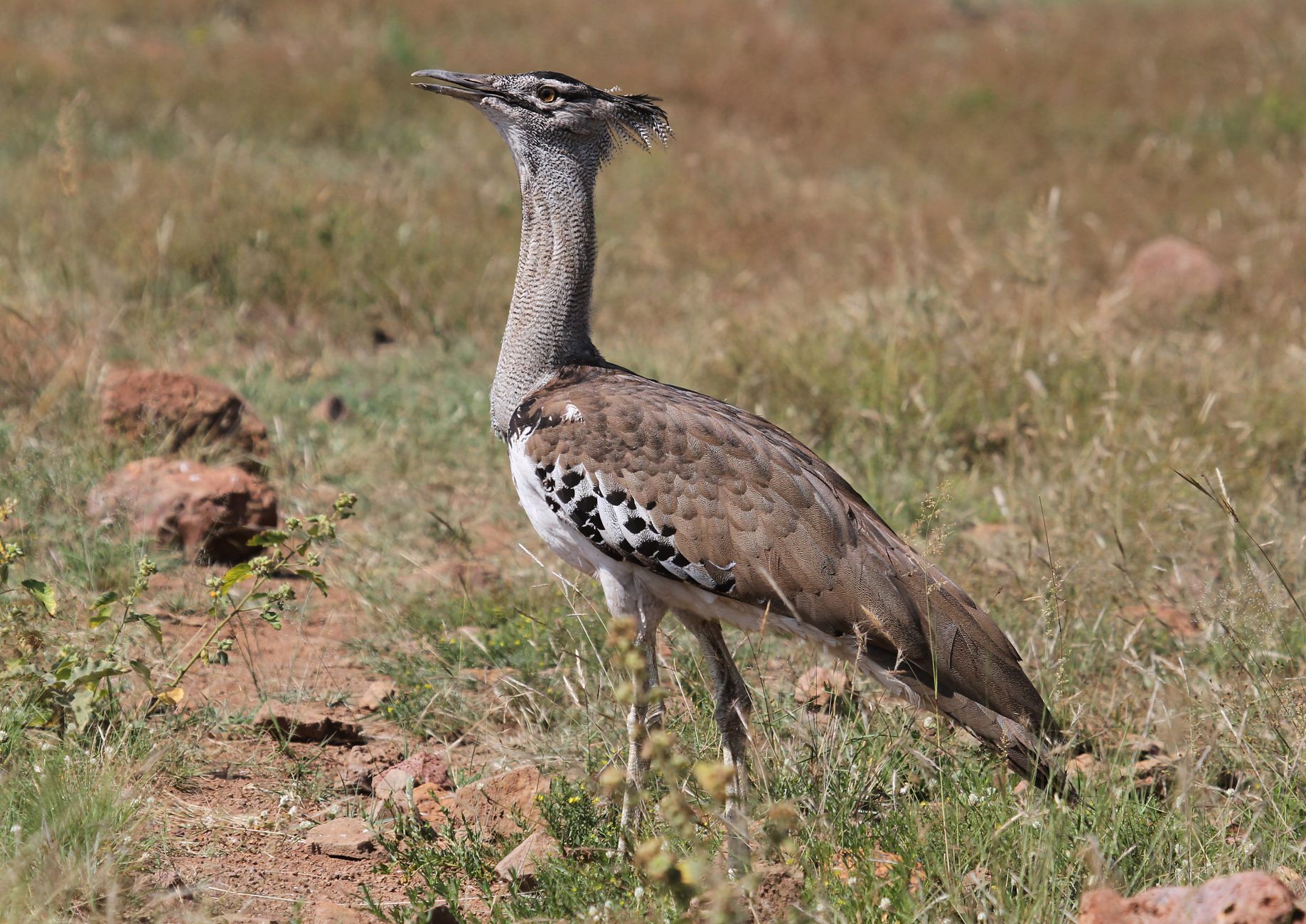
The Great Indian Bustard, or GIB (Ardeotis nigriceps), is one of the most extraordinary birds of India’s grasslands. Standing nearly a metre tall and weighing well over 10 kg in large males, it is among the heaviest birds in the world capable of flight.
But do you know that this magnificent bird, once widespread across much of India, is now Critically Endangered, with only around 100–150 individuals believed to survive in the wild?
A new study by scientists from the Wildlife Institute of India (WII) has now mapped potential refuges where the species could survive and possibly recover. The results reveal both hope—and just how little suitable habitat remains.
Do you know? Only 6.6% of the Deccan landscape remains suitable
Researchers examined a vast 720,000 sq km landscape covering Maharashtra, Karnataka, Telangana and Andhra Pradesh.
Their modelling found that only about 48,000 sq km—just 6.6%—remains potentially suitable for the Great Indian Bustard.
The scientists went a step further and identified 16 priority conservation areas covering about 18,000 sq km. These could become crucial safe havens for the bird in the southern part of its remaining range.
Do you know? A bustard does not necessarily need a wilderness
One of the most interesting findings challenges the conventional idea of what wildlife habitat should look like.
Great Indian Bustards favour open landscapes, not dense forests. And some of their best potential habitats aren’t untouched wilderness at all.
The 16 priority areas contained a mixture of natural grasslands and agricultural landscapes. Researchers found them dominated by fallow land (28.6%), kharif crops (24.3%), mixed crops (18.8%) and grasslands (11.6%).
This means traditional low-intensity agriculture can potentially coexist with bustard conservation.
Do you know? Researchers searched 372 grids—and didn’t see a single bustard
The rarity of the species becomes starkly apparent from the fieldwork.
More than 30 survey teams conducted 2,117 line transects covering about 6,437 km across 372 grids in Maharashtra.
Despite this enormous effort, researchers did not directly sight a single Great Indian Bustard during those surveys.
So they also turned to people who know these landscapes intimately.
Researchers interviewed 1,401 local residents, and 72 respondents reported Great Indian Bustard presence in their areas during the preceding six months. That local ecological knowledge was combined with habitat modelling to identify priority areas.
Do you know? Rainfall can help decide where a bustard lives
The scientists analysed climate, vegetation, human settlements, land use, power lines and other environmental factors.
Among the strongest predictors of suitable habitat was rainfall during the warmest part of the year. Vegetation conditions around the beginning of the monsoon were also important.
That makes sense for a bird dependent on semi-arid grasslands and seasonal agricultural landscapes.
The Great Indian Bustard needs large, open areas where it can feed, breed and perform its elaborate courtship displays. It generally avoids dense forests and heavily urbanised landscapes.
Do you know? Farming changes can determine whether the bird survives
For generations, large areas of the Deccan were characterised by dryland agriculture. Farmers cultivated crops such as pulses and oilseeds and periodically left fields fallow.
These open agricultural mosaics could provide habitat for bustards.
But irrigation and changes in agricultural practices have increasingly transformed parts of these landscapes into intensive cultivation, including crops such as sugarcane and cotton. Open grasslands have also been lost or fragmented by development.
The new study therefore argues that conserving the GIB cannot simply mean protecting isolated wildlife sanctuaries. Traditional farming systems and remaining natural grasslands may have to be conserved together.
Do you know? Power lines are particularly dangerous to this giant bird
Being a large, heavy-bodied bird comes with another disadvantage.
Great Indian Bustards can collide with overhead power lines, which may be difficult for them to detect while flying. WII has long identified power infrastructure as a serious threat alongside habitat loss, changing agriculture, roads and increasing pressure from predators around nests.
This makes the newly identified conservation zones especially valuable for planning future infrastructure. Knowing where the most important remaining habitat lies can help governments decide where power lines, roads, mines and other developments require particularly careful planning.
Do you know? The Great Indian Bustard once occupied a huge part of India
The species was historically distributed across 11 Indian states and parts of Pakistan. Today, its range has contracted dramatically and surviving populations are fragmented.
Rajasthan’s Thar landscape remains its principal stronghold, while tiny populations persist or have recently persisted in places including Gujarat and parts of the Deccan.
And there has recently been a small but significant piece of good news: in September 2026, a Great Indian Bustard chick produced through conservation efforts in Gujarat’s Naliya grasslands was confirmed to be male—the first male GIB chick recorded there in nearly eight years.
The 16 safe havens could make the difference
The importance of the new study lies in turning conservation science into a map that planners can actually use.
Rather than treating the entire Deccan Plateau equally, researchers have narrowed attention to 16 landscapes totalling roughly 18,000 sq km where conservation intervention could have the greatest impact.
Protecting those places does not necessarily mean excluding people.
It could mean maintaining native grasslands, retaining fallow fields, encouraging bustard-compatible farming, carefully locating infrastructure and making dangerous power lines safer.
The Great Indian Bustard’s predicament also carries a larger lesson for Indian conservation.
Grasslands are not wastelands.
They are complex natural ecosystems supporting highly specialised wildlife—and the disappearance of open landscapes can mean the disappearance of the animals that evolved to depend upon them.
The Great Indian Bustard is one of the most striking examples.
One of the world’s heaviest flying birds has survived for centuries in India’s vast open country. Scientists have now identified some of the places where it still has a chance.
The question is whether those safe havens can be protected before the bird disappears from them altogether.
Source credit: Research Matters; study by Shaheer Khan, Gautam Talukdar and Bilal Habib of the Wildlife Institute of India, published in PLOS ONE in August 2026.
Leave a Reply