
Kerala | September 12, 2026
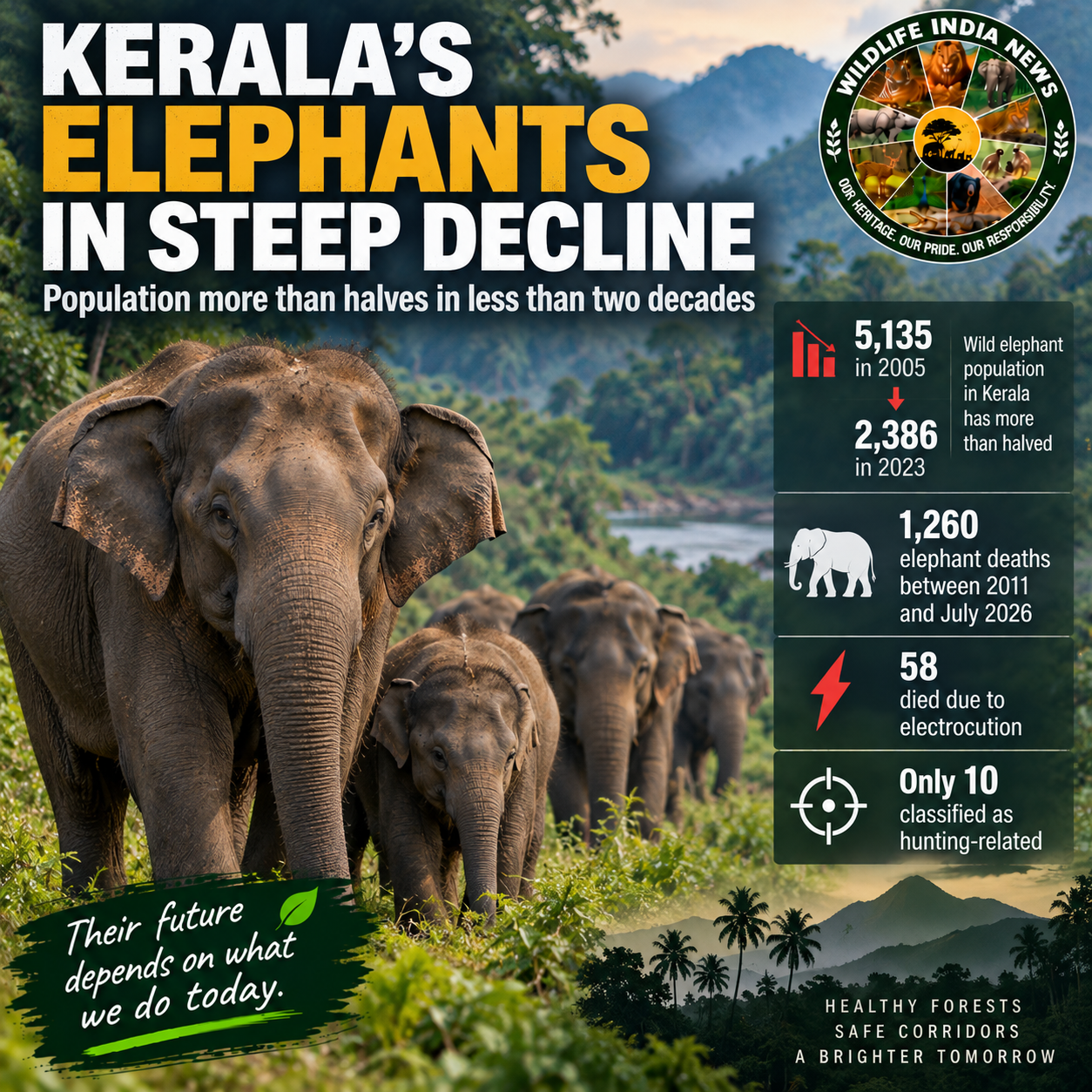
Kerala’s wild elephant population has undergone an alarming decline over the past two decades, with official figures showing that the number of elephants in the state’s forests fell from 5,135 in 2005 to just 2,386 in 2023.
Adding to the concern, official records show that 1,260 wild elephants died in Kerala between 2011 and July 2026. While the Forest Department has attributed most deaths to natural causes and accidents, conservationists are questioning whether the official classifications tell the complete story.
1,260 elephant deaths in 15 years
Data obtained under the Right to Information Act by T S Santhosh, legal representative of the Animal and Nature Ethics Community, provides a disturbing picture of elephant mortality in the state.
Of the 1,260 recorded deaths, 345 were attributed to natural accidents and 339 to natural causes. Another 159 elephants died from disease, 138 in fights with other animals, 105 due to predators and 50 from old age.
The records show that 581 of the elephants that died were females and 569 were males. The sex of the remaining animals was not specified.
Together, natural causes and natural accidents account for more than half of all officially recorded deaths.
But conservationists are questioning whether enough scientific investigation was carried out before some deaths were placed in these categories.
Questions over postmortem examinations
Santhosh alleged that proper scientific procedures were not always followed to establish whether elephant deaths were genuinely natural.
He also questioned whether postmortem examinations consistently complied with protocols prescribed under Project Elephant and guidelines of the Union Ministry of Environment, Forest and Climate Change.
This is important because the cause assigned to an elephant’s death determines whether authorities subsequently investigate possible hunting, poisoning, electrocution or other human-related factors.
Wildlife activists are consequently demanding stronger forensic scrutiny of suspicious elephant deaths.
Is poaching still a hidden threat?
Officially, only 10 elephant deaths between 2011 and 2026 were classified as hunting-related.
However, conservationists cited in the report argue that this figure may not reflect the full extent of the threat.
Their concerns have been reinforced by recent wildlife-crime cases. In early September, two people were arrested with elephant tusks at Neriamangalam under the Kothamangalam forest range.
Santhosh argues that the incident indicates that illegal ivory networks could still be operating in parts of the Western Ghats. He also alleged links between suspects associated with some Kerala forest ranges and poaching cases in neighbouring Karnataka and Tamil Nadu. These remain claims by conservationists rather than proof that unrecorded poaching explains Kerala’s overall elephant decline.
Electrocution emerges as another serious danger
One cause of mortality is much more clearly connected with human activity: electrocution.
RTI records show that 58 wild elephants died from electrocution between 2011 and July 2026.
Even more worrying is how recently many of these deaths occurred.
According to data from the Forest Department’s Hostile Activity Watch Kernel, developed in collaboration with the Wildlife Trust of India, 50 of those electrocution deaths occurred from 2019 onwards.
Deaths have been concentrated particularly around Wayanad, Nilambur, Palakkad, Idukki and the southern Western Ghats, as well as forest-agriculture boundaries in central Kerala.
Another elephant reportedly died under similar circumstances at Kothamangalam in Ernakulam this week.
Forest edges becoming dangerous for elephants
The geographical pattern of electrocution deaths highlights one of the biggest challenges facing elephants in Kerala.
Elephants require enormous landscapes and frequently move beyond protected forests in search of food, water and traditional movement routes.
But many forest boundaries now meet agricultural fields, settlements and infrastructure.
Where elephants and people increasingly use the same landscape, electric fencing and other barriers can become deadly—particularly when fences are illegally connected directly to high-voltage electricity.
The problem therefore goes beyond simply protecting elephants inside wildlife sanctuaries and national parks.
Safe movement between habitats is becoming equally important.
From 5,135 elephants to 2,386
Perhaps the most striking figures in the report concern the overall population.
Kerala was estimated to have 5,135 wild elephants in 2005.
By 2023, that figure had fallen to 2,386—less than half the 2005 estimate.
Census figures separated by many years should be interpreted with some caution because elephant-counting methodologies and survey conditions can change. Nevertheless, the scale of the reported reduction, combined with the large number of documented deaths, has generated serious concern about the long-term status of elephants in Kerala.
Conservationists demand independent scrutiny
Wildlife activists are now calling for greater transparency in investigating elephant mortality.
V K Venkitachalam, secretary of the Heritage Animal Task Force, has sought a comprehensive forensic and legal review of cases involving hunting, explosives, poisoning and other unnatural causes.
Conservationists have also demanded that elephant postmortems strictly follow Union government guidelines and that suspicious deaths receive independent investigation.
Such scrutiny could help establish whether mortality currently described as natural is being correctly classified.
Saving Kerala’s giants will require more than counting them
Kerala’s forests form an important part of the Western Ghats elephant landscape, and elephants routinely move across administrative and even state boundaries.
Their conservation therefore requires more than periodic population estimates.
Protecting elephant corridors, preventing illegal electrification of fences, investigating wildlife crime, maintaining connected forests and ensuring scientifically rigorous investigation of every suspicious elephant death will all be critical.
The latest figures present a sobering picture.
From 5,135 wild elephants in 2005 to 2,386 in 2023, accompanied by 1,260 recorded deaths since 2011, Kerala’s elephants are facing pressures that demand closer scientific investigation.
The debate over exactly what is driving the decline will continue. But one conclusion is difficult to ignore: Kerala cannot afford to treat the disappearance of its giants as merely another wildlife statistic.
Source credit: The New Indian Express, September 11, 2026.
Leave a Reply