Terai West Forest Division, Uttarakhand | August 26, 2026
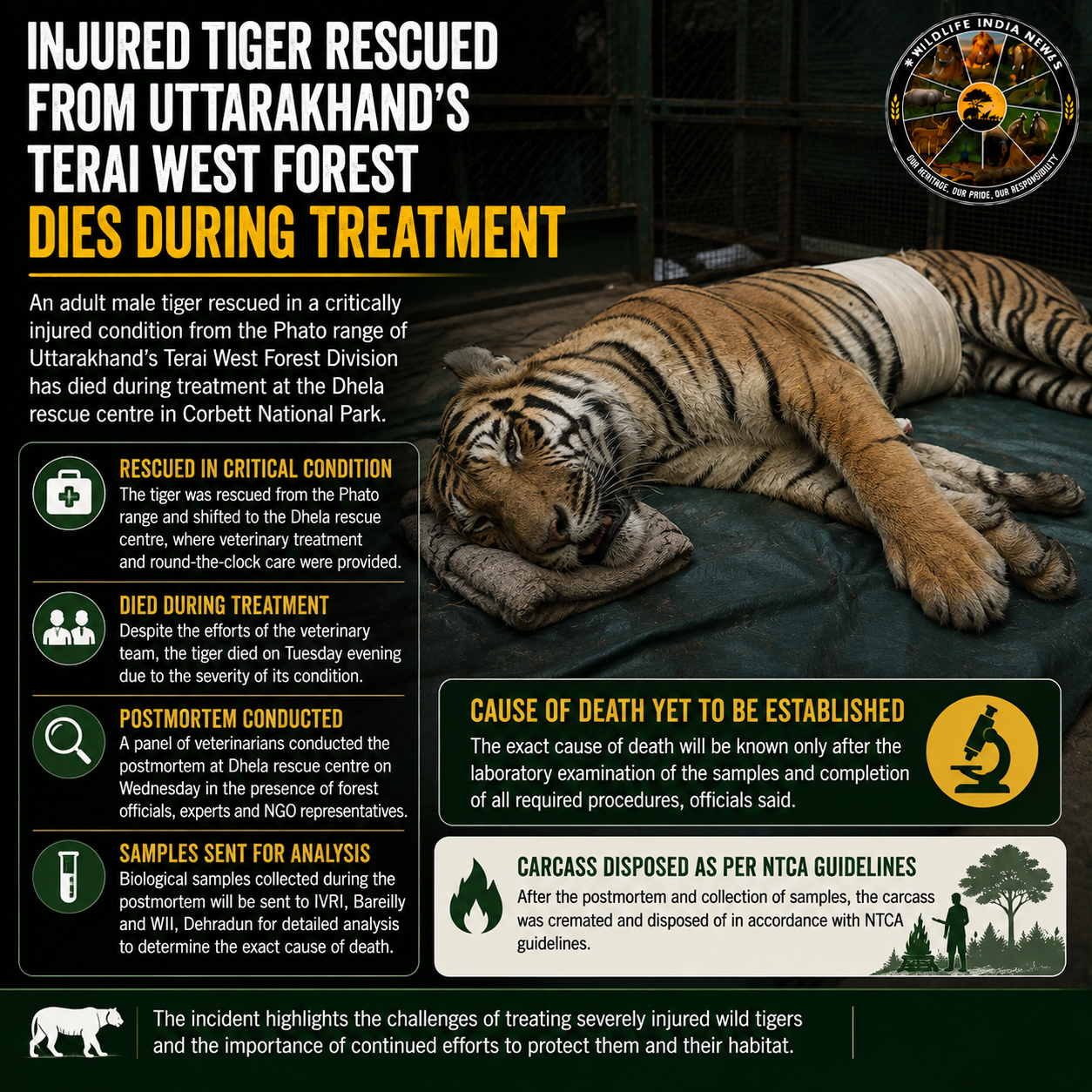
An adult male tiger rescued in a critically injured condition from the Phato range of Uttarakhand’s Terai West Forest Division has died during treatment at a rescue centre in Corbett National Park.
The tiger died on Tuesday evening, just days after it was rescued and shifted to the Dhela rescue centre for specialised veterinary care.
Tiger was in critical condition when rescued
Forest officials said the tiger was found in an extremely serious condition when the rescue operation was carried out.
After being rescued from the Phato range, the animal was transported to the rescue centre in the Dhela range of Corbett National Park. A team of wildlife veterinarians immediately began treatment and kept the tiger under round-the-clock observation.
Corbett National Park warden Binder Pal Singh confirmed that the tiger’s condition had been critical from the time it was brought to the centre.
Postmortem conducted
Following the tiger’s death, a panel of veterinarians conducted a postmortem examination at the Dhela rescue centre on Wednesday.
The procedure was carried out in accordance with the guidelines of the National Tiger Conservation Authority (NTCA) and in the presence of forest officials, wildlife experts and representatives of non-governmental organisations.
However, the exact cause of death has not yet been established.
Officials collected biological samples during the postmortem for further examination. These samples will be sent to the Indian Veterinary Research Institute (IVRI), Bareilly, and the Wildlife Institute of India (WII), Dehradun, for detailed analysis.
Cause of death to be determined
According to Singh, the final findings regarding the tiger’s physical condition and the precise cause of death will be known only after the laboratory examination of the samples and completion of other required procedures.
This means that no definitive conclusion about what caused the tiger’s injuries or subsequent death can yet be drawn.
Carcass disposed of as per NTCA guidelines
After the postmortem and collection of samples, the tiger’s carcass was cremated and disposed of in accordance with NTCA guidelines.
The incident is a reminder of the challenges involved in treating severely injured wild tigers, particularly when animals reach rescue facilities in an already critical condition.
For conservation authorities, the laboratory examination of the samples will now be important in establishing the circumstances surrounding the tiger’s death and ensuring that the incident is properly documented.
Source credit: This story is based on a report by Hindustan Times, “Injured tiger rescued from Uttarakhand’s Terai West forest dies during treatment,” published on August 26, 2026.
Leave a Reply