
Bhopal, Madhya Pradesh | August 23, 2026
India’s ambitious Project Cheetah is set to enter a significant new phase, with Madhya Pradesh preparing to establish a third habitat for cheetahs in the state.
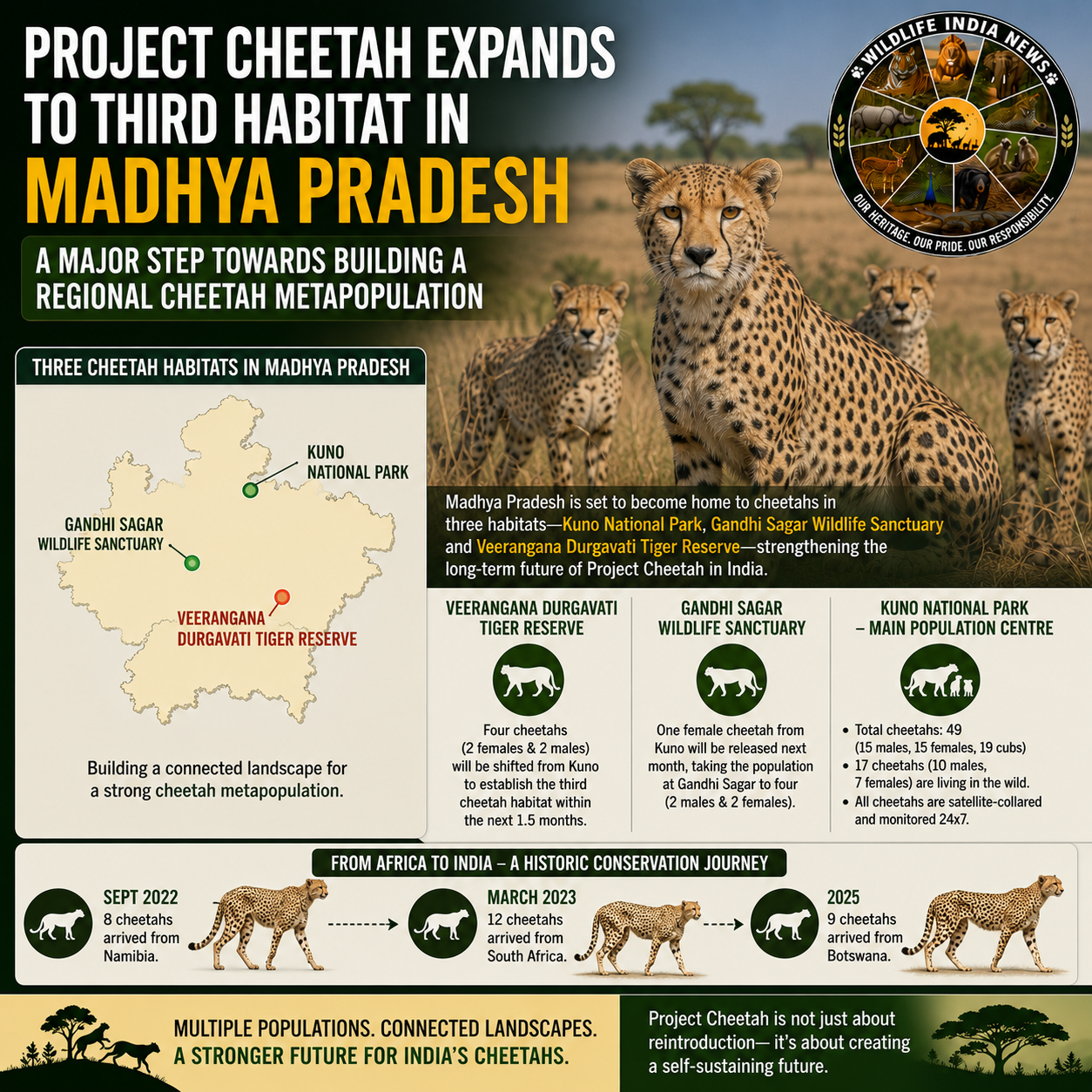
The proposed expansion will see Veerangana Durgavati Tiger Reserve in Narsinghpur district become the third home for cheetahs in Madhya Pradesh, alongside Kuno National Park and Gandhi Sagar Wildlife Sanctuary. The objective is to create interconnected regional meta-populations, strengthening the long-term prospects of cheetah conservation in India.
Four cheetahs to be shifted to Veerangana Durgavati
According to a senior Forest Department official, four cheetahs—two females and two males—will be shifted from Kuno National Park to Veerangana Durgavati Tiger Reserve within the next one and a half months.
Their release will formally establish the tiger reserve as the third cheetah habitat in Madhya Pradesh.
The expansion is being seen as an important step towards reducing dependence on a single major population centre and creating multiple populations that can contribute to the species’ long-term survival.
Gandhi Sagar to receive another cheetah
The expansion is also continuing at Gandhi Sagar Wildlife Sanctuary in Mandsaur district, which became the second cheetah habitat in Madhya Pradesh.
A female cheetah from Kuno is scheduled to be released in Gandhi Sagar next month. Once she is moved, the sanctuary’s cheetah population will increase to four.
Three cheetahs—two males and one female—have already been shifted from Kuno and released at Gandhi Sagar in two batches over the past one and a half years.
Kuno remains the main population centre
Kuno National Park, where Project Cheetah began in September 2022, continues to remain the country’s principal cheetah habitat.
According to the latest figures cited in the report, Kuno currently houses 49 cheetahs, comprising:
- 15 males
- 15 females
- 19 cubs
Of these, 17 cheetahs—10 males and seven females—are currently living in the wild within Kuno.
All 49 cheetahs at Kuno, including those in the wild and those in enclosures, are equipped with satellite collars for monitoring.
Round-the-clock monitoring
The movement of the free-ranging cheetahs is being monitored continuously by specialised rescue and tracking teams.
Some of the animals have travelled across five or six districts, requiring teams to constantly follow their movements and remain prepared to respond if an animal moves into a potentially vulnerable area.
Forest officials involved in the programme described the round-the-clock monitoring of the satellite-collared cheetahs as a major achievement in wildlife conservation.
From Namibia and South Africa to India
Project Cheetah began with the arrival of eight cheetahs from Namibia on September 17, 2022, marking the first intercontinental translocation of the species into India.
Six months later, 12 cheetahs from South Africa were brought to Kuno.
The project was subsequently expanded further with the recent arrival of nine cheetahs from Botswana, adding another source population to India’s conservation programme.
The Government of India describes Project Cheetah as an ambitious effort to establish a viable cheetah population in India through international translocation, scientific planning and long-term management.
Building a metapopulation
The creation of multiple habitats is particularly important because conservationists do not want India’s entire cheetah population concentrated in a single landscape.
By establishing populations at Kuno, Gandhi Sagar and Veerangana Durgavati, Madhya Pradesh is moving towards a landscape-level conservation model in which separate populations can potentially contribute to a larger regional metapopulation.
The upcoming expansion could therefore represent an important transition for Project Cheetah—from simply reintroducing the species to India towards building a self-sustaining network of cheetah populations across suitable central Indian habitats.
The programme’s next major test will be how successfully the animals adapt to their new habitats, establish territories and reproduce while continuing to coexist with the existing wildlife and human communities.
Source credit: This story is based on a report by Deccan Chronicle, “Madhya Pradesh: Project Cheetah Expands To 3rd Habitat To Build Metapopulation,” by Rabindra Nath Choudhury, published on August 23, 2026.
Leave a Reply