
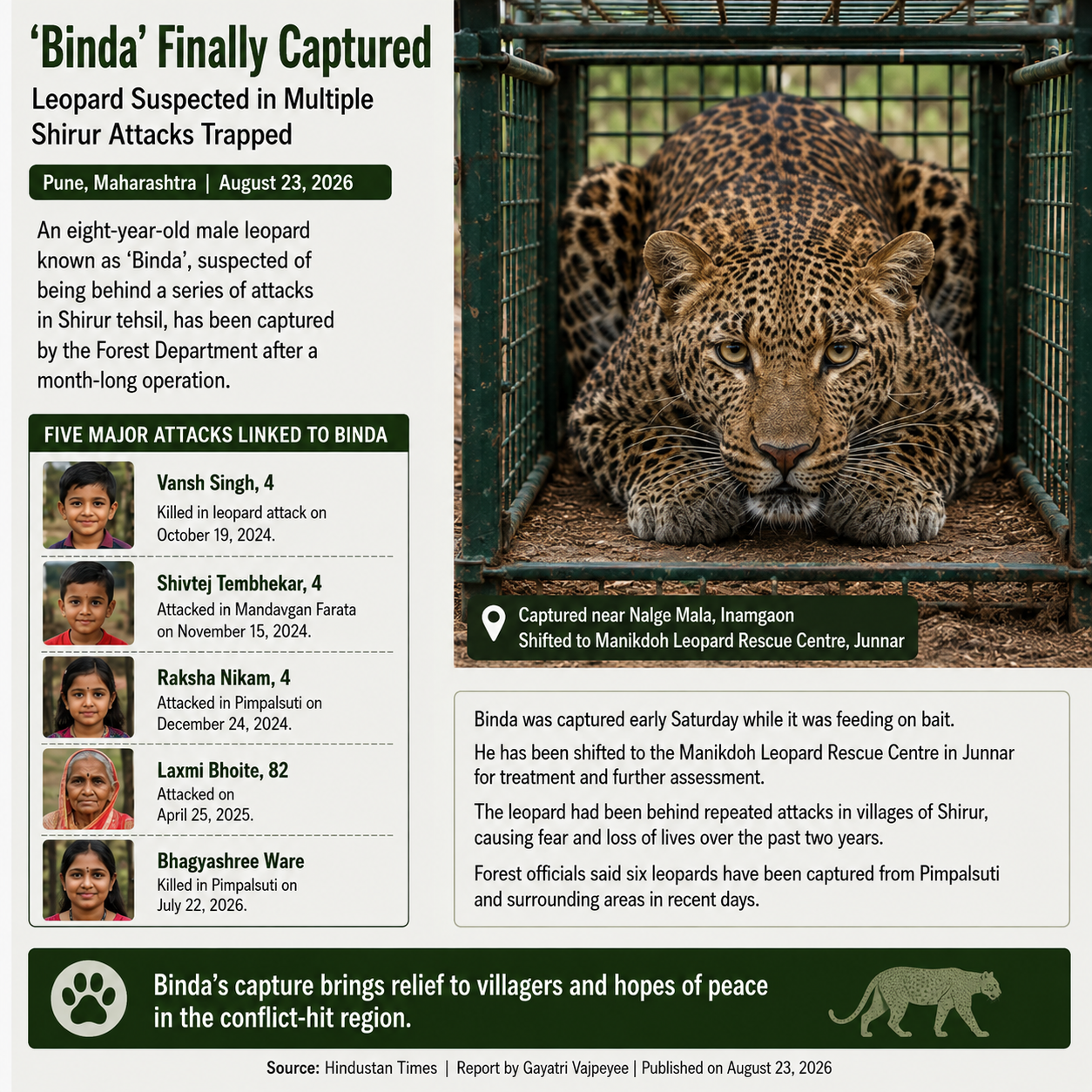
Pune, Maharashtra | August 23, 2026
An eight-year-old leopard known as ‘Binda’, suspected of being responsible for a series of attacks on people in eastern Shirur tehsil of Pune district, has finally been captured by the Maharashtra Forest Department after an intensive, month-long operation.
The leopard was tranquilised and captured early Saturday near the farm of Shrinivas Ghadge at Nalge Mala in Inamgaon, while it was feeding on bait. It has since been shifted to the Manikdoh Leopard Rescue Centre in Junnar, where it will undergo treatment and further assessment.
Operation intensified after fatal attack
The search operation was intensified following the death of Bhagyashree Ware, a resident of Pimpalsuti, who was killed in a leopard attack on July 22, 2026.
The fatal incident triggered considerable anger among villagers, with residents blocking roads and demanding immediate action against the leopard believed to be involved in repeated attacks in the area.
Forest officials deployed an extensive surveillance network comprising nearly 15 trap cages, around 50 camera traps and drones. Rescue teams studied the animal’s movements and placed livestock and bait at locations where the leopard was frequently sighted.
For six consecutive days, veterinarians also maintained an overnight watch from a cage installed inside a cattle shed in an effort to capture the animal safely.
How Binda was identified
Wildlife researchers had been monitoring Binda for several years and were able to distinguish him from other leopards using facial patterns, body markings and other physical characteristics.
Researchers traced Binda’s history back to Kathapur, where he was first observed as a cub.
On March 26, 2023, wildlife observer Nachiket Avdhani photographed two leopards in Kathapur. The female was identified as ‘Audi’, because of a distinctive marking on her head resembling the Audi automobile logo. She subsequently gave birth to two cubs, which researchers named ‘Chanda’ and ‘Binda’.
Binda’s movements were subsequently documented through camera traps and field observations.
Earlier capture may have separated him from his mother
Binda was previously captured in a cage at Kathapur following demands from local residents. He was subsequently released away from his original home range.
That intervention separated the young leopard from his mother at an early stage of his development.
Wildlife researchers believe the separation may have affected his natural learning, including the development of hunting skills and his ability to avoid human habitation.
This aspect has become an important part of the discussion surrounding the leopard’s subsequent behaviour and repeated proximity to human settlements.
Five major attacks linked to Binda
According to the Forest Department and rescue teams, Binda was linked to multiple attacks through a combination of camera-trap photographs, movement patterns, physical characteristics, pugmarks and evidence collected from attack sites.
The incidents subsequently attributed to him include:
- Vansh Singh, 4 — killed in a leopard attack on October 19, 2024.
- Shivtej Tembhekar, 4 — attacked in Mandavgan Farata on November 15, 2024.
- Raksha Nikam, 4 — attacked in Pimpalsuti on December 24, 2024.
- Laxmi Bhoite, 82 — attacked on April 25, 2025.
- Bhagyashree Ware — killed in Pimpalsuti on July 22, 2026.
The rescue team noted that victims in the attacks attributed to Binda were consistently targeted around the neck. Camera-trap records also placed the leopard in or near several of the locations where the incidents occurred.
A distinctive injured foot helped investigators
Another important clue was an injury to one of Binda’s feet, which had resulted in missing claws and produced a distinctive pugmark.
Investigators found similarities between pugmarks recorded after recent incidents and those associated with Binda. This evidence, combined with photographic identification and movement data, strengthened the Forest Department’s assessment that the same leopard was involved in multiple attacks.
Shirur Range Forest Officer Nilkanth Gavhane said camera-trap evidence, pugmarks and movement monitoring supported the conclusion that Binda was involved in the attacks across Shirur.
Officials who supervised the operation
The capture operation was conducted by the Shirur Forest Department, rescue teams and members of the Rescue Charitable Trust.
The operation was carried out under the supervision of:
- Prashant Khade — Deputy Conservator of Forests, Junnar
- Smita Rajhans — Assistant Conservator of Forests
- Nilkanth Gavhane — Shirur Range Forest Officer
The operation also involved wildlife researchers and rescue personnel who had been monitoring Binda’s movements for several years.
Wildlife researchers played key role
Gayatri Rajgurav-Avdhani, honorary wildlife warden for Junnar and a founder-member of Eco Rescue Daund, was among those who had monitored Binda in coordination with the Forest Department.
She worked alongside her husband Nachiket Avdhani and her sister Sharada Rajgurav in documenting and identifying the leopard.
Their long-term photographic records proved particularly valuable because they enabled researchers to distinguish Binda from other leopards in the landscape.
Rajgurav-Avdhani emphasised the importance of identifying individual leopards rather than treating every conflict incident as involving an unknown animal. Detailed knowledge of an individual animal’s movements and behaviour can help authorities respond more scientifically when conflicts occur.
Six leopards captured in recent operation
Forest officials said six leopards had been captured from Pimpalsuti and surrounding areas in recent days as part of the wider operation.
Binda’s capture therefore represents the culmination of a much broader effort to identify and manage leopard movements in an area where human settlements and leopard habitat overlap.
The case also demonstrates the importance of long-term camera-trap databases, individual identification and systematic monitoring in addressing recurring human-leopard conflict.
What happens to Binda now?
Binda has been transferred to the Manikdoh Leopard Rescue Centre in Junnar, where officials will assess his physical condition and behaviour before determining the next course of action.
His capture brings relief to communities that had lived under the threat of repeated leopard attacks, particularly following the death of Bhagyashree Ware.
At the same time, the case raises wider questions about how leopards that repeatedly enter human-dominated landscapes should be managed and how interventions such as capture and relocation can affect individual animals.
The episode highlights the difficult balance between protecting people from dangerous encounters and conserving leopards in landscapes where human settlements have expanded into wildlife habitat.
Source credit: This report is based on reporting by Hindustan Times, written by Gayatri Vajpeyee, published on August 23, 2026.
Leave a Reply