
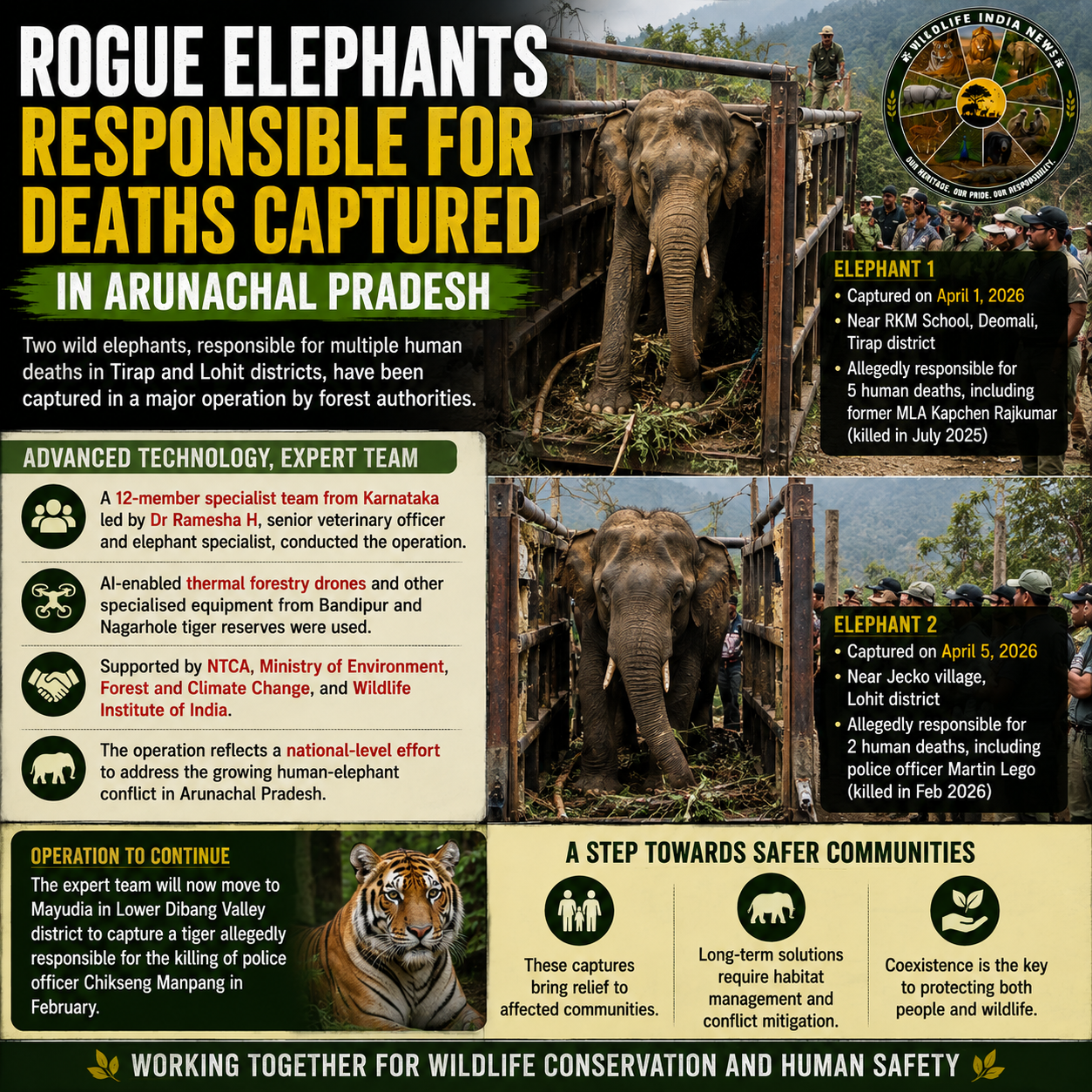
In a major operation aimed at reducing human-elephant conflict, forest authorities in Arunachal Pradesh, working with an expert team from Karnataka, have captured two wild elephants allegedly responsible for multiple human deaths in Tirap and Lohit districts.
The operation began on March 30. The first elephant was captured near RKM School in Deomali, Tirap district, on April 1. According to forest officials, the animal had allegedly been responsible for the deaths of five people, including former MLA Kapchen Rajkumar, who was killed in July 2025.
A second elephant, allegedly linked to the deaths of two people, including police officer Martin Lego in February 2026, was captured near Jecko village in Lohit district on April 5. Officials used thermal scanning and eyewitness accounts to identify and track the animal before successfully trapping it.
Advanced technology used
A 12-member specialist team from Karnataka travelled to Arunachal Pradesh to assist with the operation. The team is headed by Dr Ramesha H, a senior veterinary officer and elephant specialist associated with Karnataka’s major wildlife landscapes.
The operation employed AI-enabled thermal forestry drones and other specialised equipment brought from the Bandipur and Nagarhole tiger reserves. The effort was also supported by the NTCA, Ministry of Environment, Forest and Climate Change, and Wildlife Institute of India.
Forest officials described the operation as a national-level effort, reflecting the seriousness of the human-elephant conflict in parts of Arunachal Pradesh.
Operation to continue
The expert team is now expected to move to Mayudia in Lower Dibang Valley district, where authorities are attempting to capture a tiger allegedly responsible for the killing of police officer Chikseng Manpang in February.
The successful capture of the two elephants offers temporary relief to communities in the affected areas, but the incidents also underline the need for long-term scientific monitoring, habitat management and effective human-wildlife conflict mitigation rather than relying solely on capturing individual animals.
Leave a Reply