
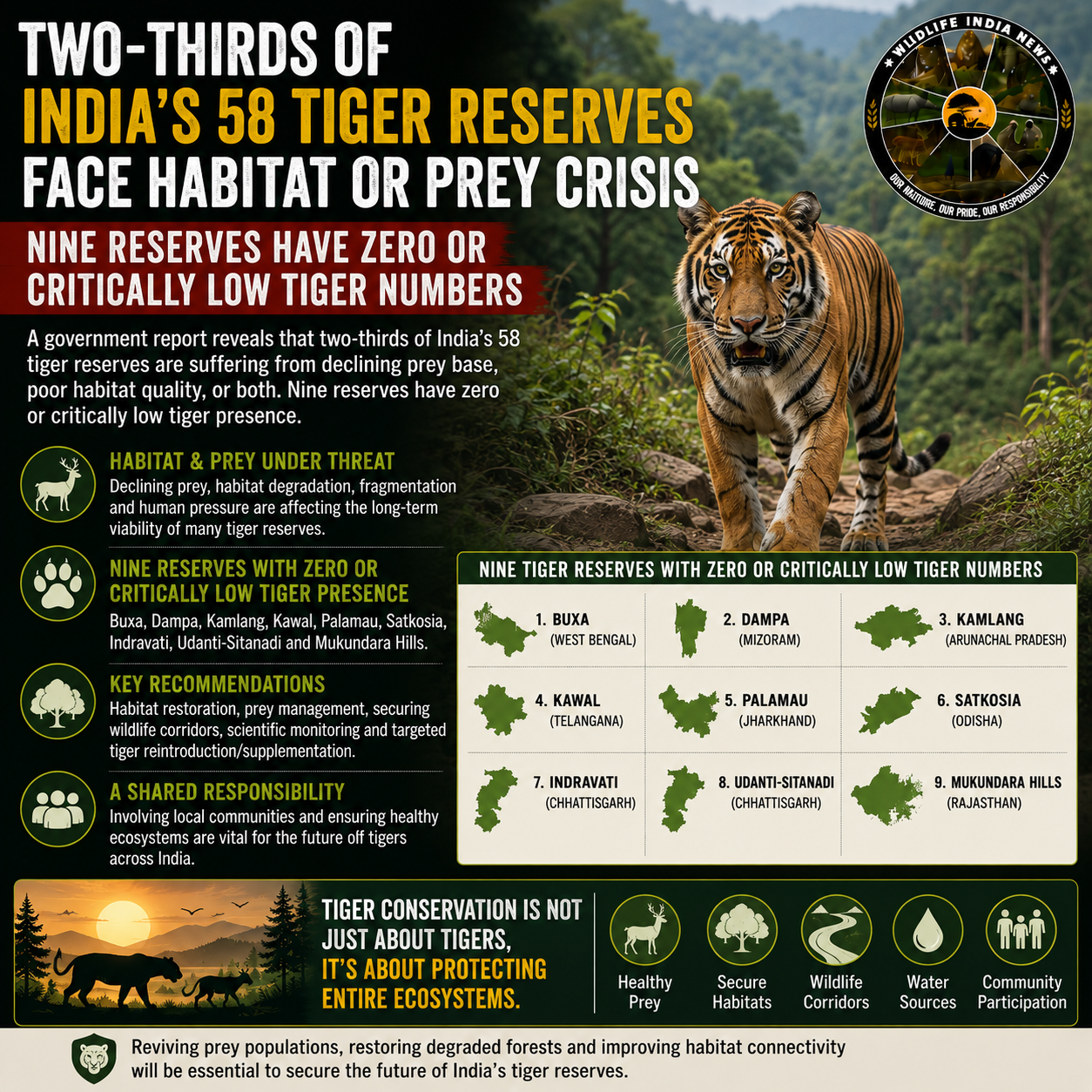
A government report has raised serious concerns over the health of India’s tiger habitats, revealing that two-thirds of the country’s 58 tiger reserves are facing either a declining prey base, poor habitat quality, or both. While India has recorded remarkable growth in its overall tiger population, the report warns that many reserves are struggling to sustain viable breeding populations.
The report identifies nine tiger reserves with either zero or critically low tiger numbers. These include Buxa (West Bengal), Dampa (Mizoram), Kamlang (Arunachal Pradesh), Kawal (Telangana), Palamau (Jharkhand), Satkosia (Odisha), Indravati (Chhattisgarh), Udanti-Sitanadi (Chhattisgarh) and Mukundara Hills (Rajasthan). Many of these reserves have suffered from poor prey availability, habitat fragmentation, poaching, armed conflict in the past, or unsuccessful tiger reintroduction efforts.
According to the report, healthy tiger populations depend not only on protection from poaching but also on abundant prey species, secure habitats, functional wildlife corridors, adequate water sources and minimal human disturbance. Without these conditions, even protected tiger reserves may fail to support breeding populations over the long term.
The report recommends habitat restoration, prey augmentation, strengthening of wildlife corridors, scientific monitoring and targeted tiger supplementation or reintroduction wherever ecologically suitable. It also stresses the importance of involving local communities in conservation programmes to ensure long-term success.
Conservationists say the findings are a reminder that tiger conservation is about safeguarding entire ecosystems, not just increasing tiger numbers. Reviving prey populations, restoring degraded forests and improving habitat connectivity will be essential to securing the future of India’s tiger reserves and maintaining the country’s global leadership in tiger conservation.
Leave a Reply