
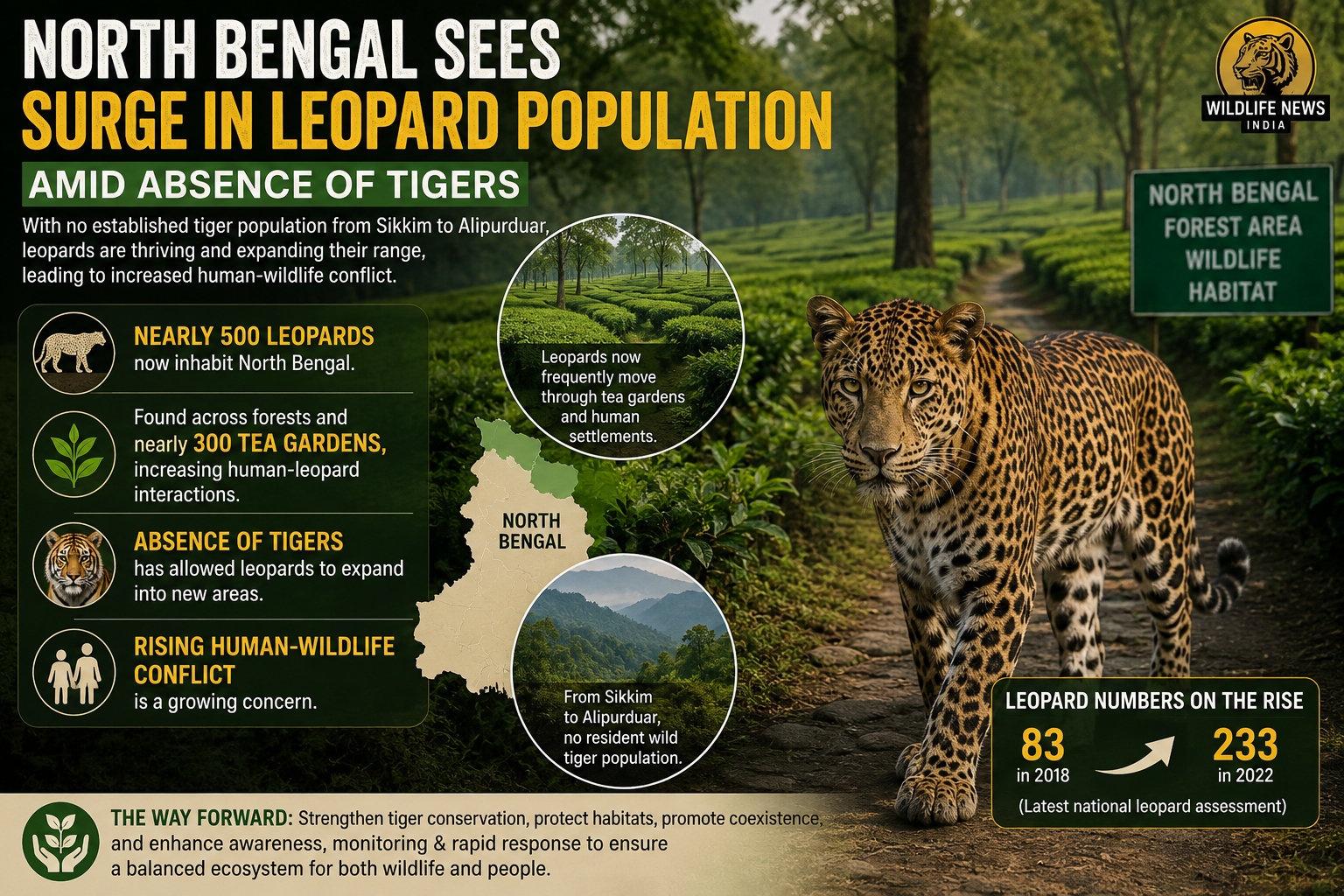
North Bengal’s forests are witnessing a remarkable rise in leopard numbers, but wildlife experts warn that the increase reflects a deeper ecological imbalance—the near-complete disappearance of resident Royal Bengal Tigers from the region. Speaking on the occasion of International Tiger Day, forest officials said the landscape stretching from Sikkim to Alipurduar currently has no permanently established wild tiger population, allowing leopards to become the dominant large predator.
According to preliminary estimates, nearly 500 leopards now inhabit North Bengal. Many of them are found not only inside protected forests but also across nearly 300 tea gardens, bringing the animals into frequent contact with people. The growing overlap between leopard habitat and human settlements has led to increasing concerns over human-wildlife conflict.
Wildlife biologists explain that tigers play a crucial role in regulating the distribution and behaviour of leopards. In landscapes where healthy tiger populations exist, leopards generally occupy peripheral habitats and prey on smaller animals. With tigers largely absent from North Bengal, leopards have expanded into areas they previously used less intensively, including tea estates and village fringes.
The region has already recorded one of India’s fastest increases in leopard numbers. The latest national leopard assessment estimated 233 leopards in North Bengal in 2022, up sharply from 83 in 2018, highlighting the rapid growth of the population.
Conservationists stress that the solution is not to reduce leopard numbers but to restore ecological balance by strengthening tiger conservation, protecting habitats, and improving coexistence measures in tea garden landscapes. Enhanced awareness programmes, better monitoring, rapid response teams and community participation are seen as essential to minimise conflict while ensuring the long-term survival of both predators.
Leave a Reply